01
Consultation
Technical needs assessment

![708 CD/P4a Angular Contact Ball Bearing High Speed Super Precision [WARN] draft identifier mismatch - 1](https://skfiso.com/wp-content/uploads/2026/09/708-cd-p4a-angular-contact-ball-bearing-high-speed-super-precision-warn-draft-identifier-mismatch-e33b16.avif)
![708 CD/P4a Angular Contact Ball Bearing High Speed Super Precision [WARN] draft identifier mismatch - 2](https://skfiso.com/wp-content/uploads/2026/09/708-cd-p4a-angular-contact-ball-bearing-high-speed-super-precision-warn-draft-identifier-mismatch-705c10.avif)
![708 CD/P4a Angular Contact Ball Bearing High Speed Super Precision [WARN] draft identifier mismatch - 3](https://skfiso.com/wp-content/uploads/2026/09/708-cd-p4a-angular-contact-ball-bearing-high-speed-super-precision-warn-draft-identifier-mismatch-e999d4.avif)
![708 CD/P4a Angular Contact Ball Bearing High Speed Super Precision [WARN] draft identifier mismatch - 4](https://skfiso.com/wp-content/uploads/2026/09/708-cd-p4a-angular-contact-ball-bearing-high-speed-super-precision-warn-draft-identifier-mismatch-60baff.avif)
![708 CD/P4a Angular Contact Ball Bearing High Speed Super Precision [WARN] draft identifier mismatch - 5](https://skfiso.com/wp-content/uploads/2026/09/708-cd-p4a-angular-contact-ball-bearing-high-speed-super-precision-warn-draft-identifier-mismatch-b7dc77.avif)
![708 CD/P4a Angular Contact Ball Bearing High Speed Super Precision [WARN] draft identifier mismatch - 6](https://skfiso.com/wp-content/uploads/2026/09/708-cd-p4a-angular-contact-ball-bearing-high-speed-super-precision-warn-draft-identifier-mismatch-0622d9.avif)
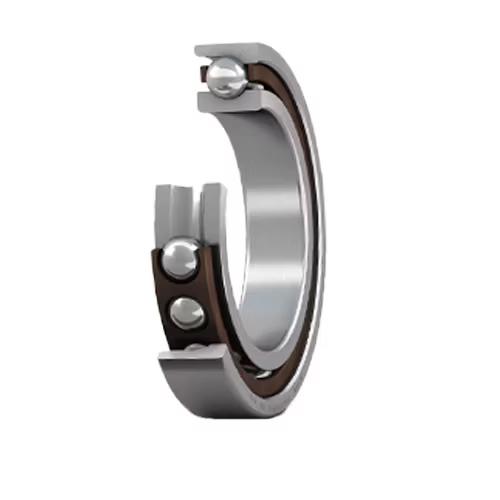
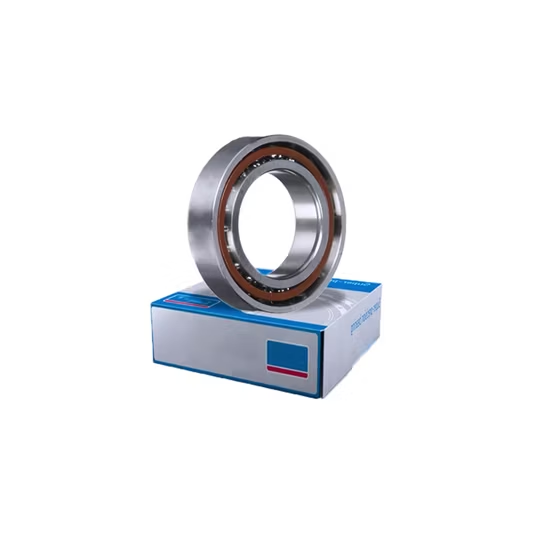
708 CD/P4a Angular Contact Ball Bearing — engineered with 15° contact angle (CD) for reduced friction heat at high rotational speeds, paired with P4a precision class delivering strict dimensional and running accuracy for demanding spindle environments.
Accurate cross-reference must align contact angle, precision suffix, and pairing arrangement to prevent thermal binding in service.
Verified via official app — Every 708 CD/P4a angular contact ball bearing we supply includes a scannable QR code linking directly to the manufacturer's authentication database.
| Parameter | Value |
|---|---|
| Designation | 708 CD/P4a |
| Bearing Type | Angular Contact Ball Bearing |
| Material | Bearing Steel |
| Contact Angle | 15° (CD) |
| Precision Class | P4a |
| Internal Design | Unseparated |
| Vibration Levels | Z1V1, Z2V2, Z3V3 options |
| Origin Options | Germany, Japan, Sweden, Malaysia, China |
| Industry | Typical Applications |
|---|---|
| Machine Tool Manufacturing | High-frequency motorized spindles, precision grinding wheel heads |
| Robotics & Automation | High-speed articulated joints, precision rotary actuators |
| Fluid Dynamics | High-speed centrifugal pump shafts, vacuum pump rotors |
| Precision Equipment | Optical measuring instruments, semiconductor wafer handling arms |
Precision grades dictate thermal stability, not just dimensional tolerance.
I once inspected a high-speed spindle in a Yangtze Delta machining center that suffered from severe chatter and premature cage wear. The maintenance team had installed a standard P0 grade replacement because the base number matched. In high-RPM applications, that overlooked suffix difference generates excessive friction heat, leading to thermal binding and catastrophic raceway damage . Sourcing a genuine 708 CD/P4a angular contact ball bearing requires strict adherence to the exact precision and contact angle designations to maintain the spindle's dynamic rigidity.
The 15° optimized design inherent to the CD suffix specifically minimizes friction heat generation during continuous high-speed rotation. When procurement teams request cross-references, we ensure the replacement maintains this exact contact angle rather than defaulting to a 25° alternative. This precise alignment preserves the axial stiffness and thermal equilibrium required for demanding machine tool spindles and high-speed pump applications.
Operating at extreme rotational speeds generates significant internal heat, which directly impacts the internal clearance and lubricant film thickness. The P4a precision class provides exceptionally tight control over dimensional and running accuracy, preventing the microscopic deviations that cause vibration at high frequencies. Proper lubrication management and strict temperature control during operation are critical to prevent the bearing steel from exceeding its thermal stability limits .
The CD suffix indicates a 15° contact angle optimized for high-speed, low-friction performance, distinguishing it fundamentally from higher-angle variants designed for heavy axial loads. Meanwhile, the P4a designation represents an elevated tier of dimensional and running accuracy, ensuring the inner and outer rings maintain strict concentricity under dynamic loads. Combined with available Z1V1 through Z3V3 vibration grading, these specifications guarantee the smooth, quiet operation essential for precision grinding and robotic actuation.
Substituting a bearing based solely on the base 708 number while ignoring the CD and P4a suffixes frequently results in unplanned downtime and severe equipment damage. A mismatched contact angle alters the load distribution, causing localized stress concentrations and accelerated fatigue failure . This oversight not only destroys the bearing but can also warp the spindle housing, voiding equipment warranties and triggering extensive secondary repair costs.
We provide authorized coverage across all major international brands, allowing you to consolidate mixed-brand spindle requirements into a single, fully traceable order. Our cross-reference process strictly aligns the contact angle, precision class, and internal design, ensuring a 708 CD/P4a angular contact ball bearing is never incorrectly swapped with a lower-precision variant. Every shipment includes batch traceability and QR verification, giving your maintenance team absolute confidence in the authenticity and performance capability of the installed components.
Share your exact radial and axial load profiles, operating speeds, and thermal conditions so our engineering team can verify the L10 life calculation for this specific configuration. If you are replacing an OEM component, provide the original equipment part number to allow us to perform a comprehensive cross-reference check. This technical review ensures the selected 708 CD/P4a angular contact ball bearing perfectly matches your spindle's dynamic requirements.
Q: Why must the CD and P4a suffixes match exactly during cross-referencing?
A: The CD suffix defines the 15° contact angle optimized for high-speed thermal stability, while P4a guarantees strict running accuracy. Substituting a base number without these exact suffixes alters load distribution and precision, leading to severe spindle vibration, thermal binding, and premature cage failure in high-RPM applications.
Q: What is the practical difference between P4 and P4a precision classes?
A: While both denote high precision, P4a typically enforces even tighter tolerances on running accuracy and dimensional stability compared to standard P4. This enhanced strictness is critical for machine tool spindles, ensuring minimal runout and vibration at extreme rotational speeds, thereby protecting the surface finish of the machined parts.
Q: How does the 15° contact angle affect spindle performance compared to 25°?
A: A 15° contact angle generates significantly less friction heat during high-speed rotation, making it ideal for high-RPM spindles where thermal expansion must be minimized. Conversely, a 25° angle offers higher axial load capacity but creates more heat, which can compromise the precision and thermal equilibrium of high-frequency grinding applications.
Q: What lubrication practices are recommended for high-speed precision bearings?
A: High-speed precision applications typically require specialized high-speed spindle oils or specific greases applied in strictly controlled, minimal quantities. Over-lubrication causes excessive churning heat, which degrades the lubricant and compromises the P4a precision tolerances, so following the manufacturer's exact fill volume and re-lubrication intervals is critical.
Our 5-step process ensures every order is engineered, validated, and supported for optimal performance.
Technical needs assessment
Custom specifications
Free samples for $50k+
Pre-shipment inspection
On-site & predictive
Our certified engineers respond within 24 hours with detailed technical specifications, pricing, and lead time information.