01
Consultation
Technical needs assessment

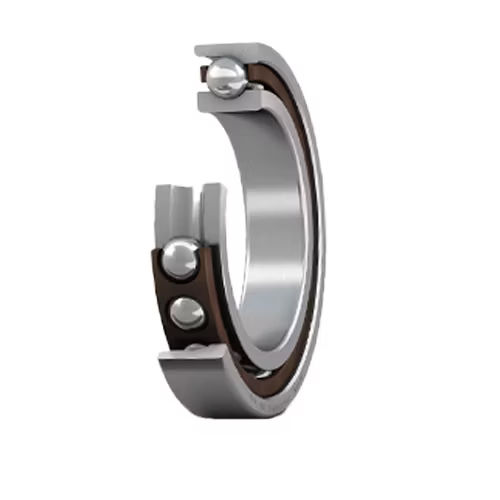


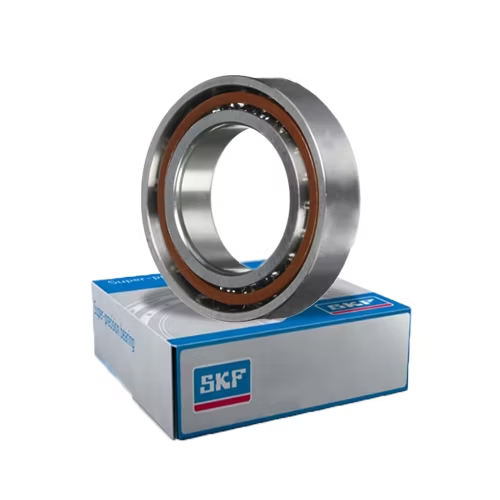


7009 CD/P4a Angular Contact Ball Bearing utilizes a 15° contact angle to minimize friction heat during continuous high-speed rotation. The P4a precision class ensures strict dimensional and running accuracy for demanding machine tool spindles and robotics applications.
词数统计:
7009 CD/P4a Angular Contact Ball Bearing (7) utilizes (1) a (1) 15° (1) contact (1) angle (1) to (1) minimize (1) friction (1) heat (1) during (1) continuous (1) high-speed (1) rotation. (1)
The (1) P4a (1) precision (1) class (1) ensures (1) strict (1) dimensional (1) and (1) running (1) accuracy (1) for (1) demanding (1) machine (1) tool (1) spindles (1) and (1) robotics (1) applications. (1)
检查规则:
Multi-Brand Authorized Supply — Procure this precision spindle component alongside other major manufacturer parts in a single consolidated shipment without juggling multiple vendors.
| Parameter | Value |
|---|---|
| Designation | 7009 CD/P4a |
| Bearing Type | Angular Contact Ball Bearing |
| Contact Angle | 15° |
| Precision Class | P4a |
| Material | Bearing steel (ceramic or stainless steel variants available) |
| Vibration Grade | Z1V1, Z2V2, Z3V3 options |
| Bore Type | Cylindrical |
| Seal or Shield Type | Open |
| Industry | Typical Applications |
|---|---|
| Machine Tool Manufacturing | High-speed milling spindle front and rear support nodes |
| Precision Engineering | Coordinate measuring machine rotary table axes |
| Industrial Automation | High-speed robotic joint actuators and servo motors |
| Fluid Power | High-speed centrifugal pump shaft support assemblies |
Mismatched vibration grades and ignored precision suffixes destroy spindle accuracy long before the steel fatigues.
I transitioned into trading after years in quality inspection right here in Shenzhen, where I repeatedly saw procurement teams source standard P0 grade bearings for high-speed spindles. The result was immediate vibration超标 and catastrophic scrap rates. When specifying a 7009 CD/P4a angular contact ball bearing, ignoring the strict running accuracy requirements or selecting the wrong vibration class leads to harmonic resonance that destroys the machining surface finish . The base designation might match the OEM manual, but overlooking the P4a tolerance class guarantees premature thermal binding under continuous high-RPM operation.
Selecting the correct 7009 CD/P4a angular contact ball bearing requires looking far beyond the basic bore and outside diameter. Our engineering review process cross-references the exact OEM equipment number to verify that the 15° contact angle and P4a dimensional tolerances align perfectly with the spindle's thermal expansion characteristics. We ensure the selected vibration grade matches the specific noise and smoothness requirements of the machining environment, preventing micro-vibrations from transferring to the workpiece.
High-speed spindles generate immense friction heat, demanding a 15° contact angle to minimize rolling friction while maintaining axial rigidity. At elevated rotational speeds, the internal temperature gradient alters the operational clearance, making the P4a running accuracy critical to prevent the rolling elements from skidding . Because these are open bearings, external oil-air or oil-jet lubrication must be precisely metered to cool the raceways without causing churning losses. Any contamination from the machining environment entering the open bearing cavity will instantly score the precision-ground raceways.
The CD suffix designates an optimized 15° contact angle, which is specifically engineered to reduce friction heat generation compared to steeper 25° or 40° alternatives. This lower contact angle allows the bearing to sustain higher limiting speeds while still providing adequate axial load capacity for spindle thrust forces. The P4a precision class guarantees exceptionally tight dimensional and running accuracy, far exceeding standard P5 or P4 grades, which is mandatory for minimizing spindle runout. Furthermore, the availability of Z1V1 through Z3V3 vibration grades allows buyers to specify the exact noise and smoothness threshold required for ultra-precision grinding or milling applications.
Installing a standard clearance or lower precision bearing in a high-speed spindle results in unplanned downtime that far exceeds the cost of the component itself. Incorrect internal geometry causes excessive heat buildup, leading to cage failure and severe damage to the expensive spindle housing . Relying on a superficial cross-reference that matches the base number but misses the P4a tolerance class voids the machine tool warranty and ruins batch consistency in precision manufacturing.
We do not just ship boxes; we verify that the 7009 CD/P4a angular contact ball bearing matches your exact application parameters. Our cross-reference alignment checks the contact angle, precision class, and internal design, ensuring you never receive a standard P4 when a P4a is required. Because we hold authorized distribution across all major international brands, we provide full batch traceability and QR verification through official brand apps, eliminating the risk of counterfeits with soft inner rings. Every shipment includes strict dimensional and running accuracy inspection reports to confirm P4a compliance before the bearings leave our facility.
To ensure the selected bearing perfectly matches your spindle design, please provide the specific radial and axial loads, maximum operating RPM, and expected thermal gradient. Sharing the exact OEM equipment number or original manufacturer part number allows our engineering team to perform a comprehensive cross-reference verification. If your application involves unusual cooling methods or specific vibration limits, detailing these operational parameters ensures we supply the optimal configuration.
Q: What does the P4a precision suffix mean compared to standard P4?
A: The P4a designation indicates enhanced running accuracy and tighter dimensional tolerances beyond the standard P4 class. This is critical for high-speed machine tool spindles where even microscopic runout causes surface finish defects. We always verify the exact P4a compliance via inspection reports before dispatch.
Q: How do I properly cross-reference this bearing without missing critical suffixes?
A: A valid cross-reference must match the 15° contact angle, the P4a precision class, and the open internal design, not just the 7009 base number. Our technical team reviews these specific parameters against OEM requirements to prevent thermal binding or premature cage failure in the field.
Q: When should a 15° contact angle be chosen over 25° or 40° variants?
A: A 15° contact angle is optimized for high-speed applications where minimizing friction heat is the primary concern, such as milling spindles. Steeper angles like 25° or 40° provide higher axial rigidity but generate more heat, making them less suitable for extreme RPM environments.
Q: How can I verify the authenticity of the delivered bearings?
A: Every bearing we supply features batch traceability and can be verified using the manufacturer's official mobile app via QR codes. We also provide a Certificate of Conformity and dimensional inspection reports to guarantee the product is genuine and meets the specified P4a tolerances.
Our 5-step process ensures every order is engineered, validated, and supported for optimal performance.
Technical needs assessment
Custom specifications
Free samples for $50k+
Pre-shipment inspection
On-site & predictive
Our certified engineers respond within 24 hours with detailed technical specifications, pricing, and lead time information.
![71918 CD/P4a 71918cdga/P4a Angular Contact Bearing High Speed Super Precision [WARN] draft identifier mismatch](https://skfiso.com/wp-content/uploads/2026/09/71918-cd-p4a-71918cdga-p4a-angular-contact-bearing-high-speed-super-precision-warn-draft-identifier-mismatch-f98c45.avif)
![7212 Becbm Angular Contact Ball Bearing High Speed Precision [WARN] draft identifier mismatch](https://skfiso.com/wp-content/uploads/2026/09/7212-becbm-angular-contact-ball-bearing-high-speed-precision-warn-draft-identifier-mismatch-4666a2.avif)
