01
Consultation
Technical needs assessment



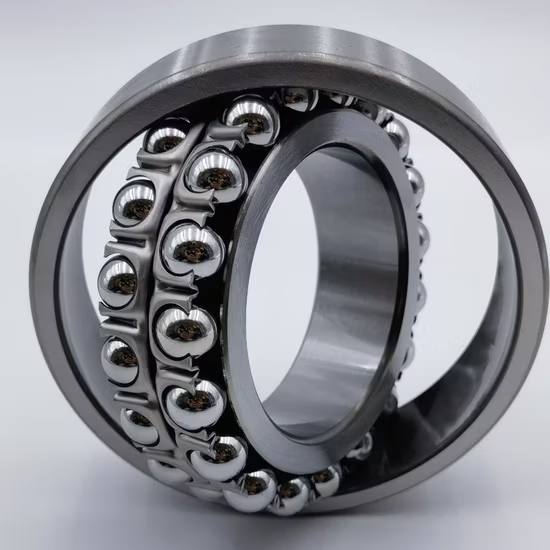
2207K Self-Aligning Ball Bearing 35×72×23 mm features a 1:12 tapered bore optimizing adapter sleeve mounting.
Original Batch Traceability — Every 2207K self-aligning ball bearing shipped includes manufacturer lot documentation verifiable through official brand applications.
| Parameter | Value |
|---|---|
| Designation | 2207K |
| Bearing Type | Self-Aligning Ball Bearing |
| Bore Diameter (d) | 35 mm |
| Outside Diameter (D) | 72 mm |
| Width (B) | 23 mm |
| Bore Type | Tapered 1:12 |
| Seal or Shield Type | Open / Rubber Seals / Iron Seals |
| Origin | Germany / Japan / Sweden / Malaysia / China |
Note: The cross-reference designation 111507 is an unverified suffix equivalent and requires manufacturer catalog confirmation prior to substitution.
| Industry | Typical Applications |
|---|---|
| Petroleum Machinery | Mud pump power ends and drawworks shafts |
| Wind Power Gearboxes | Planetary gear stages and high-speed shaft supports |
| Industrial Gearboxes | Input and output shafts subject to structural misalignment |
| Electric Motors | Rotor supports in heavy-duty industrial drive units |
Thermal expansion in high-temperature environments rapidly eliminates standard internal clearance, leading to catastrophic thermal binding.
In Dubai wind farm sites, I have witnessed gearbox seizures caused by specifying standard clearance where expanded clearance was mandatory. When ambient heat and operational friction combine, the internal gap vanishes entirely. Procurement teams often overlook this suffix detail during cross-referencing, resulting in severe downtime and destroyed shafts . Matching the base number is never enough; the internal geometry must survive the actual thermal profile of the equipment.
Heavy-duty gearboxes and petroleum drawworks rarely maintain perfect shaft alignment under fluctuating loads. The 2207K self-aligning ball bearing compensates for these angular errors automatically, preventing edge loading on the rolling elements. By sourcing from authorized channels, we ensure the internal raceway curvature matches the specific misalignment tolerances required by your OEM equipment, rather than relying on generic dimensional equivalents that fail under dynamic stress.
Petroleum and wind power environments subject components to intense radial loads combined with high-frequency vibrations. At elevated temperatures, standard lubricants degrade and internal clearances shrink, making the correct initial clearance class vital for survival. Proper sealing configurations must balance contamination exclusion against friction heat generation . Selecting the right seal type ensures the grease film remains intact without causing the bearing to overheat from contact friction.
The K suffix dictates a 1:12 tapered bore, fundamentally changing how this component interfaces with the shaft. Unlike cylindrical bore variants, the tapered design relies on an adapter sleeve to lock the bearing in place, allowing precise adjustment of the internal radial clearance during mounting. This is critical for gearbox applications where interference fits must be dialed in exactly. The availability of open, rubber-sealed, or iron-shielded variants means the sealing strategy can be matched to the specific contamination level of the gear housing, preventing abrasive particle ingress.
Installing a standard clearance bearing in a high-heat application guarantees premature failure through thermal binding. According to ISO 281 and ISO 15243 frameworks, this specific failure mode accelerates fatigue and causes catastrophic cage disintegration . The resulting unplanned downtime in a wind turbine or petroleum rig far exceeds the initial component cost, often damaging adjacent gears and shafts. Accurate cross-referencing must account for thermal expansion coefficients, not just physical dimensions.
We do not merely swap part numbers; we verify the exact clearance class and cage material required for your specific gearbox model. The K suffix demands precise adapter sleeve drive-up calculations, and our technical team reviews these mounting parameters to prevent residual clearance errors. Every batch is traced back to the manufacturer's production facilities, eliminating the risk of counterfeit rings with incorrect heat treatment. This rigorous alignment of base designation, internal geometry, and sealing type ensures reliable operation in critical infrastructure.
To ensure the 2207K self-aligning ball bearing performs reliably, share your exact radial and axial load profiles, operating speeds, and housing temperature ranges. Providing the OEM equipment number allows our engineering team to cross-reference the required clearance class and cage material, preventing field failures. We will review your mounting space and adapter sleeve specifications to confirm the tapered bore configuration is optimal for your maintenance strategy.
Q: How does the K suffix affect the installation of this bearing compared to a cylindrical bore?
A: The K suffix indicates a 1:12 tapered bore, requiring an adapter sleeve for mounting. This allows technicians to drive the bearing up the taper to achieve a specific interference fit and precisely set the residual internal radial clearance, which is impossible with a standard cylindrical bore pressed directly onto a shaft.
Q: What parameters must be checked when cross-referencing the 2207K for a gearbox replacement?
A: Beyond the base dimensions, you must verify the internal clearance class, cage material, and seal type. Installing a standard clearance bearing in a high-temperature gearbox will cause thermal binding. The cross-reference must match these internal specifications to handle the specific thermal expansion and vibration profiles of the application.
Q: How can I verify the authenticity and batch origin of the bearings before installation?
A: Every unit we supply includes batch traceability documentation. You can scan the QR code on the packaging using the manufacturer's official mobile application to verify the production lot, origin, and authenticity, ensuring the component meets the exact metallurgical standards required for heavy-duty wind or petroleum machinery.
Q: Which seal type should I choose for a highly contaminated petroleum machinery environment?
A: For severe contamination, rubber seals provide the best exclusion of abrasive dust and moisture, though they generate slightly more friction. Iron shields offer lower friction for higher-speed applications but provide less protection against fine particulate ingress. The choice depends on balancing the operating speed against the contamination level inside the housing.
Our 5-step process ensures every order is engineered, validated, and supported for optimal performance.
Technical needs assessment
Custom specifications
Free samples for $50k+
Pre-shipment inspection
On-site & predictive
Our certified engineers respond within 24 hours with detailed technical specifications, pricing, and lead time information.