01
Consultation
Technical needs assessment


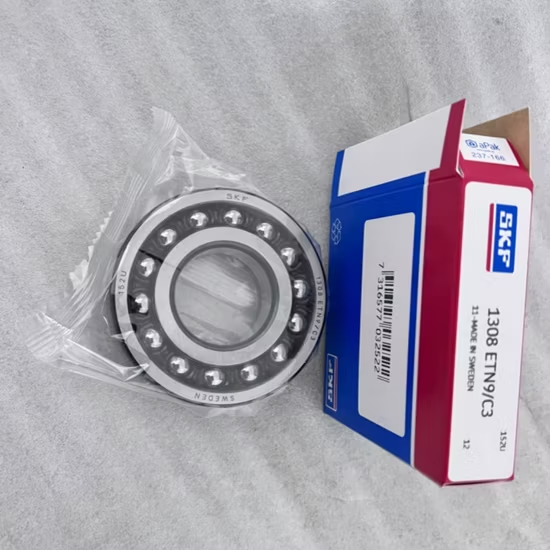


2217K Self-Aligning Ball Bearing — engineered with a 1:12 tapered bore for secure adapter sleeve mounting and precise internal clearance adjustment.
Traceable Batch Origins — Every 2217K unit ships with manufacturer lot documentation to verify authenticity before installation.
| Parameter | Value |
|---|---|
| Designation | 2217K |
| Product Type | Self-Aligning Ball Bearing |
| Bore Type | Tapered 1:12 |
| Seal or Shield Type | Open, Rubber Seals, Iron Seals (available options) |
| Feature Options | Low Noise, High Speed, Long Service Life |
| Origin | Germany, Japan, Sweden, Malaysia, China (available options) |
| Industry | Typical Applications |
|---|---|
| Material Handling | Conveyor pulley shafts experiencing slight structural deflection |
| Agricultural Machinery | Harvester drive shafts exposed to heavy dust and crop debris |
| Industrial Gearboxes | Intermediate shafts requiring tolerance to housing misalignment |
| Electric Motors | Large-format motor shafts where thermal expansion alters fits |
Matching the base number without verifying the K suffix leads to catastrophic interference fits.
During my years overseeing installations in the Middle East, I repeatedly saw heavy-duty crushers halt because procurement teams sourced standard cylindrical bore replacements when the equipment specifically required a tapered design. When a standard bore is forced onto a tapered adapter sleeve, or when a tapered bearing is pressed onto a straight shaft without the proper sleeve, the internal clearance vanishes entirely. This oversight generates immense friction under heavy radial loads, causing thermal expansion that locks the rolling elements against the raceway. A significant share of premature failures in heavy material processing stems directly from these cross-reference errors where the base designation matches but the critical bore geometry is overlooked .
The primary function of this 2217K self-aligning ball bearing is to tolerate angular misalignment between the shaft and the housing. In sprawling conveyor systems or vibrating screens, structural flexing is inevitable. The spherical outer ring raceway allows the inner ring and ball assembly to pivot slightly, preventing edge loading that would otherwise fracture the raceway edges. By sourcing genuine units with verified batch traceability, maintenance teams ensure the internal geometry genuinely matches the OEM alignment tolerances rather than relying on cloned products that fail under dynamic structural stress.
Crushing and agricultural environments introduce severe contamination risks alongside heavy radial forces. Selecting the correct seal variant is critical; while open designs facilitate higher limiting speeds and easier relubrication, they require pristine external housings. Rubber seals provide superior exclusion of fine particulate matter but introduce contact friction, whereas iron shields offer a non-contact barrier for moderate dust environments. Furthermore, the high ambient temperatures typical of desert mining operations drastically affect internal clearance. If the thermal expansion of the shaft is not accounted for during the initial selection, the bearing will operate with negative clearance, accelerating fatigue and lubricant degradation .
The defining characteristic of this designation is the K suffix, indicating a 1:12 tapered bore. This geometry is engineered specifically for mounting on adapter sleeves or directly onto tapered shaft seats. This design provides a distinct mechanical advantage: it allows technicians to precisely adjust the internal radial clearance during installation by controlling the drive-up distance on the sleeve. Achieving the correct residual clearance is paramount for applications involving elevated temperatures or heavy interference fits. Unlike cylindrical bore variants that rely entirely on machining tolerances, the tapered interface ensures a rigid, vibration-resistant lock while permitting fine-tuned clearance optimization for the specific operational envelope.
Relying solely on basic dimensional cross-references without auditing the bore type and sealing configuration results in severe operational penalties. When a cylindrical bore unit is mistakenly installed in place of a tapered requirement, the resulting improper fitment causes micro-movements or excessive preload. This leads to unplanned downtime, catastrophic damage to the shaft journal, and premature failure of adjacent drivetrain components. The financial impact extends far beyond the replacement part cost, encompassing lost production hours and secondary machining repairs required to salvage the damaged shaft seating .
Our procurement process eliminates the guesswork associated with mixed-brand inventories. We provide comprehensive cross-reference validation that verifies not just the base dimensions, but confirms the K suffix and seal configurations match your exact OEM requirements. Every shipment includes full batch traceability to the manufacturer, allowing you to bypass the risk of soft inner rings commonly found in counterfeit batches. Furthermore, we support your technical team with application-based selection reviews, ensuring the chosen seal type and internal geometry align perfectly with your specific load, speed, and temperature parameters.
To ensure the selected configuration perfectly matches your operational demands, please provide the specific radial and axial loads, operating speeds, and ambient temperature ranges. If you are replacing an existing component, sharing the OEM equipment number or the exact adapter sleeve designation allows our engineering team to perform a precise cross-reference audit. Supplying these parameters enables us to validate the internal clearance requirements and recommend the optimal sealing arrangement for your specific environment.
Q: Why is it critical to match the K suffix during cross-referencing?
A: The K suffix dictates a 1:12 tapered bore designed for adapter sleeves. Substituting a standard cylindrical bore bearing prevents proper mounting, eliminates the ability to adjust internal clearance during installation, and inevitably causes severe interference fits or shaft slippage, leading to rapid thermal failure and equipment downtime.
Q: How do I adjust the internal clearance when mounting this tapered bore bearing?
A: Clearance is adjusted by controlling the drive-up distance of the bearing onto the tapered adapter sleeve. Technicians measure the reduction in internal radial clearance using feeler gauges or by calculating the axial displacement, ensuring the optimal residual clearance is achieved before locking the nut in place.
Q: What is the procedure for verifying the authenticity of the received bearings?
A: Upon delivery, locate the QR code on the product packaging and scan it using the respective manufacturer's official mobile application. This digital verification confirms the batch origin and authenticates the product, effectively identifying counterfeit units featuring cloned labels and substandard metallurgy.
Q: Which seal type should I choose for a high-dust agricultural environment?
A: For environments with heavy, fine particulate matter, rubber seals offer the most effective physical barrier against contamination ingress. However, if the application involves high rotational speeds where seal friction generates excessive heat, iron shields or open designs with external housing seals might be required to prevent thermal degradation.
Our 5-step process ensures every order is engineered, validated, and supported for optimal performance.
Technical needs assessment
Custom specifications
Free samples for $50k+
Pre-shipment inspection
On-site & predictive
Our certified engineers respond within 24 hours with detailed technical specifications, pricing, and lead time information.


