01
Consultation
Technical needs assessment
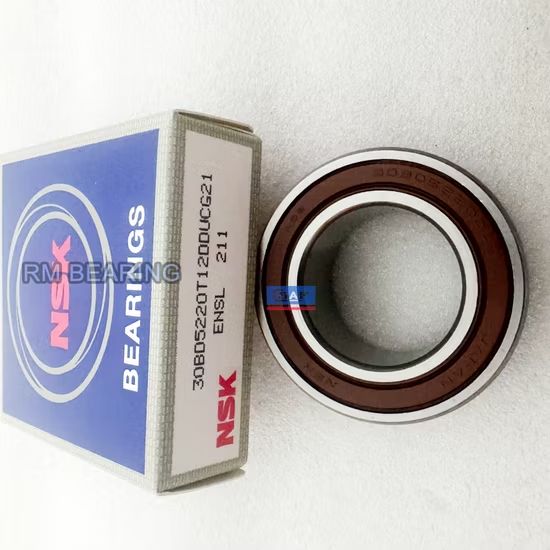
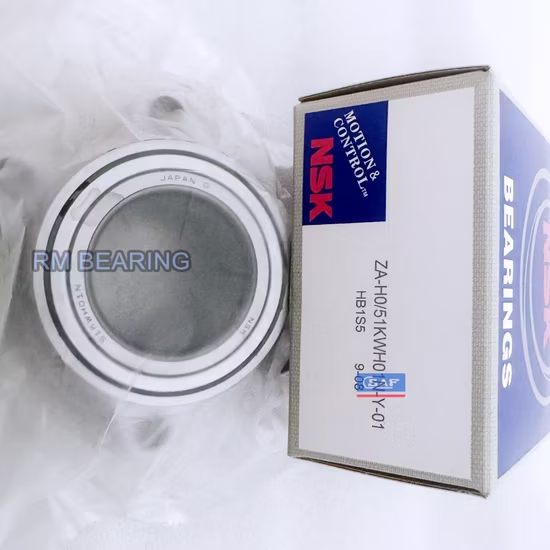
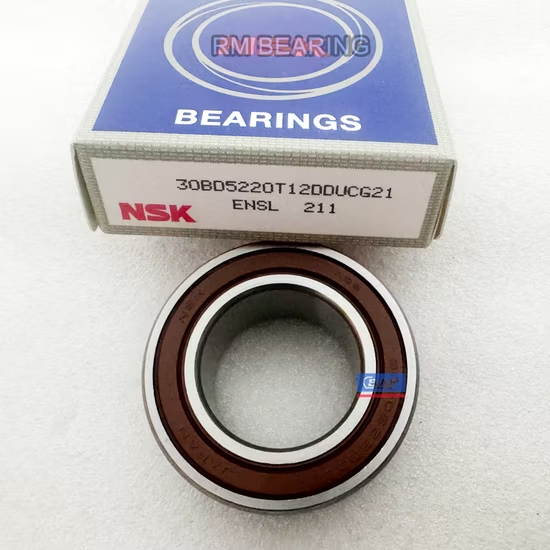
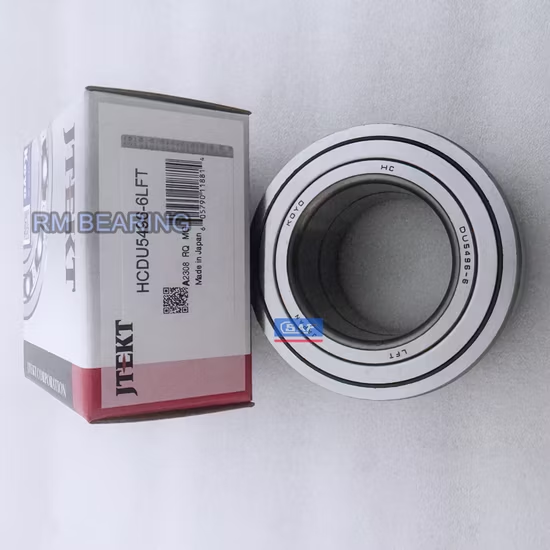
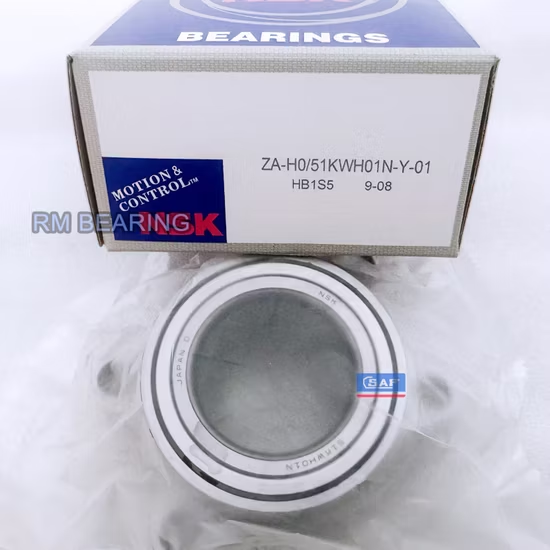
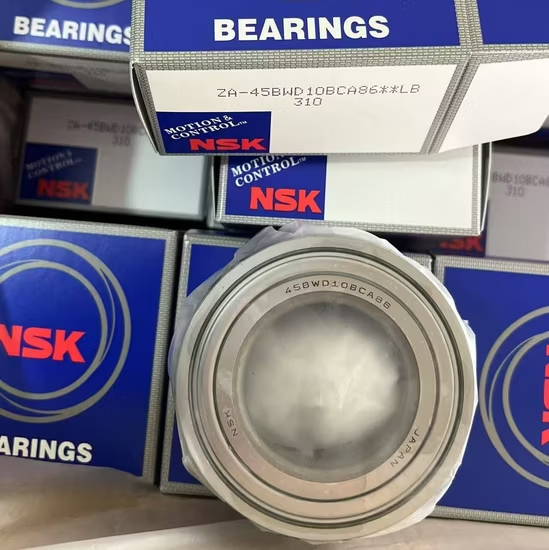
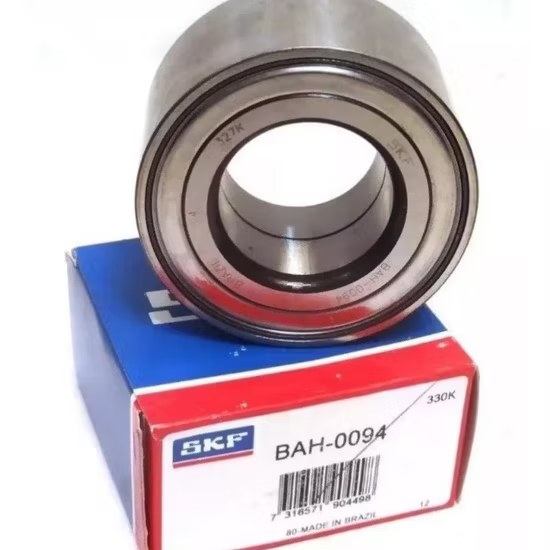
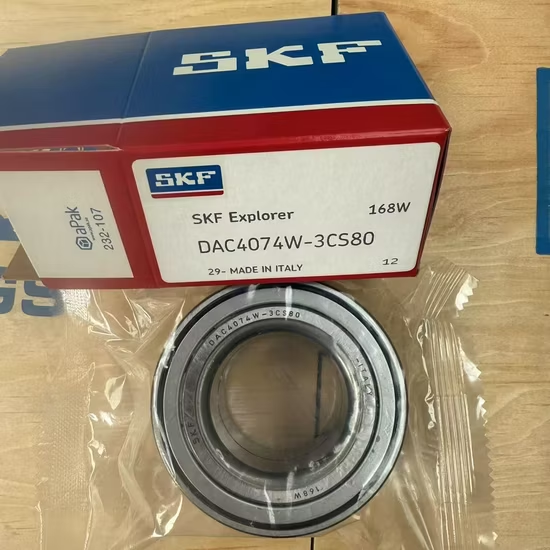
Auto Wheel Hub Bearing with Chrome Steel and ISO9001 Certification — engineered for 4WD automotive applications, this double row assembly integrates ABS sensors for accurate braking signals and iron seals to block road debris.
Official App QR Verification — Every hub assembly includes a scannable code linking directly to the manufacturer's authenticity database for immediate field validation.
| Parameter | Value |
|---|---|
| Product Type | Wheel Hub Bearing |
| Bearing Configuration | Double Row Hub Assembly |
| Material | Chrome Steel |
| Precision Class | P4 |
| Seal Type | Iron Seal |
| ABS Sensor | Integrated |
| Certification | ISO9001 |
| Origin | Shanghai |
| Industry | Typical Applications |
|---|---|
| Automotive Repair | Front and rear wheel hubs for 4WD SUVs and passenger vehicles |
| Heavy Vehicle Maintenance | Steering knuckles and axle ends for light commercial trucks |
| Agricultural Machinery | Drive axles and steering joints for utility tractors |
| Construction Equipment | Wheel ends for compact loaders and site dumpers |
Hardness below specification guarantees premature raceway spalling under cornering loads.
Sourcing replacement hubs for 4WD platforms often involves navigating a market flooded with visually identical clones. Many of these units pass casual visual inspections but feature soft inner rings that deform under the heavy axial loads generated during off-road articulation or high-speed cornering. When the inner ring yields, the integrated ABS sensor ring shifts, triggering phantom braking system faults and destroying the wheel hub bearing supplier reputation of the workshop that installed it. Identifying these metallurgical shortcuts requires strict adherence to verified distribution channels rather than relying on cloned packaging .
Upgrading to P4 precision class ensures the dimensional and running accuracy required for modern independent suspension systems. As an experienced auto wheel hub bearing supplier, we verify that the cross-reference alignment covers not just the base OEM number, but the internal geometry and sensor specifications. This prevents the subtle vibration issues that often plague generic replacements when fitted to sensitive 4WD drivetrains.
Wheel ends on 4WD vehicles endure severe combined loading, where sharp turns generate massive axial thrust while vehicle weight imposes constant radial stress. The iron seal configuration must balance contamination exclusion with minimal friction to prevent grease degradation at elevated temperatures. Furthermore, the integrated ABS sensor relies on precise air gaps; any axial play from improper internal clearances or poor machining tolerances will cause the vehicle's ECU to register erratic wheel speed signals .
Chrome steel remains the standard for automotive wheel ends due to its high fatigue limit and ability to achieve the necessary raceway hardness. While alternative materials like stainless steel variants are available for highly corrosive environments, standard chrome steel provides the optimal balance of load capacity and cost for typical road and light off-road use. The P4 precision designation ensures tighter tolerances than standard automotive grades, directly supporting the smooth rotation required to prevent steering wheel oscillation and uneven tire wear.
Installing a hub assembly with an incompatible or poorly calibrated ABS tone ring leads to immediate vehicle safety system disablement. Beyond the diagnostic labor required to trace the fault, the workshop faces warranty voidance and severe reputational damage. According to ISO 281 frameworks, improper mounting or selecting a unit with incorrect internal geometry drastically reduces the calculated L10 life, turning a routine maintenance task into a recurring liability .
We maintain authorized coverage across major brands, allowing mixed-brand fleet orders to be consolidated without sacrificing traceability. Our cross-reference process strictly verifies the internal seal design and ABS sensor polarity, avoiding the common trap of matching only the base casting number. Every unit shipped includes batch traceability to the manufacturer, ensuring that the P4 precision and chrome steel metallurgy meet the exact requirements of the original equipment. We also provide application-based selection reviews to confirm the hub assembly suits the specific vehicle weight and operating environment.
To ensure the selected wheel hub bearing perfectly matches your fleet or repair requirements, please provide the specific vehicle identification number, chassis code, or original equipment casting numbers. Sharing details regarding the typical operating environment, such as exposure to heavy road salt or extreme off-road articulation, allows our engineering team to verify the seal configuration and sensor compatibility. This technical复核 guarantees the replacement unit integrates flawlessly with the vehicle's existing braking and suspension systems.
Q: How do I determine the exact hub bearing model based on vehicle parameters?
A: The most reliable method is to provide the vehicle identification number or the original equipment casting number stamped on the old unit. Our engineering team cross-references these identifiers against manufacturer databases to verify the internal spline count, ABS sensor type, and flange dimensions, ensuring the replacement hub assembly matches the exact chassis requirements without guessing.
Q: What are common failure modes of wheel hub bearings in 4WD applications?
A: In 4WD systems, hub assemblies frequently fail due to seal degradation allowing water ingress during deep water crossings, leading to grease washout and raceway corrosion. Additionally, severe off-road articulation generates high axial loads that can cause premature fatigue spalling on the inner ring if the replacement unit lacks the proper chrome steel heat treatment and precision tolerances.
Q: How do material choices affect performance in extreme operating environments?
A: While standard chrome steel provides excellent load capacity for normal driving, vehicles operating in highly corrosive coastal or heavy road-salt environments may benefit from specialized stainless steel variants. These alternative materials offer substantially higher corrosion resistance, preventing the outer ring flange from seizing to the steering knuckle and making future maintenance significantly easier.
Q: What information is needed to source reliable replacements for discontinued hubs?
A: When original equipment hub assemblies are obsolete, we require the exact dimensional parameters, including the bolt circle diameter, flange offset, and internal spline count. Providing the vehicle's gross axle weight rating and typical usage conditions allows us to identify a heavy-duty or cross-brand equivalent that meets or exceeds the original load and speed specifications.
Our 5-step process ensures every order is engineered, validated, and supported for optimal performance.
Technical needs assessment
Custom specifications
Free samples for $50k+
Pre-shipment inspection
On-site & predictive
Our certified engineers respond within 24 hours with detailed technical specifications, pricing, and lead time information.