01
Consultation
Technical needs assessment


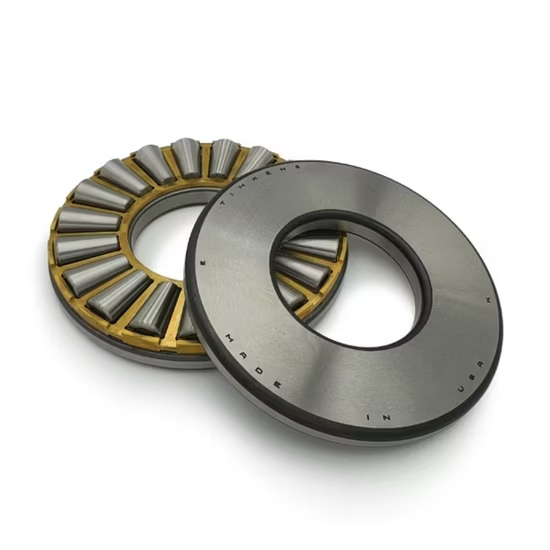


T135-902A1 Tapered Roller Thrust Bearing
Verified via official apps — Every T135-902A1 shipment includes scannable QR codes linked directly to the manufacturer's authentication database, eliminating the risk of cloned packaging.
| Parameter | Value |
|---|---|
| Designation | T135-902A1 |
| Product Type | Tapered Roller Thrust Bearing |
| Origin | Germany, Japan, Sweden, Malaysia, or China (source value — verify against manufacturer catalog) |
| HS Code | 8482500090 |
Note: The suffix -902A1 is currently unverified in standard public catalogs and requires direct manufacturer confirmation for exact internal geometry.
| Industry | Typical Applications |
|---|---|
| Automotive & Heavy Vehicle Repair | Heavy-duty transmission systems, drivetrain axial load management |
| Mining & Crushing Equipment | Gyratory crusher thrust mechanisms, heavy axial load transfer assemblies |
| Energy Sector Machinery | Turbine thrust collars, high-load directional force absorption units |
Matching the base number while ignoring internal design suffixes guarantees premature thermal binding in heavy transmissions.
During my years handling onsite installations in Dubai, I witnessed a catastrophic failure where a generic cross-reference matched the base T135 designation but completely overlooked the critical internal clearance and cage suffixes. The resulting friction caused the automotive transmission system to seize under high-temperature operating conditions. Sourcing a T135-902A1 tapered roller thrust bearing requires strict verification of every suffix to ensure the internal contact angles and roller profiles match the OEM specifications .
Supplying the correct T135-902A1 tapered roller thrust bearing goes far beyond simply locating the base part number in a warehouse. Our technical team reviews the exact suffix configuration against your OEM equipment drawings to confirm the internal load distribution paths. This meticulous cross-brand interchange process ensures that the replacement unit handles the specific axial shock loads inherent in automotive and heavy vehicle transmissions without compromising operational stability.
Transmission environments subject thrust components to intense unidirectional axial loads combined with rapid thermal fluctuations. When operating temperatures rise, inadequate internal clearance leads to roller skewing and severe cage wear. Proper lubrication management is equally critical; heavy-duty gear oil must effectively penetrate the roller-end and rib contact zones to prevent localized welding . Selecting the appropriate cage material and clearance class ensures the bearing maintains its structural integrity despite continuous thermal cycling and heavy shock impacts.
The T135 base designation identifies a specific series of single-direction tapered roller thrust bearings engineered for high axial capacity. However, the exact internal geometry, roller profile, and cage configuration are dictated by the subsequent suffixes. In heavy transmission applications, the cage material must withstand significant vibration and shock loading, making the distinction between machined brass and pressed steel variants critical for operational survival. Furthermore, the internal clearance class must be precisely matched to the housing tolerances and expected thermal expansion of the transmission casing to prevent axial binding during continuous high-speed operation.
Installing a thrust bearing with incorrect internal geometry inevitably leads to unplanned downtime and catastrophic damage to the surrounding transmission housing. When the roller contact angles do not align with the applied axial vectors, localized stress concentrations rapidly degrade the raceways. This premature failure not only voids equipment warranties but also forces expensive teardowns of the entire drivetrain assembly . Relying on incomplete cross-references ultimately costs far more than the initial savings on the component itself.
We eliminate the guesswork involved in sourcing complex thrust bearings by verifying every suffix against manufacturer engineering data. While many suppliers only match the base T135 number, we confirm the exact cage material and clearance requirements for your specific transmission model. Our single-source authorized coverage allows you to consolidate mixed-brand requirements into one traceable order. We also provide application-based selection reviews to ensure the chosen unit can handle your exact axial load and thermal conditions, backed by comprehensive pre-shipment dimensional inspections.
To ensure exact fitment and optimal lifecycle performance, please provide the specific radial and axial load profiles, operating speeds, and expected thermal ranges of your transmission system. Supplying the original OEM equipment number allows our engineering team to perform a comprehensive cross-reference check, verifying that all internal design suffixes align perfectly with your application. This technical review guarantees that the selected thrust bearing will withstand your specific operational demands without thermal binding or premature cage failure.
Q: How can I verify the authenticity of the T135-902A1 using official QR codes?
A: Every genuine unit features a unique QR code linked to the manufacturer's secure database. By scanning this code with the official brand application, you can instantly verify the batch number, production date, and origin, ensuring the bearing is not a counterfeit with soft inner rings that would fail under heavy axial loads.
Q: Why must cross-referencing include suffixes and not just the base T135 designation?
A: The base number only identifies the general series and outer dimensions. The suffixes dictate critical internal features like cage material, roller profile, and clearance class. Ignoring these suffixes often results in thermal binding or cage failure when the bearing is subjected to the specific thermal and shock loads of automotive transmissions.
Q: What are the common failure modes of tapered roller thrust bearings in mining transmissions?
A: In harsh mining environments, inadequate sealing and incorrect clearance selection frequently lead to contaminant ingress and thermal seizure. Heavy axial shock loads can also cause roller skewing and cage fracture if the internal geometry does not precisely match the OEM specifications for that specific transmission housing.
Q: How should I interpret unverified suffixes like -902A1 when sourcing replacement parts?
A: Unverified suffixes often indicate specialized internal geometries or proprietary OEM modifications not listed in standard public catalogs. It is essential to consult with authorized distributors who can cross-reference the physical dimensions and application parameters directly with the manufacturer's engineering department to ensure exact replacement compatibility.
Q: What documentation should accompany a genuine thrust roller bearing shipment?
A: A complete shipment must include a Certificate of Conformity, batch traceability records, and country-of-origin documents. Additionally, dimensional and running accuracy inspection reports should be provided to verify that the axial tolerances and surface finishes meet the strict requirements for heavy-duty transmission applications.
Our 5-step process ensures every order is engineered, validated, and supported for optimal performance.
Technical needs assessment
Custom specifications
Free samples for $50k+
Pre-shipment inspection
On-site & predictive
Our certified engineers respond within 24 hours with detailed technical specifications, pricing, and lead time information.