01
Consultation
Technical needs assessment

![7216 Becbm 7216 CD/P4a Angular Contact Bearing Wholesale Supplier [WARN] draft identifier mismatch - 1](https://skfiso.com/wp-content/uploads/2026/09/7216-becbm-7216-cd-p4a-angular-contact-bearing-wholesale-supplier-warn-draft-identifier-mismatch-1cd42e.avif)
![7216 Becbm 7216 CD/P4a Angular Contact Bearing Wholesale Supplier [WARN] draft identifier mismatch - 2](https://skfiso.com/wp-content/uploads/2026/09/7216-becbm-7216-cd-p4a-angular-contact-bearing-wholesale-supplier-warn-draft-identifier-mismatch-fdc883.avif)
![7216 Becbm 7216 CD/P4a Angular Contact Bearing Wholesale Supplier [WARN] draft identifier mismatch - 3](https://skfiso.com/wp-content/uploads/2026/09/7216-becbm-7216-cd-p4a-angular-contact-bearing-wholesale-supplier-warn-draft-identifier-mismatch-b203bd.avif)
![7216 Becbm 7216 CD/P4a Angular Contact Bearing Wholesale Supplier [WARN] draft identifier mismatch - 4](https://skfiso.com/wp-content/uploads/2026/09/7216-becbm-7216-cd-p4a-angular-contact-bearing-wholesale-supplier-warn-draft-identifier-mismatch-844d75.avif)
![7216 Becbm 7216 CD/P4a Angular Contact Bearing Wholesale Supplier [WARN] draft identifier mismatch - 5](https://skfiso.com/wp-content/uploads/2026/09/7216-becbm-7216-cd-p4a-angular-contact-bearing-wholesale-supplier-warn-draft-identifier-mismatch-bb0377.avif)
![7216 Becbm 7216 CD/P4a Angular Contact Bearing Wholesale Supplier [WARN] draft identifier mismatch - 6](https://skfiso.com/wp-content/uploads/2026/09/7216-becbm-7216-cd-p4a-angular-contact-bearing-wholesale-supplier-warn-draft-identifier-mismatch-cdbf0b.avif)
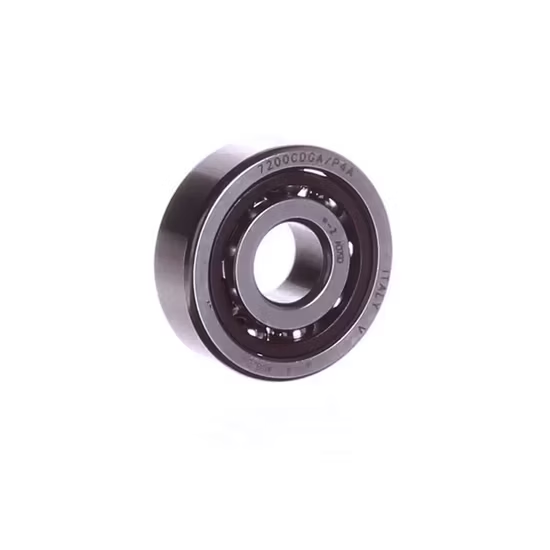
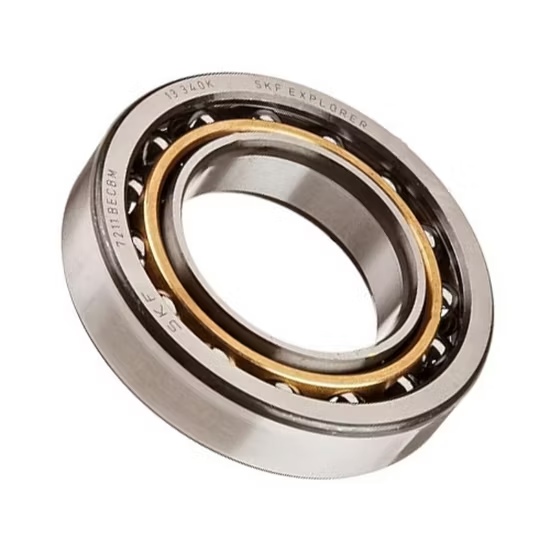
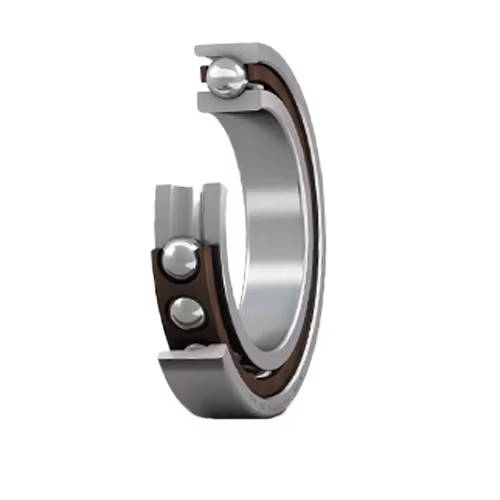
7216 Becbm Angular Contact Ball Bearing — featuring a 40° contact angle to accommodate heavy axial loads in machine tool spindles and high-speed pumps. This internal geometry ensures optimal rigidity under combined radial and thrust forces.
Traceable Batch Origins — Every 7216 Becbm angular contact ball bearing ships with manufacturer lot documentation for official QR verification.
| Parameter | Value |
|---|---|
| Designation | 7216 Becbm |
| Product Type | Angular Contact Ball Bearing |
| Bore Type | Cylindrical |
| Material | Bearing Steel |
| Cage Material | Machined Brass |
| Contact Angle | 40° |
| Precision Class | P4a (Cross-reference variant) |
| Separated | Unseparated |
| Vibration Grade | Z1V1, Z2V2, Z3V3 |
| Origin | Germany, Japan, Sweden, Malaysia, China |
Note: Suffix segments 'e', 'cb', and lowercase 'm' are unverified against standard manufacturer catalogs; standard brass cage designation is typically uppercase 'M'.
| Industry | Typical Applications |
|---|---|
| Machine Tool Manufacturing | High-speed spindle assemblies requiring tight radial and axial rigidity |
| Precision Robotics | Articulation joints demanding low vibration and high positional accuracy |
| Fluid Handling | High-speed pump shafts managing combined radial and axial hydraulic loads |
Matching the base number while ignoring suffix variations is the primary cause of thermal binding in high-speed spindles.
Procurement teams often source a 7216 Becbm angular contact ball bearing assuming the basic designation guarantees interchangeability. In reality, substituting a standard precision grade for a P4a variant or mismatching the 40° contact angle with a 15° optimized design leads to rapid heat buildup. I have seen perfectly machined spindle housings ruined because a replacement bearing lacked the specific internal geometry required for the operational speed range, resulting in catastrophic cage failure within weeks .
When outfitting precision equipment, the 7216 Becbm angular contact ball bearing must be evaluated beyond its basic dimensions. Our technical review process ensures that the selected variant matches the exact axial load capacity and speed requirements of your spindle, preventing the all-too-common scenario where a visually identical bearing fails under operational stress.
High-speed pump shafts generate significant friction heat, which directly impacts internal clearance and lubrication stability. A 40° contact angle handles heavy axial thrust but requires precise thermal management to prevent the rolling elements from skidding. Proper oil-air lubrication or high-speed grease formulation is critical, as standard lubricants will rapidly degrade beyond the thermal limit of standard bearing steel, leading to premature wear .
The 40° contact angle in this design provides maximum axial load capacity in one direction, making it ideal for applications with dominant thrust loads. When cross-referencing to the 7216 CD/P4a variant, the shift to a 15° contact angle and P4a precision class fundamentally changes the bearing's behavior, optimizing it for higher speeds and tighter dimensional running accuracy. The machined brass cage ensures stability under high rotational velocities and vibration, whereas a pressed steel alternative might suffer from fatigue in identical conditions.
Installing a bearing with incorrect internal clearance or mismatched precision grades leads to unplanned downtime and catastrophic damage to adjacent shaft components. According to ISO 15243 frameworks, improper mounting and incorrect bearing selection are leading causes of premature failure. A minor deviation in the contact angle or precision class voids equipment warranties and forces complete spindle rebuilds, costing significantly more than the initial component savings .
We maintain authorized coverage across all major brands, allowing a single order to fulfill mixed-brand requirements without coordination delays. Every batch is fully traceable to the manufacturer, with QR verification available through official brand apps to eliminate counterfeits with soft inner rings. Our cross-reference matching aligns clearance, cage material, and precision suffixes—not just the base designation. We conduct application-based selection reviews covering load, speed, and temperature to ensure the 7216 Becbm angular contact ball bearing performs exactly as engineered.
To ensure optimal performance, share your specific radial and axial load profiles, operational speeds, and temperature ranges for a comprehensive L10 life calculation. Providing the original OEM equipment number allows our engineering team to perform a precise cross-reference check, confirming that all suffix parameters align perfectly with your machinery's design requirements.
Q: How do I verify the authenticity of the 7216 Becbm angular contact ball bearing?
A: Authenticity is confirmed via official brand apps using the batch and lot traceable QR codes provided with each shipment. This digital verification ensures the internal components, including the machined brass cage, meet original manufacturer specifications, protecting your equipment from counterfeits that feature soft inner rings and cloned packaging.
Q: Why must precision suffixes align when cross-referencing to the 7216 CD/P4a?
A: The P4a suffix denotes strict dimensional and running accuracy essential for high-speed spindles. Substituting a standard precision grade causes excessive vibration and thermal binding. Cross-referencing requires matching the precision class, contact angle, and cage material to prevent premature failure and maintain the equipment's original machining tolerances.
Q: What is the operational difference between the 40° and 15° contact angles?
A: The 40° angle, designated by the 'B' suffix, maximizes axial load capacity for heavy thrust applications. The 15° angle, found in the CD variant, reduces friction and heat generation, making it superior for high-speed, light-load spindle operations. Selecting the wrong angle leads to rapid degradation under operational stress.
Q: How do I select the correct vibration grade for my application?
A: Vibration grades like Z1V1 through Z3V3 indicate the bearing's noise and vibration limits. High-precision robotics and machine tool spindles typically require the strictest Z3V3 limits to ensure surface finish quality, while general industrial gearboxes may operate efficiently with standard Z1V1 grades, balancing performance with procurement costs.
Our 5-step process ensures every order is engineered, validated, and supported for optimal performance.
Technical needs assessment
Custom specifications
Free samples for $50k+
Pre-shipment inspection
On-site & predictive
Our certified engineers respond within 24 hours with detailed technical specifications, pricing, and lead time information.