01
Consultation
Technical needs assessment


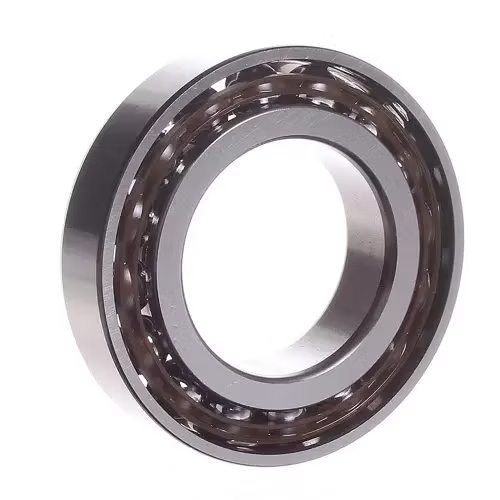


71907CD/P4a Angular Contact Ball Bearing P4a
Precision Suffix Alignment — Cross-referencing the 71907CD/P4a angular contact ball bearing requires matching the 15° contact angle, universal light preload, and P4a running accuracy simultaneously to prevent spindle thermal binding.
| Parameter | Value |
|---|---|
| Designation | 71907CD/P4a |
| Bearing Type | Angular Contact Ball Bearing |
| Contact Angle | 15° |
| Precision Class | P4a (Super Precision) |
| Arrangement | Universal Matching (GA) |
| Preload | Light |
| Cage Material | Phenolic resin or machined brass options |
| Material | High-purity bearing steel |
| Bore Type | Cylindrical |
| Seal or Shield Type | Open or non-contact shield variants |
| Certification | ISO 492 Class 4 |
| Industry | Typical Applications |
|---|---|
| Machine Tool Manufacturing | High-speed grinding spindles and milling head bearings |
| Precision Robotics | Rotary joints requiring minimal axial runout |
| Semiconductor Equipment | Wafer handling robotic arm pivot mechanisms |
| Aerospace Testing | High-frequency dynamic balancing machine arbors |
Precision suffixes dictate survival in high-speed machining environments.
I once inspected a grinding spindle that locked up catastrophically during a high-speed test run. The maintenance team had installed a standard P0 grade bearing instead of the specified 71907CD/P4a angular contact ball bearing. While the base dimensions fit perfectly into the housing, the internal geometry and running accuracy were entirely wrong for the operational speeds. The resulting vibration generated excessive heat, destroying the cage and fusing the rolling elements to the raceway . This is a recurring nightmare in precision machining facilities where procurement focuses solely on the base designation while ignoring the critical clearance, contact angle, and precision suffixes.
When sourcing replacement parts for precision equipment, the 71907CD/P4a angular contact ball bearing provides the exact geometric tolerances required for high-frequency rotation. Our technical team reviews your specific spindle load profiles and speed requirements to ensure the selected precision class and preload arrangement align perfectly with the original equipment manufacturer's design intent.
High-speed spindles generate significant internal friction, demanding a bearing that can handle combined radial and axial loads without thermal expansion causing internal binding. The lubrication strategy—whether oil-air or grease—must complement the cage design to minimize churning losses at elevated rotational velocities. Furthermore, the 15° contact angle provides an optimal balance, supporting the axial thrust from cutting forces while maintaining radial rigidity . Any contamination from coolant or metallic dust will rapidly degrade the raceway surface finish, making non-contact shielding or strict external sealing protocols essential for longevity.
The "CD" suffix indicates an optimized internal design with a 15° contact angle, specifically engineered to balance radial support with axial thrust capacity in high-speed applications. The "GA" designation specifies universal matching with a light preload, allowing technicians to mount the bearings in back-to-back or face-to-face arrangements without needing custom ground spacer shims. Finally, the "P4a" precision class guarantees dimensional and running accuracy that is significantly tighter than standard P4, ensuring minimal axial runout and vibration at extreme RPMs. Selecting the correct cage material—often phenolic resin for high-speed, low-friction performance or machined brass for heavier loads—is equally critical to the suffix configuration.
Substituting a lower precision grade or incorrect preload arrangement leads to unplanned downtime and catastrophic damage to the spindle housing. When a bearing lacks the strict running accuracy of the P4a class, the resulting micro-vibrations accelerate fatigue spalling on the raceways and compromise the surface finish of the machined parts. This premature failure not only voids equipment warranties but also forces expensive, multi-day production halts while the spindle is rebuilt and dynamically rebalanced .
Sourcing genuine super precision bearings requires strict adherence to authorized distribution channels, as counterfeiters frequently clone base numbers while ignoring internal tolerances. We verify every 71907CD/P4a angular contact ball bearing through batch traceability, ensuring the physical product matches the manufacturer's production records. Our cross-reference protocol checks the base number, precision class, and preload arrangement simultaneously, eliminating the risk of receiving a standard clearance bearing disguised as a preloaded pair. Furthermore, we provide application-based selection reviews to confirm that the specified suffix combination actually suits your spindle's thermal and dynamic profile.
To ensure precise technical alignment for your next spindle overhaul, provide our engineering team with your specific radial and axial load profiles, maximum operational speeds, and target operating temperatures. Sharing the original OEM equipment number allows us to perform a rigorous cross-reference check, verifying that the clearance, cage material, and precision suffixes match your exact application requirements for optimal L10 life calculation.
Q: How does P4a precision differ from standard P4 for spindle applications?
A: The P4a class enforces significantly tighter running accuracy tolerances compared to standard P4, specifically targeting axial and radial runout. This extreme precision minimizes high-speed vibration and heat generation, which is absolutely critical for maintaining surface finish quality and preventing thermal seizure in precision grinding and milling spindles.
Q: Why must the GA universal matching suffix be verified during cross-referencing?
A: The GA suffix confirms the bearings are universally matched with a light preload. If a supplier provides a non-matched bearing or one with a heavy preload, it will cause excessive internal friction and thermal binding at high speeds. Verifying this suffix ensures the bearings can be mounted in any arrangement without custom shimming.
Q: How can I verify the authenticity of the 71907CD/P4a angular contact ball bearing?
A: Authenticity is verified by scanning the QR code on the packaging using the manufacturer's official mobile application. This digital check confirms the batch and lot traceability, ensuring the internal precision grades and materials match the factory records, protecting your equipment from sophisticated counterfeit clones.
Q: What contact angle does the CD suffix indicate, and why is it important?
A: The CD suffix designates an optimized internal geometry with a 15° contact angle. This specific angle provides an ideal balance between radial load capacity and axial thrust support, making it highly suitable for high-speed machine tool spindles where cutting forces generate significant axial loads without compromising rotational stability.
Our 5-step process ensures every order is engineered, validated, and supported for optimal performance.
Technical needs assessment
Custom specifications
Free samples for $50k+
Pre-shipment inspection
On-site & predictive
Our certified engineers respond within 24 hours with detailed technical specifications, pricing, and lead time information.