01
Consultation
Technical needs assessment

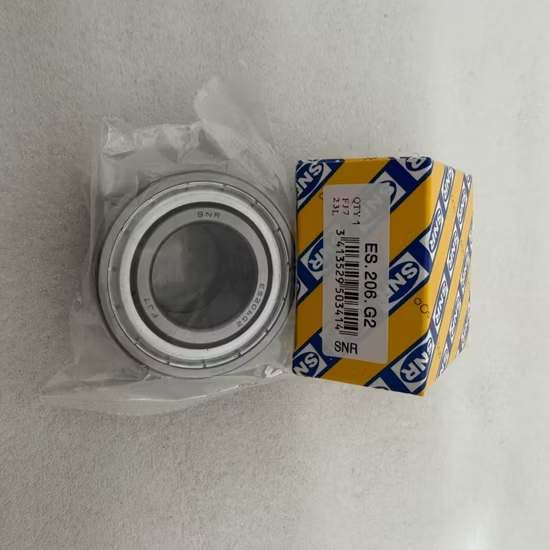

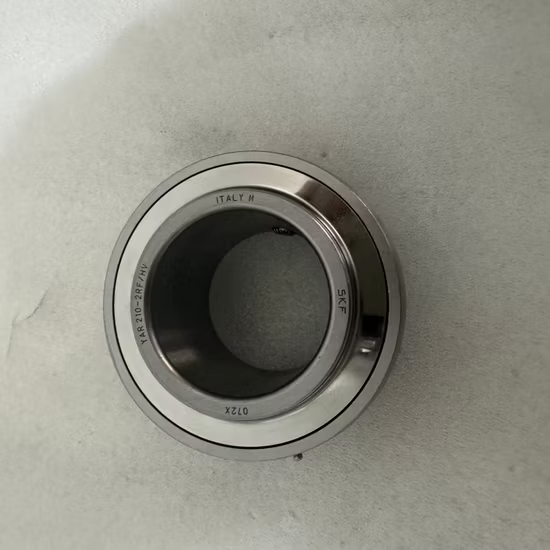


Ssuc202 Ssuc203 Ssuc204 Stainless Steel Pillow Block Insert Bearings — featuring deep groove raceways and set screw locking for secure shaft mounting.
Cross-reference triple alignment — verifying the stainless steel prefix, set screw locking mechanism, and deep groove raceway to prevent washdown failures.
| Parameter | Value |
|---|---|
| Designation | Ssuc202 Ssuc203 Ssuc204 |
| Product Type | Insert Bearing / Pillow Block Unit |
| Bearing Block Model | P |
| Raceway Type | Deep Groove Raceway |
| Number of Rows | Single |
| Material Option | Stainless Steel |
| Locking Mechanism | Set Screw |
| Feature | Corrosion Resistant, High Temperature, High Speed |
| Industry | Typical Applications |
|---|---|
| Food and Beverage | Washdown conveyor rollers, bottling line transfer guides |
| Agricultural Machinery | Fertilizer spreader discs, wet harvest sorting belts |
| Material Handling | Packaging line diverter arms, damp environment sorting chutes |
Base number matches do not guarantee material survival.
Procurement teams frequently approve cross-references that align the dimensional footprint but overlook the critical SS prefix. When a standard carbon steel insert is mounted in a high-moisture washdown environment, the inner ring rusts and seizes long before the fatigue life is reached . Sourcing the correct Ssuc202 Ssuc203 Ssuc204 stainless steel pillow block bearing requires strict verification of the housing material and seal compatibility, not just the bore diameter.
In the Pearl River Delta manufacturing hubs, I have seen countless production lines halted because a standard UC204 was mistakenly installed where an SSUC204 was required. The carbon steel inner ring corroded rapidly under daily chemical washdowns, locking the shaft completely. Ensuring your Ssuc202 Ssuc203 Ssuc204 stainless steel pillow block bearing inventory matches the exact SS prefix prevents these catastrophic material mismatches and keeps food-grade conveyors running smoothly.
High-pressure cleaning introduces severe thermal shock and chemical exposure to bearing components. The rapid temperature drop during cold water rinses causes internal contraction, which can draw contaminated moisture past inadequate seals. Single-row deep groove raceways in these units must handle combined radial and light axial loads while resisting cage deformation from high-speed water jet impacts . Proper seal selection is vital to retain lubrication and block corrosive ingress.
The SS prefix explicitly designates stainless steel construction for both the inner and outer rings, providing essential corrosion resistance. The UC suffix identifies an insert bearing with an extended inner ring on both sides, utilizing set screw locking for secure shaft attachment without complex adapter sleeves. The dimension series 2 indicates standard width and diameter proportions, while the 02, 03, and 04 suffixes define the specific bore diameter codes. Understanding these exact suffix meanings ensures the replacement unit drops directly into the existing P-type housing without modification.
Substituting a standard bearing for a stainless variant in wet environments leads to unplanned downtime and severe shaft scoring. When the inner ring seizes due to rust, extracting the damaged component often destroys the shaft surface, escalating a simple bearing swap into a major mechanical overhaul. Adhering to ISO 281 life calculation principles requires accurate material derating factors, which are entirely invalidated if the specified stainless steel construction is compromised during procurement .
Our authorized distribution network covers SKF, FAG, NSK, and NTN, allowing you to consolidate mixed-brand MRO orders into a single shipment. We specifically review the SS material prefix during cross-referencing, ensuring you never receive a carbon steel equivalent that looks identical on paper but fails in the field. Every batch features full traceability to the manufacturer, eliminating the risk of counterfeit units with soft, easily deformed inner rings. We provide application-based selection reviews to confirm that the seal variants match your specific washdown pressure requirements.
To ensure precise model selection and cross-reference validation, please provide the specific radial and axial loads, operating speeds, and washdown chemical concentrations. Sharing the OEM equipment number allows our engineering team to verify the exact bore diameter and housing alignment requirements. We will review these parameters to confirm the optimal seal arrangement and clearance class for your specific application.
Q: How can I verify the authenticity of these stainless steel insert bearings?
A: You can verify authenticity by scanning the QR code on the packaging using the official brand application. This confirms the manufacturing origin and batch details, effectively eliminating counterfeits that feature soft inner rings and cloned markings, which commonly fail under load.
Q: Why must cross-referencing align the SS prefix and not just the base number?
A: Matching only the base number like UC204 ignores the critical stainless steel material requirement. If a carbon steel equivalent is installed in a washdown environment, it will rapidly corrode and seize. The SS prefix ensures the alloy matches the corrosive demands of the application.
Q: What clearance class is appropriate for high-temperature washdown applications?
A: High-temperature washdowns cause thermal expansion of the shaft and inner ring. Selecting the correct internal clearance prevents thermal binding when the equipment reaches operating temperature, ensuring the deep groove raceway continues to distribute loads evenly without premature cage failure.
Q: How do sealing arrangements differ for washdown versus dry operations?
A: Washdown environments require seals that resist chemical degradation and block high-pressure water ingress, whereas dry operations prioritize low-friction shields to minimize heat generation. Choosing the correct seal variant ensures lubrication retention and prevents corrosive contamination of the single-row raceway.
Our 5-step process ensures every order is engineered, validated, and supported for optimal performance.
Technical needs assessment
Custom specifications
Free samples for $50k+
Pre-shipment inspection
On-site & predictive
Our certified engineers respond within 24 hours with detailed technical specifications, pricing, and lead time information.


