01
Consultation
Technical needs assessment

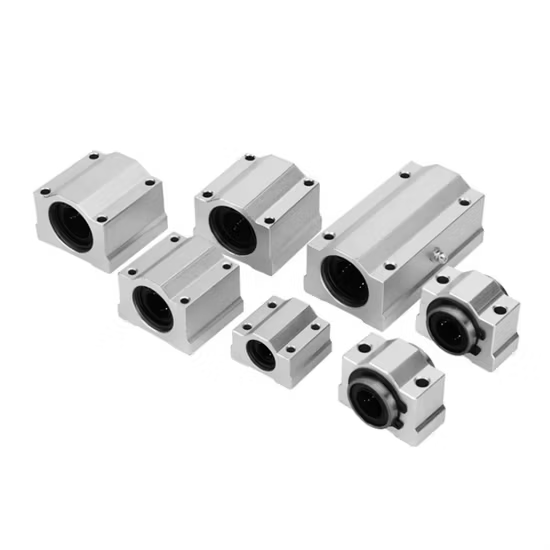
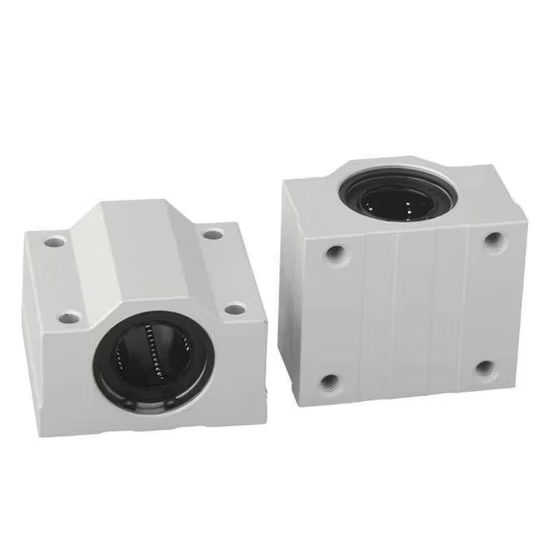


SC50UU SC60UU SC80UU Linear Guide Slider Block Bearings — stainless steel construction with polished hollow profile for high corrosion resistance in demanding automation environments.
Each shipment includes complete factory batch traceability documentation, supporting full supply chain verification and official authenticity checks.
Official QR Verification — Scan manufacturer app codes on every SC50UU SC60UU SC80UU linear guide slider block bearing to confirm authentic batch origin and prevent counterfeit installation.
| Parameter | Value |
|---|---|
| Designation | SC50UU SC60UU SC80UU |
| Product Type | Linear Guide Slider Block Bearing |
| Material Options | Stainless Steel or Standard Bearing Steel |
| Profile Type | Hollow Profile |
| Surface Treatment | Polished |
| Precision Rating | P0, P6, P5, P4, P2 |
| Certification | CE, CS, EPA, ISO 9001:2000, ISO 9001:2008, RoHS |
| Origin | Germany, Japan, Sweden, Malaysia, China |
Note: The SC and UU designations are unverified suffixes that require manufacturer catalog confirmation to ensure exact internal geometry and seal compatibility.
| Industry | Typical Applications |
|---|---|
| CNC Manufacturing | Multi-axis spindle positioning and automated tool changers |
| Material Handling | High-speed gantry robots and automated storage retrieval systems |
| Engineering Machinery | Precision linear actuation in heavy-duty automated assembly lines |
Matching the base designation is never enough to prevent catastrophic field failure in linear motion systems.
Procurement teams often assume that any slider block matching the required outer dimensions will perform adequately. In reality, ignoring internal retainer materials or seal configurations leads to rapid degradation. I have seen operations in the Pearl River Delta install standard blocks in high-dust environments, only to face complete mechanical seizure within weeks because the internal cage material was entirely wrong for the contamination level . Sourcing a genuine SC50UU SC60UU SC80UU linear guide slider block bearing requires looking past the stamped numbers to verify the exact internal architecture and seal integrity.
Selecting the right configuration means evaluating how the hollow profile and polished surfaces interact with your specific automation setup. The SC50UU SC60UU SC80UU linear guide slider block bearing series offers varied precision classes to match the tight tolerances demanded by modern CNC equipment. We review your application parameters to ensure the selected block provides the necessary rigidity and smooth travel without introducing unwanted friction or thermal binding.
Linear systems in automated production lines face relentless exposure to metallic particulates and coolant splashes. The sealing mechanism must balance low friction for high-speed travel with aggressive exclusion of microscopic debris. When dust infiltrates the recirculation zone, it acts as an abrasive paste, rapidly destroying the raceway . Selecting the appropriate material variant, such as stainless steel for highly corrosive washdown zones, ensures the structural integrity survives the facility's environmental conditions.
The available precision ratings dictate the allowable deviation in travel parallelism and height, which directly impacts the surface finish quality in machining centers. A polished surface treatment reduces friction during high-speed transitions, while the hollow profile design optimizes the weight-to-rigidity ratio for moving gantries. Material selection is highly application-dependent; stainless steel variants provide essential corrosion resistance for food processing or marine applications, whereas standard bearing steel options deliver maximum load capacity for dry, heavy-duty engineering machinery.
Installing a mismatched slider block rarely causes immediate failure; instead, it initiates a slow degradation that culminates in unplanned downtime. According to failure analysis frameworks like ISO 15243, surface fatigue and abrasive wear are primary culprits when components operate outside their intended design parameters . A slightly incorrect internal clearance or inadequate seal leads to premature wear, eventually causing axis deviation, scrapped production batches, and costly emergency replacements that far exceed the initial component savings.
Managing mixed-brand requirements across a large facility usually involves coordinating with multiple vendors, but our authorized distribution network handles diverse OEM specifications in a single order. Cross-referencing linear components is notoriously prone to errors where base numbers match but internal seal types differ; we verify every dimensional and sealing detail against your specific equipment needs. Every shipment includes full batch traceability to the manufacturer, eliminating the risk of receiving counterfeit parts with soft inner rings that pass casual visual inspections. Furthermore, our technical team provides application-based selection reviews to ensure the chosen precision class and material perfectly align with your operational loads and speeds.
To ensure the selected linear components perfectly match your machinery, please provide the specific radial and axial loads, travel speeds, and operating temperatures. Sharing the exact OEM equipment numbers allows our engineering team to perform a comprehensive cross-reference check, verifying that the internal design and seal types align with your original specifications. This technical validation guarantees that the proposed solution will deliver reliable performance and extended service life in your specific operational environment.
Q: How can we verify the authenticity of these linear guide bearings upon delivery?
A: Every genuine component features a unique QR code that links directly to the manufacturer's official database. By scanning this code with the brand's official application, your receiving team can instantly verify the batch origin, production date, and authenticity. This process effectively eliminates the risk of installing counterfeit parts with substandard internal materials that often pass casual visual inspections but fail rapidly under load.
Q: Why is cross-referencing more complex than just matching the base designation?
A: Matching the base number only confirms the outer envelope dimensions. True compatibility requires verifying the internal recirculation design, seal type, and precision class. A block with the correct base number but the wrong seal will quickly fail in a dusty environment, while an incorrect precision rating will cause vibration in high-speed CNC applications. We review all these internal parameters to ensure exact operational matching.
Q: When should we specify stainless steel over standard bearing steel for these blocks?
A: Stainless steel variants are necessary when the operating environment involves high humidity, frequent chemical washdowns, or corrosive atmospheric conditions. While standard bearing steel offers higher load capacity for dry, heavy-duty applications, it will rapidly degrade if exposed to moisture without intensive maintenance. Evaluating the specific environmental exposure ensures you select the material that provides the most reliable service life.
Q: How do different precision classes affect CNC machine tool performance?
A: Higher precision classes strictly limit the allowable deviations in height and travel parallelism. In CNC machining, even microscopic variations in the linear guide's travel path will translate directly into surface finish defects and dimensional inaccuracies on the machined parts. Selecting the appropriate precision rating ensures the machine tool maintains its required geometric accuracy throughout high-speed operations.
Q: What information is needed to determine the exact model for a custom application?
A: To specify the correct configuration, we require the maximum dynamic and static loads, travel speed, stroke length, and environmental conditions such as dust or moisture presence. Providing the available mounting space and the required rigidity allows our technical team to calculate the optimal block size and precision class, ensuring the selected linear system handles the specific operational demands reliably.
Our 5-step process ensures every order is engineered, validated, and supported for optimal performance.
Technical needs assessment
Custom specifications
Free samples for $50k+
Pre-shipment inspection
On-site & predictive
Our certified engineers respond within 24 hours with detailed technical specifications, pricing, and lead time information.

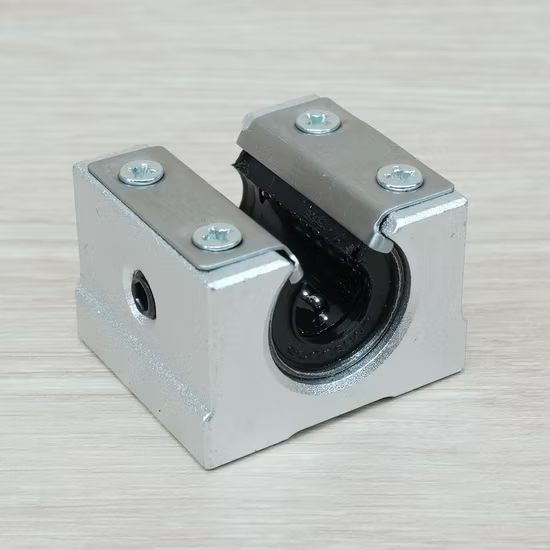

![SK8 SK10 SK12 SK13 SK16 SK20 Aluminum Linear Shaft Support Unit Slide Bearing [WARN] draft identifier mismatch](https://skfiso.com/wp-content/uploads/2026/09/sk8-sk10-sk12-sk13-sk16-sk20-aluminum-linear-shaft-support-unit-slide-bearing-warn-draft-identifier-mismatch-eb5dd1.avif)