01
Consultation
Technical needs assessment

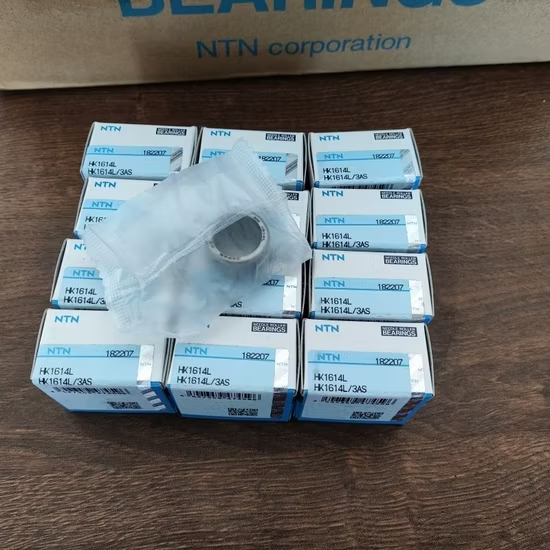


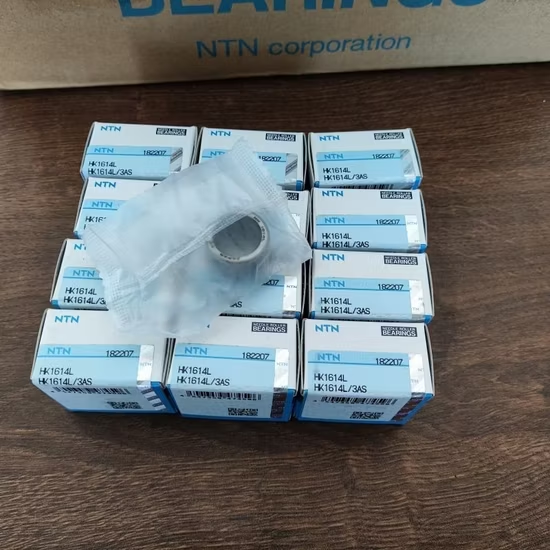

Rna4901 Needle Roller Bearing 12×24×13 mm — designed without an inner ring for direct operation on hardened shafts, optimizing compact radial spaces.
Precision Cross-Reference Alignment — We verify the Rna4901 needle roller bearing against OEM shaft hardness and mounting dimensions rather than relying solely on the base designation.
| Parameter | Value |
|---|---|
| Designation | Rna4901 |
| Bearing Type | Needle Roller Bearing |
| Bore Diameter (Fw) | 12 mm |
| Outside Diameter (D) | 24 mm |
| Width (C) | 13 mm |
| Material | Bearing Steel |
| Load Direction | Radial |
| Seal or Shield Type | Open |
| Internal Design | Without Inner Ring |
| Industry | Typical Applications |
|---|---|
| Industrial Gearboxes | Compact planetary gear stages and secondary reduction shafts |
| Machine Tool Spindles | Radial support sections in auxiliary spindle drives |
| Electric Motors | High-density radial support in compact rotor assemblies |
The Rna4901 needle roller bearing is engineered strictly for radial loads, and treating it as a thrust component guarantees rapid axial collapse.
Working on the trading frontlines in the Pearl River Delta, I frequently see procurement engineers confuse compact radial needle rollers with thrust variants due to their similar low-profile cross-sections. When an open-type Rna4901 is mistakenly installed to handle axial shaft displacement, the rollers skid against the hardened shaft shoulder. This misalignment generates intense localized friction, leading to immediate cage deformation and severe shaft scoring. The resulting unplanned downtime far outweighs the initial component cost, turning a simple replacement into a major teardown .
The primary advantage of this configuration is its exceptionally low radial cross-section, allowing designers to maximize shaft diameter within tight housing envelopes. By supplying the Rna4901 needle roller bearing with full batch traceability, we ensure that the bearing steel meets the exact metallurgical requirements for high-stress radial applications. Our technical review process confirms that the mating shaft surface is hardened and ground to the correct finish, which is mandatory when operating without an inner ring.
In compact gearboxes and auxiliary spindle drives, the Rna4901 handles significant radial forces while operating at relatively high speeds. Because this variant features an open design without integrated seals, it relies entirely on the housing’s external lubrication system to manage thermal buildup and flush out microscopic wear debris. The absence of contact seals eliminates friction heat, but it demands a clean oil bath or precise oil-mist environment to prevent contaminant ingress. If the housing lacks adequate filtration, abrasive particles will quickly penetrate the roller-to-shaft interface, accelerating surface fatigue and compromising the running accuracy .
The "Rna" prefix explicitly dictates that this component operates directly on the shaft journal. This design requires the mating shaft to be hardened to withstand the high contact stresses generated by the small-diameter rollers. The 12 mm bore diameter (Fw) and 24 mm outside diameter provide a rigid radial envelope, while the 13 mm width distributes the radial load across a sufficient roller length. Since no additional clearance or precision suffixes are specified in the base identifier, the standard radial internal clearance applies, which is generally suitable for typical industrial operating temperatures where thermal expansion remains moderate.
Overlooking the distinction between inner-ring and non-inner-ring designs often leads to the use of soft, unhardened commercial shafting. Under heavy radial loads, the rollers will indent the soft shaft material, causing brinelling and catastrophic vibration. Furthermore, substituting an open bearing in a contaminated environment without upgrading the housing seals results in premature wear that voids equipment warranties. These field failures rarely manifest as simple wear; they typically escalate into secondary gear tooth damage or complete spindle seizure, triggering extensive secondary repair costs.
We address the rampant issue of counterfeit bearings featuring soft inner rings and cloned QR codes by providing direct manufacturer traceability for every Rna4901 needle roller bearing shipped. Our cross-reference protocol goes beyond matching the base number; we verify the internal design, ensuring the "without inner ring" configuration perfectly aligns with your equipment’s shaft hardness specifications. By consolidating multi-brand requirements into single orders, we eliminate the lead-time delays typically associated with sourcing specific open-type needle rollers from fragmented suppliers.
To ensure the Rna4901 needle roller bearing is the optimal fit for your assembly, please provide the specific radial load profiles, operating speeds, and shaft hardness data for our engineering review. If you are replacing an existing component, sharing the original OEM equipment number allows us to perform a comprehensive cross-reference check to verify the internal design and clearance requirements. This technical validation ensures the open-type configuration aligns perfectly with your housing lubrication and contamination control capabilities.
Q: What is the functional difference between Rna and NA needle roller bearings?
A: The Rna series operates directly on a hardened shaft journal, eliminating the inner ring to achieve a lower radial cross-section. In contrast, NA series bearings include an inner ring, which is necessary when the mating shaft cannot be hardened or ground to the required surface finish for direct roller contact.
Q: How can I verify the authenticity of the Rna4901 needle roller bearing?
A: Every unit we supply includes batch and lot traceability documentation. You can verify the authenticity by scanning the manufacturer's QR code using the official brand application, which confirms the origin and prevents the installation of counterfeits with soft, unhardened internal components.
Q: What cross-reference precautions are needed when replacing OEM needle rollers?
A: Matching the base designation is insufficient. You must verify that the replacement features the identical "without inner ring" configuration and open seal type. Installing an inner-ring variant or a sealed alternative can alter the radial envelope, cause thermal binding, or disrupt the housing lubrication flow.
Q: How should I manage lubrication for this open-type bearing in a gearbox?
A: Since the open design lacks integrated seals to retain grease, it relies on the gearbox’s circulating oil system. You must ensure the oil filtration system is highly effective at removing microscopic particulates, as any debris entering the unsealed roller interface will rapidly accelerate surface fatigue and cage wear.
Q: What causes premature failure of needle roller bearings in compact gear stages?
A: A primary cause is shaft deflection or misalignment, which forces the rollers to skew and concentrate stress at their ends. Additionally, utilizing a shaft that lacks the necessary surface hardness will result in severe brinelling, as the rollers will permanently indent the soft journal material under heavy radial loads.
Our 5-step process ensures every order is engineered, validated, and supported for optimal performance.
Technical needs assessment
Custom specifications
Free samples for $50k+
Pre-shipment inspection
On-site & predictive
Our certified engineers respond within 24 hours with detailed technical specifications, pricing, and lead time information.
![HK2210 HK2212 HK2216 HK2220 HK2230 Needle Roller Bearing [WARN] draft identifier mismatch](https://skfiso.com/wp-content/uploads/2026/09/hk2210-hk2212-hk2216-hk2220-hk2230-needle-roller-bearing-warn-draft-identifier-mismatch-cbe937.avif)


![Hf0306 0406 0612 0812 1012 1216/Kfr One-Way Needle Roller Bearings for Machinery [WARN] draft identifier mismatch](https://skfiso.com/wp-content/uploads/2026/09/hf0306-0406-0612-0812-1012-1216-kfr-one-way-needle-roller-bearings-for-machinery-warn-draft-identifier-mismatch-155baa.avif)