01
Consultation
Technical needs assessment


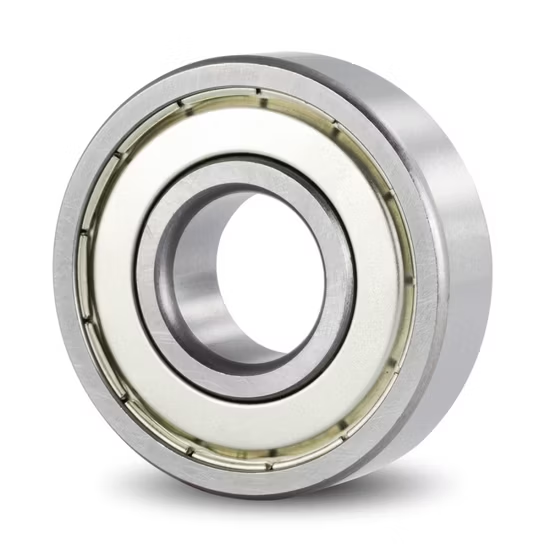


6200zz P5 Deep Groove Ball Bearing — chrome steel construction with double steel shields for effective dust protection at moderate speeds.
Scan To Verify — Every 6200zz deep groove ball bearing ships with a manufacturer QR code readable via official brand apps for instant authenticity confirmation.
| Parameter | Value |
|---|---|
| Designation | 6200zz |
| Bearing Type | Deep Groove Ball Bearing |
| Precision Class | P5 |
| Material | Chrome Steel |
| Seal or Shield Type | Double Steel Shields (ZZ) |
| Noise and Vibration Level | Z1V1, Z2V2, Z3V3, Z4V4 |
| Origin | Germany, Japan, Sweden, Malaysia, China |
| Industry | Typical Applications |
|---|---|
| Commercial Food Service | High-frequency start-stop mechanisms in commercial mixers and dough kneaders |
| Electric Motor Manufacturing | Cooling fan assemblies and small fractional horsepower motor shafts |
| Light Material Handling | Drive rollers and tensioning pulleys in bakery conveyor systems |
Precision suffixes and shield types dictate survival in high-cycle food processing environments.
Sourcing a 6200zz deep groove ball bearing based solely on the base designation often leads to catastrophic field failures. Procurement teams frequently overlook critical internal variations, resulting in standard P0 grade components being installed where P5 precision is mandatory for smooth operation. In commercial kitchens, equipment undergoes relentless start-stop cycles, and installing a bearing with incorrect internal clearance or inferior cage materials inevitably causes thermal binding . I once investigated a batch of seized motors in a food plant where standard clearance variants were used instead of thermally compensated options, a mistake that halts production lines and voids equipment warranties.
Selecting the right 6200zz deep groove ball bearing for restaurant equipment requires strict alignment between the P5 precision class and the operational demands of commercial mixers. Our technical review process ensures that the tighter dimensional tolerances of P5 grade components are correctly matched to the high-speed spindles found in food processing machinery. By verifying both the base number and the exact ZZ shield configuration, we prevent the ingress of flour dust and moisture that typically destroys open or improperly sealed variants in kitchen environments.
Commercial food preparation equipment subjects rotating elements to severe radial loads combined with sudden directional reversals during mixing cycles. The rapid temperature fluctuations near ovens and steamers drastically affect internal clearance, making the correct thermal expansion allowance vital to prevent cage collapse. Non-contact double steel shields provide essential protection against airborne particulates without introducing the friction heat generated by rubber contact seals . Furthermore, the high acoustic sensitivity of dining areas demands strict adherence to Z3V3 or Z4V4 noise and vibration grading to maintain a quiet service environment.
The ZZ suffix denotes double steel shields, offering a non-contact barrier that effectively blocks coarse contaminants while permitting higher rotational speeds than rubber-sealed alternatives. This specific configuration is ideal for electric motors and gearboxes where external lubrication is managed by the housing, and internal friction must be minimized. Upgrading to P5 precision ensures noticeably tighter running accuracy compared to standard commercial grades, directly reducing vibration amplitudes at high RPMs. The chrome steel construction delivers the necessary core hardness to withstand the repetitive shock loads inherent in heavy-duty dough kneaders. Additionally, selecting the appropriate Z-level vibration grading ensures the bearing meets the strict acoustic requirements of modern restaurant equipment.
Relying on superficial cross-references that ignore precision grades and shield types leads to premature failure and unplanned downtime. When a standard P0 bearing is substituted for a P5 requirement in a high-speed spindle, the excessive internal runout accelerates fatigue spalling on the raceways. Incorrect shield selection allows abrasive kitchen debris to penetrate the rolling elements, causing catastrophic damage and complete seizure . These failures not only disrupt critical food preparation workflows but also result in costly warranty voidance and extensive secondary damage to adjacent motor components.
We maintain authorized distribution across all major international brands, allowing mixed-brand requirements for complex kitchen installations to be fulfilled in a single order. Our cross-reference protocol strictly aligns the base designation, P5 precision class, and ZZ shield type, eliminating the dangerous mismatches that cause thermal binding. Every shipment includes batch traceability verified through official brand applications, protecting your operation from counterfeit products with soft inner rings. We conduct rigorous application-based selection reviews covering load, speed, and temperature to ensure the chosen variant survives the harsh realities of commercial food service.
To ensure optimal performance in your specific application, please provide detailed operational parameters including radial and axial loads, rotational speeds, and ambient temperature ranges. Sharing the exact OEM equipment number allows our engineering team to perform a comprehensive cross-reference verification, ensuring the selected variant perfectly matches the original design intent. This technical review guarantees that the precision class and shield configuration are fully optimized for your machinery's unique operating environment.
Q: How can I verify the authenticity of the P5 precision bearings using official apps?
A: Each unit features a unique QR code linked to the manufacturer's database. By scanning this code with the official brand application, procurement teams can instantly confirm the batch origin, material composition, and P5 precision certification, effectively eliminating the risk of installing counterfeit components with compromised inner ring hardness.
Q: Why must the ZZ shield type align perfectly during cross-reference interchange?
A: Substituting a ZZ shielded variant with a rubber-sealed or open alternative drastically alters friction characteristics and contamination resistance. In high-speed applications, rubber seals generate excess heat leading to thermal binding, while open bearings allow destructive debris ingress, fundamentally changing the operational lifespan of the equipment.
Q: What is the practical difference between Z1V1 and Z4V4 noise levels?
A: The Z and V grading indicates the strictness of vibration and acoustic emission limits during high-speed rotation. Z4V4 represents the most stringent control, ensuring exceptionally smooth and quiet operation, which is absolutely critical for commercial restaurant equipment where excessive motor noise disrupts the dining atmosphere.
Q: How do I select the correct shield type for humid kitchen environments?
A: For environments with heavy airborne moisture but no direct liquid washdown, non-contact steel shields provide excellent particulate protection without adding friction. If the equipment undergoes direct high-pressure chemical cleaning, contacting rubber seals or specialized stainless steel variants must be evaluated to prevent internal corrosion.
Our 5-step process ensures every order is engineered, validated, and supported for optimal performance.
Technical needs assessment
Custom specifications
Free samples for $50k+
Pre-shipment inspection
On-site & predictive
Our certified engineers respond within 24 hours with detailed technical specifications, pricing, and lead time information.