01
Consultation
Technical needs assessment



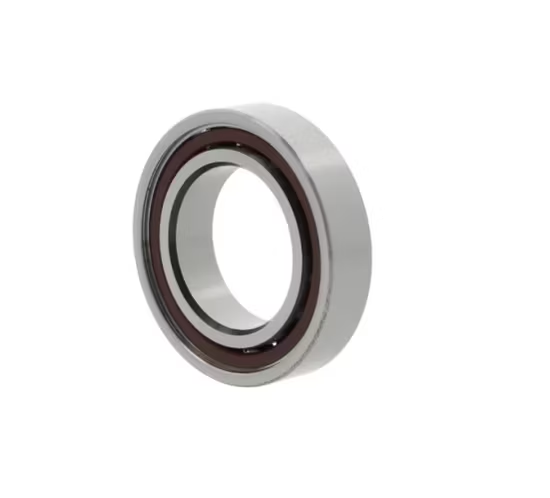
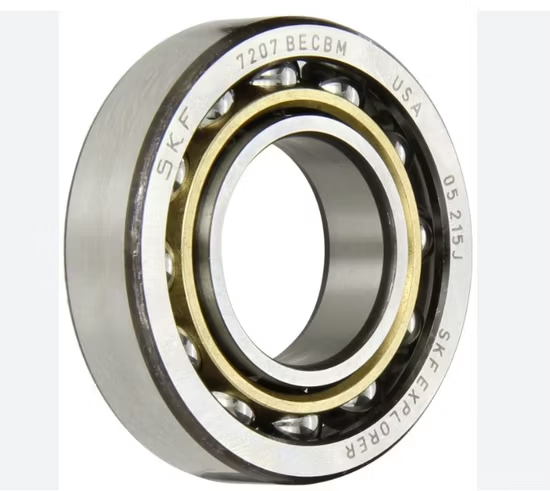
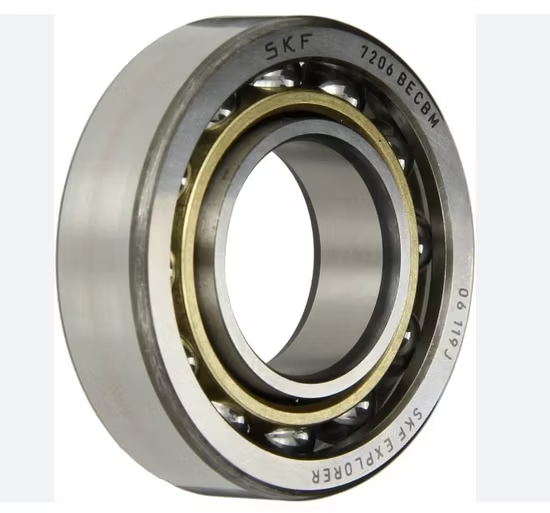
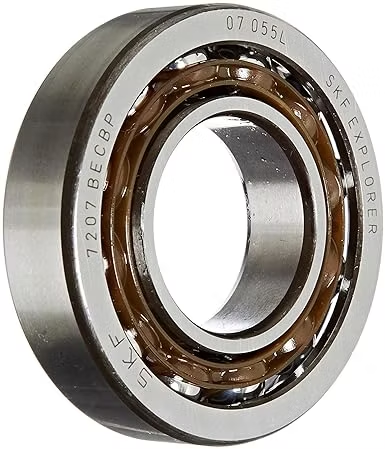
NSK NTN Timken Koyo 71928CD/P4a Angular Contact Ball Bearing P4A — engineered with a 15° contact angle to balance axial capacity and minimize friction heat in machine tool spindles. The P4A precision class ensures tighter running accuracy than standard grades.
Three-way cross-reference alignment — Base designation, 15° contact angle, and P4A running accuracy are verified simultaneously to prevent thermal binding in high-speed spindles.
| Parameter | Value |
|---|---|
| Designation | NSK NTN Timken Koyo 71928CD/P4a |
| Bearing Type | Angular Contact Ball Bearing |
| Bore Diameter (d) | 140 mm |
| Outside Diameter (D) | 190 mm |
| Width (B) | 24 mm |
| Contact Angle | 15° |
| Precision Class | P4A |
| Material | Bearing Steel |
| Customization | Available in ceramic hybrid or stainless steel variants upon request |
| Industry | Typical Applications |
|---|---|
| Machine Tool Manufacturing | High-speed motorized spindle front and rear support nodes |
| Precision Equipment | High-frequency robotic joint actuators requiring tight radial runout limits |
| Fluid Dynamics | High-speed centrifugal pump shaft support where axial thrust is present |
Standard P4 tolerances silently destroy high-speed spindle accuracy.
At a recent Hanover industrial exhibition, I examined a seized motorized spindle where the root cause was traced back to a supposed high-precision bearing. The inner ring hardness was well below specification, and the dimensional tolerances drifted far beyond the acceptable limits for high-RPM operation. When procurement teams accept standard P4 or P5 grades for ultra-light series applications, the resulting thermal expansion quickly eliminates internal clearance . The 71928CD/P4a angular contact ball bearing demands enhanced running accuracy to maintain film thickness and prevent catastrophic cage failure under continuous high-speed rotation.
High-speed machining centers require a delicate balance between radial rigidity and axial thrust capacity. The 15° contact angle inherent to the CD suffix design minimizes friction heat generation while providing sufficient axial support for the cutting forces encountered in precision milling. Procurement engineers sourcing a 71928CD/P4a angular contact ball bearing must ensure this specific contact angle aligns with the spindle's load profile, as substituting a 25° variant would drastically increase operating temperatures and compromise surface finish quality.
The ultra-light cross-section of the 140mm bore 719 series makes it highly susceptible to thermal distortion. As rotational speeds increase, friction heat alters the internal clearance, making the initial clearance selection and lubrication method critical. Oil-air or oil-jet lubrication is typically required to manage heat dissipation without introducing the churning losses associated with grease . Any contamination in the lubrication circuit will rapidly degrade the P4A raceway finish, leading to premature vibration spikes.
The CD suffix signifies an optimized internal design with a 15° contact angle, specifically engineered to reduce stress concentrations on the raceway shoulders during high-speed operation. The P4A designation elevates the standard P4 dimensional accuracy by imposing much stricter running accuracy limits, particularly for radial and axial runout. This combination ensures that the 71928CD/P4a angular contact ball bearing maintains concentricity even when subjected to the thermal gradients typical of continuous CNC machining cycles.
Substituting a standard clearance bearing where a specific preload or clearance class is required leads to unplanned downtime and catastrophic damage to the spindle housing. If the cross-reference process only matches the base 71928 number while ignoring the CD and P4A suffixes, the equipment will likely suffer from thermal binding within the first few hours of operation. Such failures not only void the machine builder's warranty but also result in massive secondary repair costs that far exceed the initial component savings.
Sourcing genuine precision components requires more than just matching a part number on a purchase order. We verify the 15° contact angle and P4A running accuracy through batch-level documentation rather than relying on visual inspection. Our cross-referencing protocol ensures that the cage material, clearance, and precision suffixes align perfectly with your OEM specifications. Every shipment includes manufacturer traceability, eliminating the risk of installing counterfeit rings that pass casual checks but fail under operational loads.
To ensure the selected configuration perfectly matches your spindle architecture, please provide the specific radial and axial load profiles, maximum operating RPM, and target operating temperature range. Sharing the OEM equipment number allows our engineering team to perform a comprehensive cross-reference check, verifying that the internal clearance and cage design meet your exact application requirements.
Q: How can I verify the authenticity of the P4A precision grade before installation?
A: Authenticity is confirmed by scanning the QR code on the packaging using the official brand application, which links directly to the manufacturer's database. Additionally, we provide a dedicated dimensional and running accuracy inspection report that verifies the strict P4A tolerances for your specific batch before the components leave our facility.
Q: Why is the CD suffix critical when cross-referencing the 71928 base designation?
A: The CD suffix specifies an optimized internal design with a precise 15° contact angle. Substituting a base number without this suffix might result in a different contact angle, which drastically alters the axial load capacity and friction heat generation, ultimately causing thermal binding in high-speed spindle applications.
Q: What distinguishes P4A precision from standard P4 in high-speed applications?
A: While standard P4 covers basic dimensional accuracy, P4A imposes significantly tighter limits on running accuracy, specifically radial and axial runout. This enhanced precision is mandatory for high-speed spindles to maintain tight machining tolerances and prevent vibration-induced surface finish defects during continuous operation.
Q: How does the 15° contact angle affect the performance of this angular contact bearing?
A: The 15° contact angle provides an optimal balance for high-speed applications by minimizing friction heat generation while still offering adequate axial thrust capacity. This specific geometry ensures the bearing maintains a stable lubricant film thickness at elevated RPMs, preventing premature cage wear and raceway degradation.
Our 5-step process ensures every order is engineered, validated, and supported for optimal performance.
Technical needs assessment
Custom specifications
Free samples for $50k+
Pre-shipment inspection
On-site & predictive
Our certified engineers respond within 24 hours with detailed technical specifications, pricing, and lead time information.
![B7220-C-T-P4 Angular Contact Ball Bearing 40tac72 for Machine Tool Spindles [WARN] draft identifier mismatch](https://skfiso.com/wp-content/uploads/2026/09/b7220-c-t-p4-angular-contact-ball-bearing-40tac72-for-machine-tool-spindles-warn-draft-identifier-mismatch-3a23fe.avif)