01
Consultation
Technical needs assessment



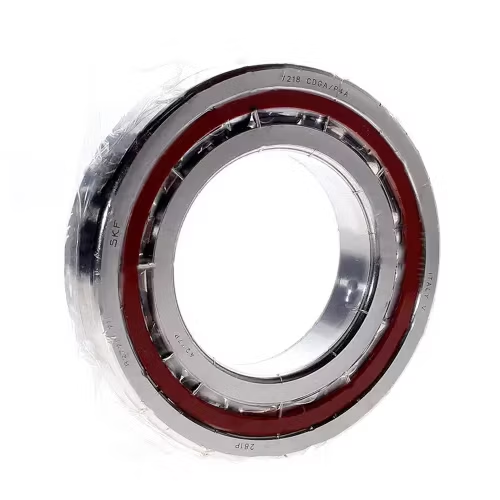
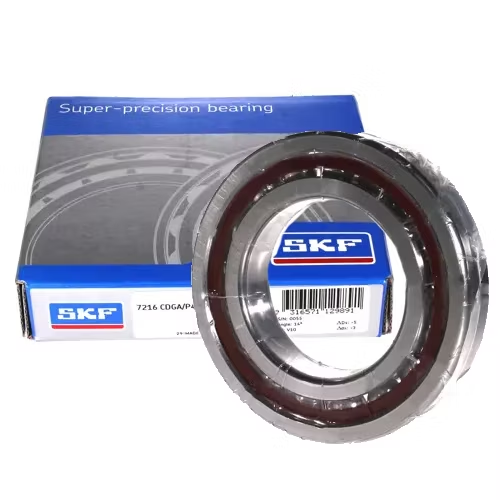
7022 CD/P4a Angular Contact Ball Bearing — machined from bearing steel for demanding precision applications.
Precision Cross-Reference Alignment — Matching the 7022 CD/P4a angular contact ball bearing requires verifying the 15° contact angle and P4a running accuracy, not just the base designation.
| Parameter | Value |
|---|---|
| Designation | 7022 CD/P4a |
| Bearing Type | Angular Contact Ball Bearing |
| Material | Bearing Steel |
| Contact Angle | 15° |
| Precision Class | P4a (Class 4 dimensional and running accuracy) |
| Internal Design | CD (Optimized for high-speed precision) |
| Customization | Available in ceramic hybrid or stainless steel variants upon request |
| Industry | Typical Applications |
|---|---|
| Machine Tool Manufacturing | High-speed grinding spindles, CNC milling headstocks, precision lathe main shafts |
| Robotics & Automation | High-precision rotary axes, articulated joint actuators, direct-drive torque motors |
| Industrial Pumps & Compressors | High-speed centrifugal pump shafts, vacuum pump rotors, turbo-machinery supports |
A 7022 CD/P4a angular contact ball bearing must maintain strict dimensional tolerances to prevent harmonic resonance in high-speed spindles. During my years repairing spindles in Suzhou, I witnessed a precision grinding machine fail catastrophically because a standard P0 grade component was installed in a high-RPM position. The resulting vibration surge not only destroyed the bearing but also burned out the drive motor coils. Sourcing a genuine 7022 CD/P4a angular contact ball bearing with verified P4a running accuracy prevents these thermal and mechanical chain reactions .
Precision machining demands extreme rotational stability. The 7022 CD/P4a angular contact ball bearing delivers the exact dimensional consistency required for tight-tolerance grinding and milling. Our technical team reviews your specific spindle load profiles to ensure the selected internal geometry aligns perfectly with your operational parameters, eliminating the guesswork from precision component sourcing.
High-speed spindle operations generate significant friction heat, which directly impacts internal clearance and lubrication film thickness. An optimized 15° contact angle balances axial rigidity with thermal stability, but selecting the correct lubrication strategy is equally critical. Oil-air or oil-mist systems are typically required to manage heat dissipation without introducing excessive fluid friction, while proper seal selection prevents coolant contamination without adding drag .
The "CD" suffix indicates an optimized internal design specifically engineered for a 15° contact angle, providing an ideal balance between radial load capacity and axial stiffness for high-speed applications. The "P4a" designation guarantees Class 4 dimensional and running accuracy, ensuring tighter tolerances for bore, outer diameter, and radial runout compared to standard P5 grades. This exacting precision is non-negotiable for maintaining concentricity in machine tool spindles where even microscopic deviations cause chatter marks on the workpiece.
Overlooking the "a" in P4a or assuming a standard C-suffix is interchangeable with CD often leads to premature spindle failure. Installing a component with incorrect running accuracy causes uneven load distribution across the rolling elements, leading to localized overheating and cage degradation. These failures result in unplanned downtime, scrapped workpieces, and expensive spindle rebuilds that far exceed the initial component cost .
We supply the 7022 CD/P4a angular contact ball bearing with full manufacturer batch traceability, ensuring you receive the exact precision class ordered. Our cross-referencing process strictly aligns the 15° contact angle and P4a tolerances, preventing the common error of substituting visually similar but dimensionally distinct variants. Every shipment includes official app QR verification, giving your maintenance team absolute confidence in the component's authenticity before it reaches the cleanroom.
To ensure precise application matching, please provide your spindle's maximum operating speed, radial and axial load profiles, and expected thermal operating range. Sharing the original OEM equipment number or the exact dimensions of the housing and shaft allows our engineering team to perform a rigorous cross-reference check. This data enables us to confirm the suitability of the 15° contact angle and P4a precision class for your specific high-speed cutting environment.
Q: How do I verify the authenticity of the P4a precision class?
A: Every unit features a unique QR code on the packaging. Scanning this code via the manufacturer's official mobile application instantly verifies the batch origin and confirms the P4a running accuracy specifications, protecting your spindle from counterfeit components with cloned visual markers but substandard internal tolerances.
Q: Why is the CD suffix critical for cross-referencing this designation?
A: The CD suffix dictates a specific 15° contact angle and optimized internal geometry for high-speed operations. Substituting a standard C or B suffix alters the axial stiffness and thermal characteristics, leading to premature failure in precision spindles. We strictly verify these suffixes during cross-referencing to ensure exact operational compatibility.
Q: What is the dimensional difference between P4 and P4A classes?
A: While both fall under the Class 4 precision umbrella, P4A imposes significantly tighter tolerances on radial runout and bore diameter variations. This enhanced running accuracy is essential for high-speed grinding spindles where microscopic deviations cause visible chatter marks on the finished workpiece and accelerate rolling element fatigue.
Q: How should I select the correct lubrication for this high-speed application?
A: High-speed spindles utilizing the 15° contact angle design typically require oil-air or oil-mist lubrication to manage heat dissipation without introducing excessive fluid friction. We recommend consulting your spindle manufacturer's guidelines and sharing your exact RPM and thermal parameters with our team to finalize the optimal lubrication strategy.
Our 5-step process ensures every order is engineered, validated, and supported for optimal performance.
Technical needs assessment
Custom specifications
Free samples for $50k+
Pre-shipment inspection
On-site & predictive
Our certified engineers respond within 24 hours with detailed technical specifications, pricing, and lead time information.
![7206 Becbm Angular Contact Ball Bearing High Speed Precision [WARN] draft identifier mismatch](https://skfiso.com/wp-content/uploads/2026/09/7206-becbm-angular-contact-ball-bearing-high-speed-precision-warn-draft-identifier-mismatch-0db82c.avif)

![71900 CD/P4a Angular Contact Bearing High Speed Super Precision [WARN] draft identifier mismatch](https://skfiso.com/wp-content/uploads/2026/09/71900-cd-p4a-angular-contact-bearing-high-speed-super-precision-warn-draft-identifier-mismatch-b377bc.avif)