01
Consultation
Technical needs assessment



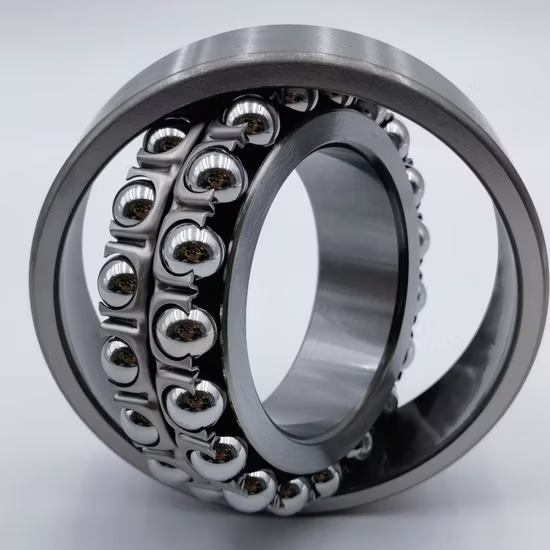


1309K Self-Aligning Ball Bearing features a 1:12 tapered bore design, enabling secure adapter sleeve mounting and precise radial clearance adjustment during installation.
Multi-brand authorized sourcing — Fulfill mixed-brand requirements for 1309K self-aligning ball bearings through a single supply chain with unified batch traceability across all major manufacturers.
| Parameter | Value |
|---|---|
| Designation | 1309K |
| Bearing Type | Self-Aligning Ball Bearing |
| Bore Type | 1:12 Tapered Bore |
| Seal or Shield Type | Open, Rubber Seals, Iron Seals |
| Origin | Germany, Japan, Sweden, Malaysia, China |
| HS Code | 848210 |
| Industry | Typical Applications |
|---|---|
| Electric Motors | Rotor shaft support requiring compensation for housing machining tolerances |
| Agricultural Machinery | Conveyor drive shafts and harvester rotating assemblies exposed to structural deflection |
| Pumps and Conveyors | Impeller shafts and belt tracking rollers subject to dynamic misalignment |
Ignoring the K suffix turns a precision component into a press-fit liability.
Procurement teams often focus solely on the base designation during cross-referencing, assuming the internal geometry remains identical across brands. When the 1:12 tapered bore requirement is overlooked, field technicians are forced to mount a cylindrical bore variant onto adapter sleeves, resulting in severe inner ring cracking or inadequate shaft grip. I have reviewed numerous failure reports where this exact suffix omission led to catastrophic slippage under load . Ensuring the tapered profile is explicitly matched prevents unplanned downtime and protects the shaft surface from irreversible scoring.
The 1309K self-aligning ball bearing is engineered specifically for applications where the shaft and housing are not perfectly aligned, or where the shaft experiences dynamic deflection during operation. The outer ring features a spherical raceway centered on the bearing axis, allowing the inner ring and ball assembly to pivot freely. This design capability absorbs static and dynamic angular misalignment without inducing excessive edge loading on the raceways, making it highly suitable for long conveyor shafts or agricultural drive systems where structural flexing is unavoidable.
Equipment operating in agricultural or material handling environments faces a combination of radial loads, shock impacts, and heavy particulate contamination. When shaft deflection occurs, standard deep groove ball bearings experience severe localized stress, accelerating fatigue and generating excess friction heat. Furthermore, the ingress of dust or moisture rapidly degrades the lubricant. Selecting the appropriate seal variant—whether open for external oil circulation, rubber seals for moderate contamination, or iron seals for high-speed dust protection—is critical to maintaining the lubricant film and preventing premature raceway wear .
The "K" suffix on this designation explicitly dictates a 1:12 tapered bore, which is designed to be mounted directly onto a tapered shaft or, more commonly, via an adapter sleeve on a cylindrical shaft. This configuration allows maintenance crews to precisely control the radial internal clearance during installation by adjusting the drive-up distance. Unlike cylindrical bore bearings where clearance is fixed at the factory, the tapered interface provides on-site adjustability. However, this requires strict adherence to the manufacturer's specified drive-up values; over-tightening will eliminate the necessary operational clearance, causing thermal binding, while under-tightening leads to fretting corrosion between the inner ring and the sleeve.
Substituting a standard cylindrical bore bearing in place of a tapered design, or ignoring the required internal clearance class, frequently results in premature seizure or catastrophic cage failure. When a standard clearance bearing is forced onto a tight adapter sleeve without accounting for the resulting clearance reduction, the rolling elements skid rather than roll, generating rapid heat accumulation. According to industry fatigue life models, operating under such constrained conditions drastically reduces the L10 calculation, leading to warranty voidance and expensive secondary damage to the surrounding housing and shaft assemblies .
Our technical team reviews every inquiry to ensure the base designation, bore suffix, and seal type align perfectly with the original equipment specifications. We provide authorized distribution across all major international brands, meaning you can source SKF, FAG, or NSK equivalents through a single, traceable order. Having transitioned from quality inspection to trade here in Shenzhen, I have seen firsthand how a minor oversight—like ignoring cage material differences on a similar 1312K batch—causes high-speed fracture. We apply that same rigorous internal design verification to the 1309K, ensuring every shipment includes full batch traceability and cross-brand interchange accuracy, eliminating the risk of field failures caused by specification drift.
To ensure the selected 1309K variant perfectly matches your operational requirements, please provide the specific radial and axial loads, operating speeds, and expected shaft deflection angles. Sharing the original OEM equipment number or the exact adapter sleeve designation allows our engineering team to perform a precise cross-reference check and verify the L10 fatigue life. If your application involves extreme contamination or temperature fluctuations, detailing these environmental factors will help us recommend the optimal seal configuration and clearance class for your machinery.
Q: What does the "K" suffix indicate on the 1309K, and how does it affect installation?
A: The "K" suffix designates a 1:12 tapered bore. Unlike cylindrical bore bearings that are pressed directly onto a shaft, this tapered design is typically mounted using an adapter sleeve and locknut. This allows technicians to precisely adjust the radial internal clearance during installation by controlling the drive-up distance, ensuring optimal load distribution and preventing thermal binding during operation.
Q: Why is it critical to verify the seal type when cross-referencing the 1309K?
A: Base numbers might match across different manufacturers, but the seal configurations often vary. Installing an open bearing in a highly contaminated agricultural environment without external sealing will lead to rapid lubricant degradation. Conversely, using heavy contact rubber seals in a high-speed electric motor application can generate excessive friction heat. Verifying the exact seal suffix ensures the bearing matches the specific contamination and speed requirements of your equipment.
Q: How do we ensure the 1309K self-aligning ball bearing is genuine and not a counterfeit?
A: Every unit we supply is sourced through authorized distribution channels and comes with comprehensive documentation. You can verify the authenticity by scanning the QR codes using the manufacturer's official mobile app. Additionally, we provide a Certificate of Conformity and batch traceability reports that link the physical bearings directly to the original factory production records, guaranteeing material and dimensional integrity.
Q: Can a standard cylindrical bore bearing be used as a substitute if the 1309K is unavailable?
A: Substituting a cylindrical bore bearing for a tapered bore design is highly discouraged. The housing and shaft preparation for a tapered setup relies on adapter sleeves for clearance adjustment and secure locking. Forcing a cylindrical bearing into this arrangement will result in improper fitment, loss of clamping force, and severe inner ring damage. We prioritize sourcing the exact tapered specification to maintain the mechanical integrity of the assembly.
Our 5-step process ensures every order is engineered, validated, and supported for optimal performance.
Technical needs assessment
Custom specifications
Free samples for $50k+
Pre-shipment inspection
On-site & predictive
Our certified engineers respond within 24 hours with detailed technical specifications, pricing, and lead time information.