01
Consultation
Technical needs assessment


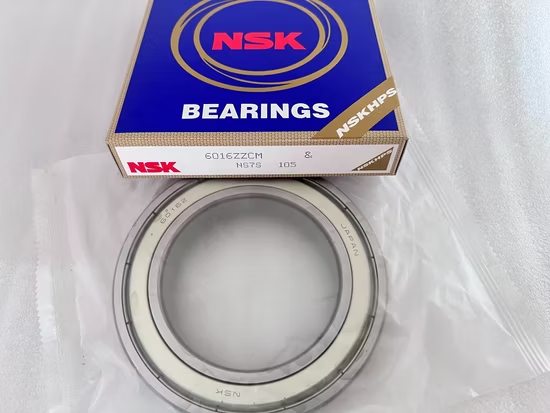
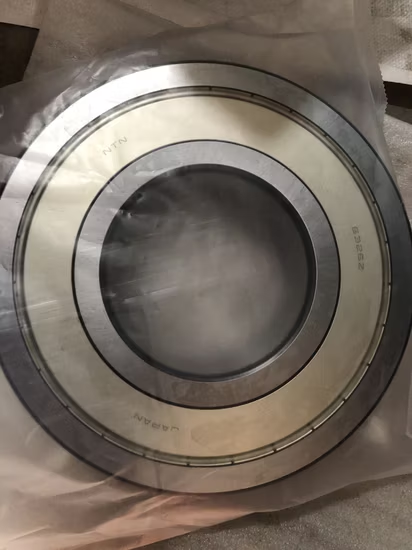
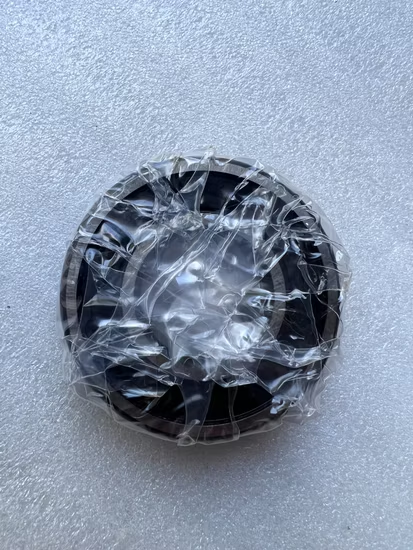
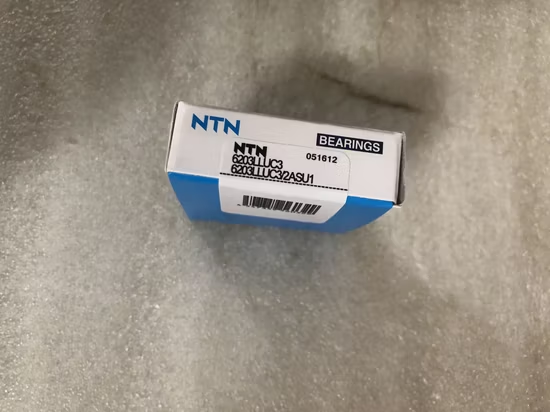
S689zz Stainless Steel Deep Groove Ball Bearing 9×17×4 mm — engineered with double steel shields to retain lubrication and exclude dust at moderate speeds, while stainless steel construction delivers consistent corrosion resistance for miniature applications.
Authentic QR Verification — Scan the manufacturer's official app code on every S689zz batch to confirm genuine stainless steel composition and traceability.
| Parameter | Value |
|---|---|
| Designation | S689zz |
| Bearing Type | Deep Groove Ball Bearing |
| Bore Diameter (d) | 9 mm |
| Outside Diameter (D) | 17 mm |
| Width (B) | 4 mm |
| Material | Stainless Steel |
| Seal or Shield Type | Iron Seals (Double Shielded) |
| Quality Level | Z1V1, Z2V2, Z3V3, Z4V4 |
| Origin | Germany / Japan / Sweden / Malaysia / China |
Note: The "S" prefix in S689zz is an unverified suffix requiring manufacturer catalog confirmation for specific alloy grades.
| Industry | Typical Applications |
|---|---|
| Electric Motors | Miniature motor rotors and cooling fan spindles |
| Household Appliances | Washing machine drain pumps and dishwasher spray arms |
| Medical Devices | Surgical handpieces and dental drill turbines |
| Precision Instruments | Optical scanner spindles and laboratory centrifuges |
Carbon steel substitutes rust internally long before the rolling elements fatigue.
Early in my career grinding bearing rings in Pearl River Delta workshops, I saw countless export water pumps seize during ocean transit. The root cause was rarely the bearing design itself, but a cross-reference error where standard carbon steel 689ZZ units were installed instead of the required stainless variants. Salt雾 and high humidity rapidly corrode the inner raceway of standard steel, creating rust debris that jams the miniature rotor. When sourcing the S689zz stainless steel deep groove ball bearing, overlooking the material prefix while matching the base 9x17x4 mm dimensions leads to catastrophic field failures in damp environments .
Selecting the correct material is critical when equipment faces frequent washdowns or high ambient humidity. The S689zz stainless steel deep groove ball bearing provides the necessary corrosion resistance for food processing conveyors and marine instruments where standard chrome steel would quickly degrade. Our technical review process ensures that cross-referencing aligns not just the 9 mm bore and 17 mm outer diameter, but also verifies the stainless material grade and double shield configuration to prevent premature seizure.
Miniature applications often operate at exceptionally high rotational speeds, generating significant internal friction heat. The double steel shield (zz/2z) configuration offers non-contact protection, effectively retaining factory lubrication while excluding dust and moisture without adding the friction penalty of rubber seals. This balance is vital for precision instruments where thermal expansion could otherwise alter the internal clearance and cause binding. Proper shield selection directly impacts the operational lifespan and noise profile of high-speed spindles .
The "zz" suffix indicates double iron shields, which provide a physical barrier against particulate ingress while maintaining low friction at high RPMs, unlike rubber contact seals that generate excess heat. Furthermore, the available quality levels ranging from Z1V1 to Z4V4 dictate the vibration and noise characteristics of the bearing. For noise-sensitive household appliances or medical handpieces, specifying a higher precision and lower vibration class ensures smooth operation and prevents acoustic resonance within the equipment housing.
Installing a standard carbon steel bearing in a corrosive environment leads to rapid raceway degradation and unplanned downtime. According to ISO 15243 frameworks, surface distress from corrosion debris accelerates fatigue spalling far beyond normal operational expectations. This premature failure not only halts production but often causes secondary catastrophic damage to the miniature motor shaft or housing. Relying on visual inspection alone is insufficient, as counterfeit soft inner rings may pass casual checks but fail under operational loads, voiding equipment warranties and inflating maintenance costs .
We maintain authorized distribution channels that guarantee full batch traceability for every stainless steel miniature bearing shipped. Cross-reference errors frequently occur when purchasers match the base 689 number but miss the crucial "S" material prefix or the specific shield suffix. Our technical team reviews application parameters to confirm that the selected variant matches the exact clearance and corrosion resistance required. This prevents the common pitfall of receiving open or rubber-sealed variants when double shielded units are necessary for maintenance-free operation.
To ensure optimal performance, please provide the specific radial and axial loads, operational speeds, and ambient temperature ranges for your application. Sharing the exact OEM equipment designation allows our engineering team to perform a thorough cross-reference check, confirming that the material, clearance, and shield configurations perfectly match your original design requirements. This technical validation prevents costly mismatches and ensures reliable operation in demanding environments.
Q: How can I verify the authenticity of the stainless steel material?
A: Genuine units feature batch traceability and QR codes verifiable through the manufacturer's official app. We also provide material test reports confirming the specific stainless alloy composition. This prevents the risk of installing counterfeit bearings with soft inner rings that fail prematurely under load, ensuring long-term reliability in corrosive environments.
Q: Why is matching the base 689 number insufficient for cross-referencing?
A: The base number only defines the 9x17x4 mm dimensions. Missing the "S" prefix means you might receive carbon steel instead of stainless, and ignoring the "zz" suffix could result in open or rubber-sealed variants. Our technical review ensures all material, shield, and clearance parameters align exactly with your equipment's operational requirements.
Q: What is the difference between the Z1V1 and Z4V4 quality levels?
A: These designations indicate the vibration and noise limits of the bearing. Z1V1 represents standard commercial grade, suitable for general industrial motors. Z4V4 denotes ultra-precision with minimal vibration, which is strictly required for noise-sensitive medical devices, optical scanners, and high-speed precision instruments to prevent acoustic resonance.
Q: Can I replace a rubber-sealed 689-2RS with this S689zz variant?
A: While dimensions match, the "zz" iron shields provide non-contact protection, generating less friction and heat than rubber contact seals at high speeds. However, they offer slightly lower resistance to liquid ingress. We evaluate your specific speed and contamination profile to confirm if the shielded variant is the correct engineering substitute for your application.
Our 5-step process ensures every order is engineered, validated, and supported for optimal performance.
Technical needs assessment
Custom specifications
Free samples for $50k+
Pre-shipment inspection
On-site & predictive
Our certified engineers respond within 24 hours with detailed technical specifications, pricing, and lead time information.