01
Consultation
Technical needs assessment

![NSK NTN Timken Koyo 7200 CD/P4a Angular Contact Ball Bearing [WARN] draft identifier mismatch - 1](https://skfiso.com/wp-content/uploads/2026/09/nsk-ntn-timken-koyo-7200-cd-p4a-angular-contact-ball-bearing-warn-draft-identifier-mismatch-c6f736.avif)
![NSK NTN Timken Koyo 7200 CD/P4a Angular Contact Ball Bearing [WARN] draft identifier mismatch - 2](https://skfiso.com/wp-content/uploads/2026/09/nsk-ntn-timken-koyo-7200-cd-p4a-angular-contact-ball-bearing-warn-draft-identifier-mismatch-c4b5c3.avif)
![NSK NTN Timken Koyo 7200 CD/P4a Angular Contact Ball Bearing [WARN] draft identifier mismatch - 3](https://skfiso.com/wp-content/uploads/2026/09/nsk-ntn-timken-koyo-7200-cd-p4a-angular-contact-ball-bearing-warn-draft-identifier-mismatch-a0315c.avif)
![NSK NTN Timken Koyo 7200 CD/P4a Angular Contact Ball Bearing [WARN] draft identifier mismatch - 4](https://skfiso.com/wp-content/uploads/2026/09/nsk-ntn-timken-koyo-7200-cd-p4a-angular-contact-ball-bearing-warn-draft-identifier-mismatch-f07ce4.avif)
![NSK NTN Timken Koyo 7200 CD/P4a Angular Contact Ball Bearing [WARN] draft identifier mismatch - 5](https://skfiso.com/wp-content/uploads/2026/09/nsk-ntn-timken-koyo-7200-cd-p4a-angular-contact-ball-bearing-warn-draft-identifier-mismatch-322ea8.avif)
![NSK NTN Timken Koyo 7200 CD/P4a Angular Contact Ball Bearing [WARN] draft identifier mismatch - 6](https://skfiso.com/wp-content/uploads/2026/09/nsk-ntn-timken-koyo-7200-cd-p4a-angular-contact-ball-bearing-warn-draft-identifier-mismatch-ec66e5.avif)
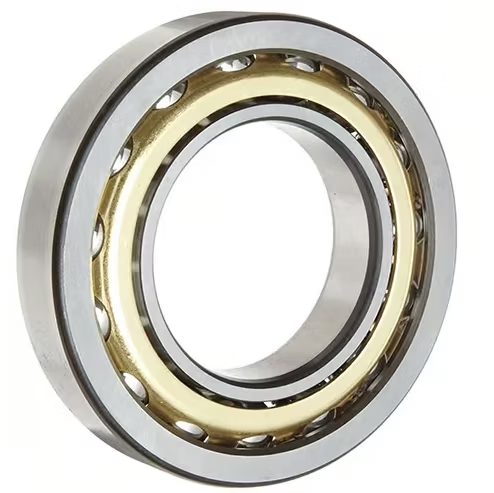
7200 CD/P4a Angular Contact Ball Bearing P4A Precision — 15° contact angle (CD) reduces friction heat for high-speed machine tool spindle applications. P4A class delivers tighter dimensional and running accuracy than standard P5, supporting stable operation in precision equipment and robotics.
Precision Cross-Reference — We verify the 15° contact angle and P4A tolerance to prevent thermal binding in high-speed spindles.
| Parameter | Value |
|---|---|
| Designation | 7200 CD/P4a |
| Bearing Type | Angular Contact Ball Bearing |
| Bore Diameter (d) | 10 mm |
| Outside Diameter (D) | 30 mm |
| Width (B) | 9 mm |
| Contact Angle | 15° |
| Precision Class | P4A |
| Material | Bearing Steel |
| Vibration Grade | Z1V1 / Z2V2 / Z3V3 |
| Origin | Germany / Japan / Sweden / Malaysia / China |
| Industry | Typical Applications |
|---|---|
| Machine Tool Manufacturing | High-speed motorized spindles, precision grinding headstocks |
| Robotics & Automation | High-accuracy joint actuators, SCARA robot arm pivots |
| Fluid Handling | High-speed centrifugal pump shafts, vacuum pump rotors |
Matching the base number while ignoring the precision suffix is a direct path to catastrophic thermal failure.
I have seen it happen on the showroom floor in Hanover and in actual production facilities: a maintenance team replaces a worn spindle bearing with a standard P0 or P5 grade unit because the base 7200 designation matches perfectly. Within hours, the spindle heats up and seizes. High-speed applications generate immense friction, and without the tight dimensional and running accuracy of a P4A class component, the internal clearances collapse as temperatures rise. This cross-reference oversight causes premature cage failure and unplanned downtime that halts entire machining lines .
When sourcing an NSK NTN Timken Koyo 7200 CD/P4a angular contact ball bearing, the primary goal is maintaining rotational accuracy under extreme thermal loads. The 15° contact angle is specifically engineered to handle the combined radial and axial loads typical in motorized spindles while minimizing friction heat. Our technical review process ensures that the supplied unit matches the exact precision and internal geometry required by your OEM equipment, preventing the subtle mismatches that degrade surface finish quality in precision grinding or milling operations.
High-speed spindles operate in a delicate thermal balance. As rotational speeds climb, friction heat causes the inner ring to expand more rapidly than the outer ring, effectively reducing the internal clearance. If the initial clearance or preload arrangement is incorrect, the bearing will preload itself to destruction. Proper lubrication is equally critical; oil-air or oil-mist systems are typically required to manage heat dissipation without introducing the churning losses associated with grease. Contamination from coolant or metal fines further complicates the environment, demanding strict adherence to sealing or shielding protocols recommended by the machine tool builder .
The "CD" suffix dictates a 15° contact angle with an optimized internal design, striking the ideal balance between radial load capacity and axial rigidity for high-speed applications. This geometry generates significantly less friction heat compared to steeper contact angles. The "P4a" designation indicates a precision class that meets P4 dimensional tolerances but enforces even stricter running accuracy and geometric tolerances. This enhanced running accuracy is what prevents the micro-vibrations that ruin surface finishes in precision machining. Together, these suffixes ensure the bearing maintains its geometric integrity at tens of thousands of RPMs, a feat impossible for standard commercial grades.
Substituting a standard clearance or lower precision grade to save on initial procurement costs inevitably triggers a cascade of operational failures. A bearing lacking P4A running accuracy will introduce chatter into the machining process, resulting in scrapped parts and rejected batches. Furthermore, the thermal binding caused by incorrect internal geometry forces the drive motor to work harder, increasing energy consumption and risking motor burnout. According to failure analysis frameworks, these progressive degradation modes often lead to secondary damage on the spindle housing and shaft, transforming a simple bearing replacement into a massive mechanical rebuild .
Our procurement strategy focuses on eliminating the specific risks associated with high-precision angular contact bearings. We provide authorized coverage across all major brands, meaning your mixed-brand spindle rebuilds are handled in a single, fully documented shipment. Every unit features batch traceability back to the manufacturer, verified through official brand apps to eliminate counterfeits with cloned QR codes. Crucially, our cross-reference alignment checks the base number, the 15° contact angle, and the P4A precision suffix simultaneously. We also conduct an application-based selection review to confirm that the internal design matches your specific speed and thermal conditions, ensuring exact interchangeability without performance degradation.
To ensure the selected bearing perfectly matches your spindle requirements, please provide the specific OEM equipment model number and the original bearing designation. Sharing operational parameters such as maximum rotational speed, typical radial and axial cutting loads, and the operating temperature range allows our engineering team to validate the L10 life and confirm the suitability of the 15° contact angle. If you are evaluating a cross-brand interchange, supplying the exact suffix string from the existing unit ensures we match the internal geometry and precision class without compromising your machine's performance.
Q: How do I verify the authenticity of a high-precision angular contact bearing?
A: Authenticity is verified by scanning the QR code on the packaging using the manufacturer's official mobile application. This confirms the batch number and production origin, effectively identifying counterfeits that rely on cloned visual markers but fail to meet the strict P4A metallurgical and dimensional standards required for high-speed spindles.
Q: Why must cross-referencing include the CD and P4A suffixes?
A: Matching only the base 7200 number ignores critical internal geometry and precision tolerances. The CD suffix ensures the correct 15° contact angle for high-speed thermal management, while P4A guarantees the tight running accuracy needed to prevent spindle vibration and subsequent thermal binding under heavy operational loads.
Q: What is the difference between P4 and P4A precision classes?
A: While both fall under the high-precision category, P4A enforces stricter running accuracy and geometric tolerances than standard P4. This enhanced precision minimizes micro-vibrations at extreme RPMs, which is essential for achieving superior surface finishes in precision grinding and high-speed milling applications.
Q: How does the 15° contact angle affect spindle performance?
A: A 15° contact angle provides an optimal balance between radial load capacity and axial rigidity. Crucially, it generates less friction heat than steeper angles, allowing the spindle to operate at higher speeds without experiencing the thermal expansion that leads to internal clearance loss and premature seizure.
Our 5-step process ensures every order is engineered, validated, and supported for optimal performance.
Technical needs assessment
Custom specifications
Free samples for $50k+
Pre-shipment inspection
On-site & predictive
Our certified engineers respond within 24 hours with detailed technical specifications, pricing, and lead time information.

![71900 CD/P4a Angular Contact Bearing High Speed Super Precision [WARN] draft identifier mismatch](https://skfiso.com/wp-content/uploads/2026/09/71900-cd-p4a-angular-contact-bearing-high-speed-super-precision-warn-draft-identifier-mismatch-b377bc.avif)
