01
Consultation
Technical needs assessment


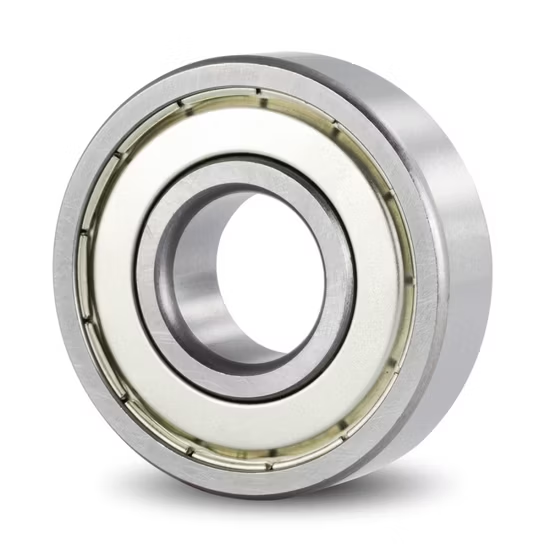


NACHI 6201 Deep Groove Ball Bearing — base designation with open configuration requiring external sealing and lubrication in the housing design.
Verified Batch Traceability — Every NACHI 6201 deep groove ball bearing we dispatch includes a scannable QR code linked directly to the manufacturer's official authentication database.
| Parameter | Value |
|---|---|
| Designation | NACHI 6201 |
| Bearing Type | Deep Groove Ball Bearing |
| Bore Diameter (d) | 12 mm |
| Outside Diameter (D) | 32 mm |
| Width (B) | 10 mm |
| Seal or Shield Type | Open |
| Noise and Vibration Level | Standard (Z1V1 to Z4V4 available with specific suffixes) |
| Material | High-carbon chromium bearing steel |
| Cage Material | Pressed steel |
| Clearance Class | CN (Standard) |
| Precision Class | P0 (Standard) |
| HS Code | 848210 |
| Industry | Typical Applications |
|---|---|
| Electric Motors | Small to medium-sized motor rotors and stator end-shields |
| Industrial Gearboxes | High-speed input shafts and intermediate support journals |
| Automotive Systems | Alternator pulleys, idler tensioners, and auxiliary drive components |
| General MRO | Conveyor pulley shafts, pump impellers, and household appliance spindles |
Matching the base number is only the first step in preventing thermal binding.
Sourcing a NACHI 6201 deep groove ball bearing based solely on the core digits often leads to field failures when the operating environment demands specific internal clearances or shielding. We frequently inspect replaced units where the basic dimension matched perfectly, yet the wrong internal geometry caused excessive friction and subsequent cage failure. Procurement teams often overlook that an open bearing requires a pristine housing, whereas contaminated environments demand shielded or sealed variants to protect the raceways . Ignoring these application-specific suffixes turns a precision component into a critical point of failure.
Selecting the correct configuration requires looking beyond the catalog number to the actual physical environment. When we review requisitions for this NACHI 6201 deep groove ball bearing, we cross-reference the equipment's operating temperature and contamination levels to determine if the open design is sufficient or if a sealed variant is necessary. Our technical team evaluates the specific radial loads and rotational speeds to ensure the standard pressed steel cage and CN clearance will maintain the optimal oil film thickness during continuous operation.
High-speed electric motor applications generate significant internal heat, which directly impacts the internal clearance of the bearing. If the thermal expansion of the shaft and housing is not accounted for, a standard clearance bearing can lose its internal gap, leading to excessive preload and rapid temperature spikes. Furthermore, open bearings rely entirely on the housing's lubrication system; if the external grease supply is compromised or contaminated with particulate matter, the rolling elements will suffer from abrasive wear . Proper sealing and clearance selection are therefore non-negotiable for sustained reliability.
The 12 mm bore and 32 mm outside diameter of this designation make it a staple for compact, high-speed rotational assemblies. The standard pressed steel cage provides a low-friction interface suitable for the high rotational speeds typical in electric motors, minimizing centrifugal forces on the rolling elements. As an open type, it offers the lowest possible friction torque, but it strictly requires a clean, well-sealed housing environment to prevent ingress of dust or moisture. The deep groove raceway geometry is engineered to handle predominantly radial loads while accommodating moderate axial thrust in both directions, making it highly versatile for general industrial machinery.
Installing a bearing with mismatched internal parameters inevitably leads to unplanned downtime and cascading mechanical damage. When an open bearing is forced into a contaminated environment without proper housing seals, abrasive particles score the raceways, drastically reducing the fatigue life. Similarly, ignoring thermal expansion requirements can cause the bearing to seize on the shaft, resulting in catastrophic damage to the motor end-bells and voiding equipment warranties . These failures always cost significantly more than the initial price difference of a correctly specified component.
We prevent cross-reference errors by verifying not just the base number, but the exact clearance, cage material, and precision requirements of your specific machinery. Unlike suppliers who simply ship the base designation, we review your application parameters to ensure the internal geometry matches the thermal and load profile of your equipment. Every shipment is backed by authorized distribution channels, guaranteeing that the metallurgy and dimensional tolerances meet the manufacturer's exact specifications. We also provide comprehensive cross-brand interchange support, ensuring you get the right technical equivalent if your preferred brand faces supply constraints.
To ensure this bearing meets your exact operational demands, please provide the specific radial and axial loads, operating speeds, and expected temperature ranges. Sharing the OEM equipment number or the original manufacturer's part number allows our engineering team to perform a precise cross-reference and verify the required internal clearance. This technical data enables us to calculate the expected L10 life and confirm the optimal configuration for your machinery.
Q: How can I verify the authenticity of the NACHI 6201 deep groove ball bearing I receive?
A: Every bearing we supply features a unique QR code on the packaging. You can scan this code using the official manufacturer application to instantly verify the production batch, origin, and authenticity. This direct digital traceability ensures you are installing genuine components and protects your equipment from the severe risks associated with counterfeit bearings featuring soft inner rings.
Q: Why is it critical to check suffixes when cross-referencing this bearing?
A: The base number only defines the physical dimensions. If your original equipment requires a specific internal clearance for thermal expansion or a shielded design for contamination protection, installing a standard open bearing with normal clearance will lead to rapid failure. We cross-reference the complete designation, including all suffixes, to guarantee exact functional equivalence.
Q: What are the operational differences between Z1V1 and Z4V4 noise levels?
A: These designations classify the acoustic and vibration signatures of the bearing. Z1V1 represents standard commercial grades suitable for general machinery, while Z4V4 indicates ultra-precision grinding and stringent assembly controls required for high-end electric motors and sensitive appliances where operational silence and minimal vibration are critical performance parameters.
Q: When should I choose an open bearing over a sealed variant?
A: Open bearings generate less friction and run cooler, making them ideal for high-speed applications where the housing provides adequate sealing and continuous, clean lubrication. If the environment is dusty, wet, or lacks a reliable external grease supply, a sealed or shielded variant is necessary to protect the internal rolling elements from abrasive wear and corrosion.
Q: How do you ensure quality consistency between sample and bulk orders?
A: We source all quantities directly from authorized manufacturer channels, meaning both sample and bulk orders originate from the same certified production facilities. We provide identical documentation, including batch traceability and inspection reports, for every shipment, ensuring the metallurgical and dimensional quality remains strictly consistent regardless of the order volume.
Our 5-step process ensures every order is engineered, validated, and supported for optimal performance.
Technical needs assessment
Custom specifications
Free samples for $50k+
Pre-shipment inspection
On-site & predictive
Our certified engineers respond within 24 hours with detailed technical specifications, pricing, and lead time information.