01
Consultation
Technical needs assessment

![7036 CD/P4a Angular Contact Ball Bearing High Speed Super Precision [WARN] draft identifier mismatch - 1](https://skfiso.com/wp-content/uploads/2026/09/7036-cd-p4a-angular-contact-ball-bearing-high-speed-super-precision-warn-draft-identifier-mismatch-b44c9e.avif)
![7036 CD/P4a Angular Contact Ball Bearing High Speed Super Precision [WARN] draft identifier mismatch - 2](https://skfiso.com/wp-content/uploads/2026/09/7036-cd-p4a-angular-contact-ball-bearing-high-speed-super-precision-warn-draft-identifier-mismatch-6f8304.avif)
![7036 CD/P4a Angular Contact Ball Bearing High Speed Super Precision [WARN] draft identifier mismatch - 3](https://skfiso.com/wp-content/uploads/2026/09/7036-cd-p4a-angular-contact-ball-bearing-high-speed-super-precision-warn-draft-identifier-mismatch-546997.avif)
![7036 CD/P4a Angular Contact Ball Bearing High Speed Super Precision [WARN] draft identifier mismatch - 4](https://skfiso.com/wp-content/uploads/2026/09/7036-cd-p4a-angular-contact-ball-bearing-high-speed-super-precision-warn-draft-identifier-mismatch-bac90b.avif)
![7036 CD/P4a Angular Contact Ball Bearing High Speed Super Precision [WARN] draft identifier mismatch - 5](https://skfiso.com/wp-content/uploads/2026/09/7036-cd-p4a-angular-contact-ball-bearing-high-speed-super-precision-warn-draft-identifier-mismatch-e83b72.avif)
![7036 CD/P4a Angular Contact Ball Bearing High Speed Super Precision [WARN] draft identifier mismatch - 6](https://skfiso.com/wp-content/uploads/2026/09/7036-cd-p4a-angular-contact-ball-bearing-high-speed-super-precision-warn-draft-identifier-mismatch-d8c7c6.avif)
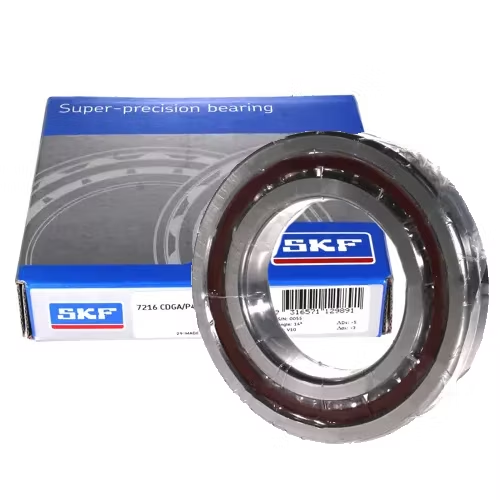
7036 CD/P4a Angular Contact Ball Bearing utilizes a 15° contact angle to minimize friction heat during high-speed rotation, while P4a class accuracy ensures strict dimensional control for machine tool spindles and precision equipment.
Multi-brand authorized coverage — source genuine equivalents for your 7036 CD/P4a angular contact ball bearing requirements in a single consolidated shipment without coordinating multiple vendors.
| Parameter | Value |
|---|---|
| Designation | 7036 CD/P4a |
| Bearing Type | Angular Contact Ball Bearing |
| Contact Angle | 15° |
| Precision Class | P4a |
| Material | Bearing Steel |
| Vibration Level | Z1V1 / Z2V2 / Z3V3 |
| Origin | Germany / Japan / Sweden / Malaysia / China |
| Industry | Typical Applications |
|---|---|
| Machine Tool Manufacturing | High-speed machining center spindles and precision grinding wheel heads |
| Robotics and Automation | High-precision rotary joints and articulated arm actuators |
| Fluid Machinery | High-speed centrifugal pump shafts and compressor rotors |
| Precision Equipment | Optical measuring instruments and semiconductor wafer handling systems |
Mismatched clearance and incorrect contact angles generate internal heat that expands the spindle housing long before the rolling elements fatigue.
I have seen too many high-speed spindles seize on shop floors because a standard P0 grade was swapped in where P4a was strictly required, or a 25° contact angle was used instead of the specified 15° design. The resulting friction heat causes thermal binding that ruins machining tolerances and destroys the shaft . Procurement teams often match the base number but overlook the critical suffixes, leading to catastrophic downtime that could have been prevented with exact cross-reference alignment.
The 7036 CD/P4a angular contact ball bearing utilizes a 15° contact angle specifically optimized for high-speed, light-to-moderate axial load applications. This geometry minimizes sliding friction between the rolling elements and raceways, which is critical for maintaining thermal stability in machine tool spindles. Our technical team verifies these exact geometric suffixes during cross-brand interchange to ensure your spindle maintains its designed rigidity and speed capability.
High-speed spindle applications demand strict control over operating temperatures and vibration to maintain sub-micron machining tolerances. A 15° contact angle generates considerably less friction heat than larger angles, preventing the thermal expansion that causes internal preload to spike and cages to fail. Combined with Z1V1 to Z3V3 vibration limits, this configuration ensures smooth rotation and protects the spindle from destructive harmonic resonance .
The P4a designation indicates extremely tight dimensional and running accuracy tolerances, ensuring the inner and outer rings maintain exact concentricity under high rotational speeds. The CD suffix confirms the 15° optimized internal design, which balances axial load capacity with the low-friction requirements of high-speed operation. Together, these suffixes guarantee that the bearing can sustain the rigorous demands of precision grinding and milling without generating excessive heat or compromising the spindle's rotational accuracy.
Substituting a base-number match that lacks the correct P4a precision or 15° contact angle inevitably leads to premature thermal seizure and scrapped production batches. The resulting unplanned downtime and replacement of damaged spindle shafts far exceed the initial savings of using an incorrect variant. Following the failure analysis frameworks in ISO 15243, these thermal failures are entirely preventable through rigorous suffix verification .
We prevent the common disaster of installing CN clearance where C3 was required for thermal expansion by strictly auditing every suffix combination before shipment. Our authorized multi-brand coverage allows us to source the exact 7036 CD/P4a angular contact ball bearing or its precise equivalent from top-tier manufacturers in one order. We provide full batch traceability and cross-reference validation that checks internal design and contact angles, not just the basic designation. Every shipment includes factory documentation proving the P4a running accuracy, ensuring your equipment receives exactly what the OEM specified.
To ensure optimal spindle performance, please provide your specific radial and axial load profiles, maximum operating speeds, and target operating temperatures for L10 life recalculation. If you are replacing an existing unit, share the exact OEM equipment number and current spindle housing dimensions so our engineering team can perform a comprehensive cross-reference review. This technical validation ensures the selected configuration perfectly aligns with your unique machining environment and prevents costly integration errors.
Q: Why must the CD and P4a suffixes be matched exactly during cross-referencing?
A: Matching only the base number ignores critical internal geometry. The CD suffix ensures the 15° contact angle required for high-speed thermal stability, while P4a guarantees the tight running accuracy needed for precision spindles. Substituting different suffixes alters internal friction and clearance, leading to rapid thermal binding and catastrophic spindle failure under high RPM.
Q: What is the practical difference between standard P4 and the P4a precision class?
A: While both fall under the ISO 492 Class 4 umbrella, P4a specifies significantly tighter running accuracy and geometric tolerances, particularly regarding bore and outer diameter variations. This enhanced precision minimizes spindle runout and vibration at high speeds, which is absolutely critical for achieving superior surface finishes in precision grinding and high-speed milling applications.
Q: How does the 15° contact angle affect spindle performance compared to larger angles?
A: A 15° contact angle provides an optimal balance for high-speed applications by minimizing sliding friction and the resulting heat generation. Larger angles increase axial rigidity but generate excessive thermal growth at high RPMs. The 15° design maintains thermal stability, preventing the internal preload from spiking and protecting the cage from premature failure.
Q: How can I verify the authenticity and precision grade of the delivered bearings?
A: Every shipment includes a Certificate of Conformity and original batch traceability documents. You can verify authenticity by scanning the QR codes using the manufacturer's official mobile application. Additionally, we provide dimensional and running accuracy inspection reports that explicitly confirm the P4a tolerances and 15° contact angle before the bearings leave our facility.
Our 5-step process ensures every order is engineered, validated, and supported for optimal performance.
Technical needs assessment
Custom specifications
Free samples for $50k+
Pre-shipment inspection
On-site & predictive
Our certified engineers respond within 24 hours with detailed technical specifications, pricing, and lead time information.


![7212 Becbm Angular Contact Ball Bearing High Speed Precision [WARN] draft identifier mismatch](https://skfiso.com/wp-content/uploads/2026/09/7212-becbm-angular-contact-ball-bearing-high-speed-precision-warn-draft-identifier-mismatch-4666a2.avif)