01
Consultation
Technical needs assessment


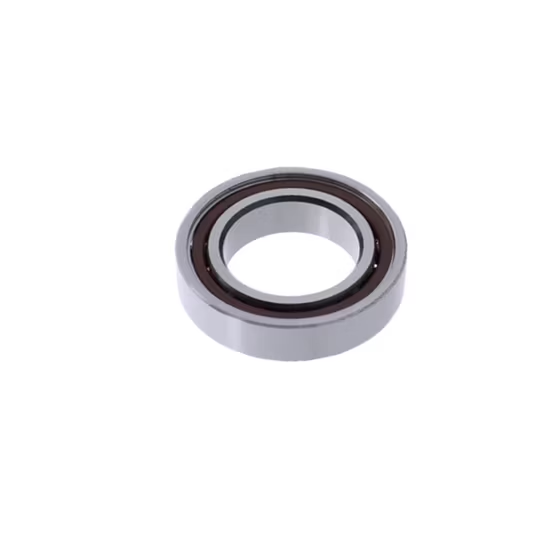
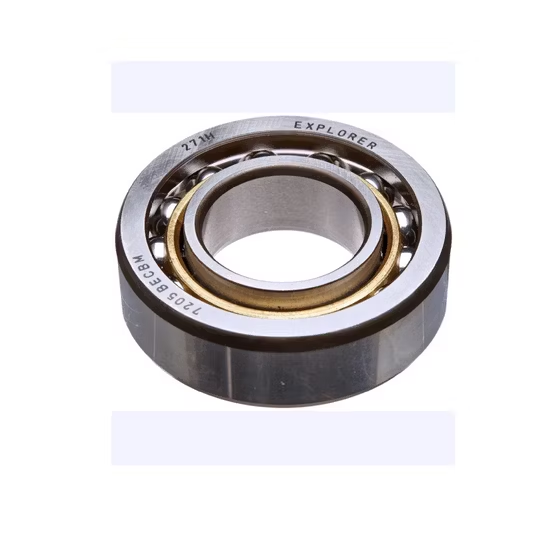
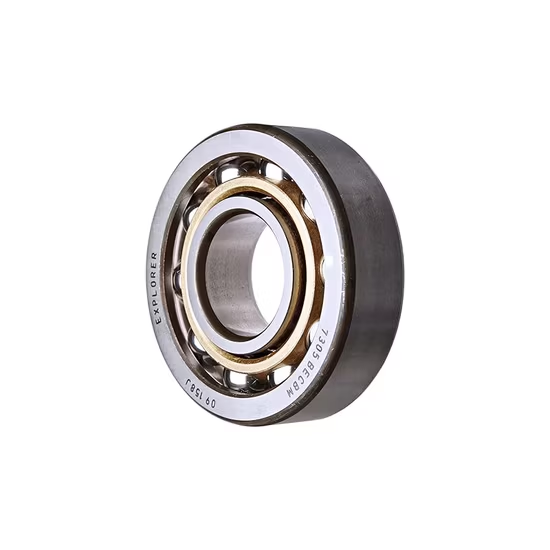
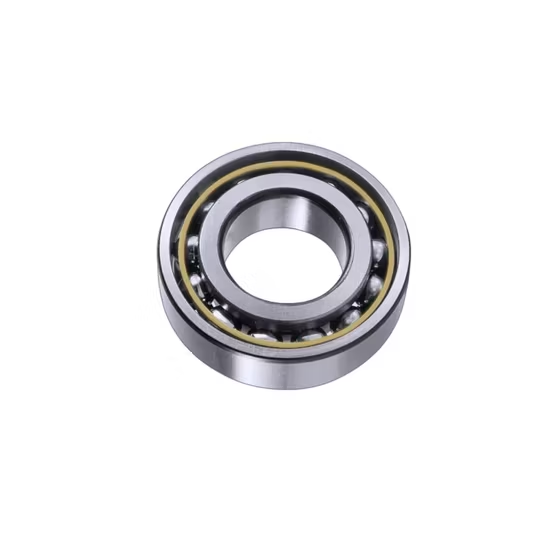
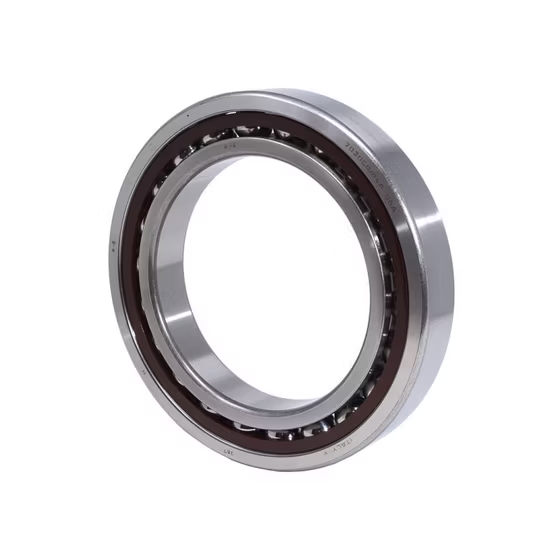
7025 CD/P4a Angular Contact Ball Bearing — features a 15° contact angle for optimized high-speed performance and reduced friction heat. The P4a precision class guarantees strict dimensional and running accuracy for demanding machine tool spindles.
Unified Multi-Brand Sourcing — Procure your 7025 CD/P4a angular contact ball bearing alongside other spindle components in a single consolidated shipment, eliminating multi-vendor coordination.
| Parameter | Value |
|---|---|
| Designation | 7025 CD/P4a |
| Bearing Type | Angular Contact Ball Bearing |
| Material | Bearing Steel |
| Contact Angle | 15° |
| Precision Class | P4a |
| Origin | Germany / Japan / Sweden / Malaysia / China |
Note: The alternate string 7025 Cdga/P4a contains an unverified suffix requiring manufacturer catalog confirmation before procurement.
| Industry | Typical Applications |
|---|---|
| Machine Tool Manufacturing | High-speed milling spindle front and rear journal supports |
| Precision Equipment | Coordinate measuring machine rotary table axial positioning |
| Industrial Robotics | High-rigidity wrist joint rotary actuators |
| Fluid Machinery | High-speed centrifugal pump thrust compensation assemblies |
Base numbers match, but ignoring the 15° contact angle and P4a running accuracy guarantees thermal binding and premature failure.
At the Hanover trade fair, I constantly see procurement teams focusing solely on the 7025 basic designation while completely missing the critical CD and P4a suffixes. This oversight leads to catastrophic results on the shop floor. I once investigated a CNC milling spindle that suffered from severe high-frequency chatter marks, ruining an entire batch of aerospace workpieces. The root cause was a cross-reference error where a standard P5 bearing was installed instead of the required P4a precision class, compounded by an incorrect contact angle that caused thermal seizure under high-speed operation . When sourcing a 7025 CD/P4a angular contact ball bearing, exact suffix alignment is non-negotiable for maintaining micron-level spindle stability.
Selecting the correct geometry is critical for machine tool spindles operating at high rotational speeds. The 7025 CD/P4a angular contact ball bearing utilizes a 15° optimized contact angle design, which significantly reduces friction heat generation compared to steeper 25° or 40° alternatives. This specific geometry allows the bearing to sustain high radial rigidity while accommodating the axial thrust generated by cutting forces, ensuring the spindle maintains its rotational accuracy during heavy metal removal operations.
Machine tool spindles generate immense internal heat, which directly impacts internal clearance and lubricant film thickness. If the thermal expansion is not properly managed through correct precision selection, the bearing will experience preload loss or excessive tightening. The P4a classification ensures exceptionally tight dimensional and running accuracy, minimizing vibration and heat generation at elevated speeds . Proper oil-air or oil-jet lubrication is mandatory to flush away friction heat and prevent cage degradation in these high-speed precision environments.
The "CD" suffix explicitly defines the 15° contact angle, optimizing the load distribution between the inner and outer raceways for high-speed capability. The "P4a" designation goes beyond standard P4 dimensional tolerances; it mandates enhanced running accuracy, which is vital for minimizing radial and axial runout in precision grinding or milling spindles. Constructed from high-purity bearing steel, the raceways and rolling elements provide the structural rigidity necessary to withstand combined radial and axial loads without elastic deformation that would otherwise compromise surface finish quality.
Substituting a standard precision bearing in a high-speed spindle application leads to unplanned downtime and catastrophic damage to the spindle shaft and housing. When running accuracy falls short of P4a requirements, the resulting vibration accelerates fatigue spalling on the raceways. According to failure analysis frameworks, a significant share of premature spindle failures stems from installing bearings with mismatched contact angles or inadequate precision grades, ultimately voiding the machine tool warranty and halting production lines .
We eliminate the risk of receiving counterfeit bearings with soft inner rings that pass casual visual inspections but fail under spindle loads. Our technical team verifies that cross-references align perfectly on the 15° contact angle and P4a running accuracy, not just the base 7025 number. Every 7025 CD/P4a angular contact ball bearing we supply features full batch traceability back to the manufacturer's production facilities. We provide application-based selection reviews to ensure the bearing matches your specific spindle speed and load profile, preventing the costly installation of incorrect clearance classes.
To ensure optimal spindle performance, please provide your specific radial and axial load profiles, maximum operating speeds, and target operating temperatures. Sharing the OEM equipment number or existing spindle drawing allows our engineering team to perform a comprehensive cross-reference review and L10 life calculation. This technical validation ensures the selected bearing perfectly matches your machine tool's dynamic requirements.
Q: How does P4a precision differ from standard P4 for spindle applications?
A: While both denote high precision, P4a enforces stricter running accuracy tolerances, specifically targeting radial and axial runout. This enhanced control is critical for high-speed machine tool spindles where even microscopic deviations cause visible chatter marks on machined surfaces and accelerate fatigue.
Q: Why must the 15° contact angle be strictly maintained in cross-references?
A: The 15° angle optimizes the bearing for high-speed operation by minimizing friction heat and centrifugal forces on the rolling elements. Substituting a 25° or 40° contact angle alters the internal load distribution, leading to excessive thermal expansion, preload loss, and eventual seizure in high-speed spindle applications.
Q: How can I verify the authenticity of the supplied bearings?
A: We provide full batch traceability and a Certificate of Conformity for every shipment. You can independently verify the authenticity by scanning the QR codes on the packaging using the official mobile applications provided by the original bearing manufacturers, ensuring the product is genuine.
Q: What application parameters are needed for a technical selection review?
A: Our engineering team requires the spindle's maximum RPM, continuous and peak radial/axial loads, operating temperature range, and lubrication method. Providing the OEM machine model or spindle drawing also enables precise cross-referencing to ensure exact suffix alignment.
Our 5-step process ensures every order is engineered, validated, and supported for optimal performance.
Technical needs assessment
Custom specifications
Free samples for $50k+
Pre-shipment inspection
On-site & predictive
Our certified engineers respond within 24 hours with detailed technical specifications, pricing, and lead time information.
![7026 CD/P4a Angular Contact Bearing High Speed Super Precision [WARN] draft identifier mismatch](https://skfiso.com/wp-content/uploads/2026/09/7026-cd-p4a-angular-contact-bearing-high-speed-super-precision-warn-draft-identifier-mismatch-20c7ea.avif)

![708 CD/P4a Angular Contact Ball Bearing High Speed Super Precision [WARN] draft identifier mismatch](https://skfiso.com/wp-content/uploads/2026/09/708-cd-p4a-angular-contact-ball-bearing-high-speed-super-precision-warn-draft-identifier-mismatch-e33b16.avif)
