01
Consultation
Technical needs assessment


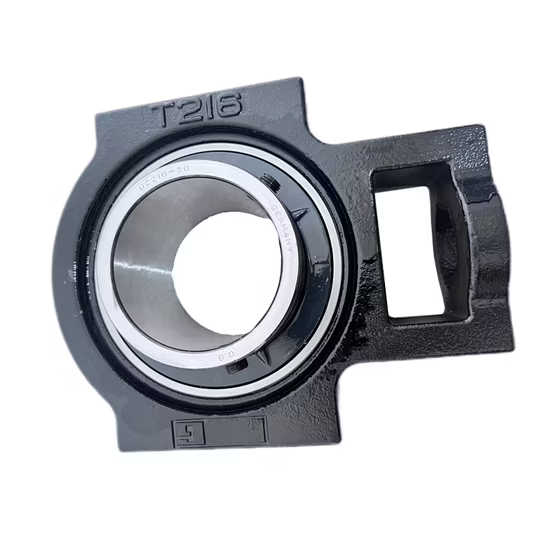
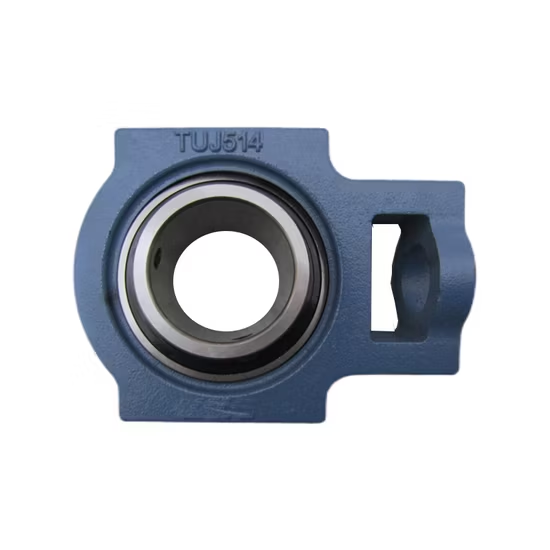

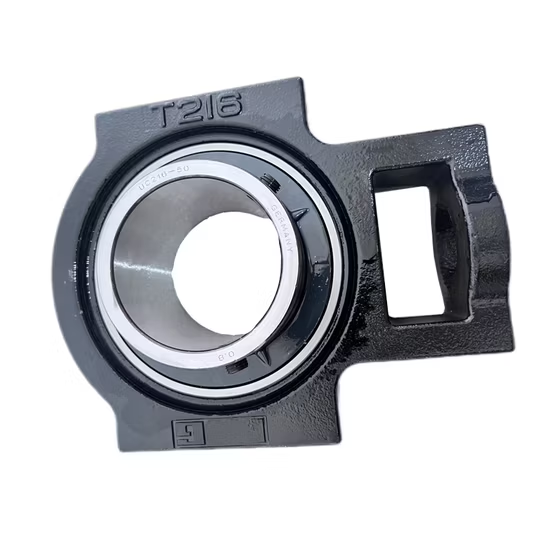
UCT214-43 Take-up Pillow Block Bearing 2-11/16" Bore — cast iron take-up housing with deep groove raceway insert for stable conveyor tensioning.
Full Batch Traceability — Every UCT214-43 unit ships with manufacturer lot documentation and QR verification to confirm origin and authenticity.
| Parameter | Value |
|---|---|
| Designation | UCT214-43 |
| Bearing Type | Take-up Pillow Block Bearing |
| Bore Diameter (d) | 2-11/16" |
| Housing Series | Light series / standard duty |
| Housing Type | Take-up unit |
| Material Options | Available in cast iron, stamped steel, or stainless steel variants |
| Seal Type Options | Open, shielded, or contact seal variants available |
| Clearance Options | CN, C3, or C4 clearance classes available |
| Origin | Germany / Japan / Sweden / Malaysia / China |
| HS Code | 8483200000 |
| Industry | Typical Applications |
|---|---|
| Agricultural Machinery | Combine harvester grain auger tensioners, tractor PTO shaft supports |
| Conveyor Systems | Belt conveyor take-up frames, bucket elevator tail shaft tensioners |
| Material Handling | Aggregate crusher screen deck adjusters, bulk loader belt trackers |
Matching the base number is never enough for reliable tensioner operation.
Purchasing teams often approve replacements based solely on the UCT214 prefix, ignoring the critical bore diameter and internal clearance suffixes. In agricultural and conveyor environments, this oversight leads to rapid field failures. A unit with standard clearance installed in a high-temperature harvester application will experience thermal binding, while an incorrectly sized bore causes micro-movements that destroy the shaft. We prevent these costly mistakes by verifying every suffix against the actual operating conditions before shipment.
Take-up units endure constant radial loads combined with axial shocks from belt starting and stopping. The UCT214-43 take-up pillow block bearing provides the necessary radial support while allowing axial adjustment along the guide rails. Our technical team reviews your specific load profiles to ensure the selected insert bearing internal geometry and housing strength align with the tensioner demands, preventing housing deformation under peak startup torque.
Tensioner positions are highly exposed to abrasive crop dust, aggregate particles, and moisture ingress. Standard non-contact seals often fail to keep contaminants out, leading to raceway scoring and premature grease degradation. Furthermore, outdoor equipment faces significant temperature swings that affect internal clearance; a unit assembled with standard clearance in the morning may bind completely by midday when operating temperatures rise. Selecting the correct seal friction profile and thermal clearance class is mandatory to avoid unplanned downtime.
The UCT prefix identifies a take-up unit housing designed to slide within guide channels for belt or chain tensioning. The number 2 denotes a light to standard duty housing series, balancing weight and structural rigidity for most material handling applications. The 14 indicates the basic insert bearing size series, dictating the outer diameter and load capacity. Finally, the -43 suffix specifies the exact inch bore diameter of 2-11/16", which must match the shaft precisely to prevent fretting corrosion and locking collar slippage during operation.
Installing a take-up unit with the wrong internal clearance or seal type inevitably leads to catastrophic seizure or shaft damage. When thermal expansion eliminates internal clearance, the rolling elements skid, generating excessive heat that destroys the cage and welds the inner ring to the shaft. This turns a simple tensioner adjustment into a major mechanical rebuild, voiding equipment warranties and causing severe production delays. Relying on ISO 15243 failure analysis frameworks, we identify these root causes and supply correctly specified replacements.
We do not just swap part numbers; we validate the complete suffix string to ensure the seal type and clearance match your specific environment. While others might ship a standard CN clearance unit for a high-heat conveyor, we verify if a C3 clearance is required to accommodate thermal expansion. Our authorized multi-brand network means we can source genuine equivalents from SKF, FAG, NSK, NTN, or TIMKEN with identical internal geometries, eliminating the long lead times typically associated with niche inch-bore take-up units.
To ensure we supply the exact UCT214-43 configuration your equipment requires, please share the operating radial and axial loads, continuous running speed, and ambient temperature range. If you are replacing an existing unit, providing the OEM equipment model number allows our engineering team to cross-reference the original factory specifications and verify the required seal and clearance suffixes. This technical review guarantees the replacement integrates flawlessly into your tensioner assembly without modification.
Q: Why does the -43 suffix matter if the base UCT214 number matches?
A: The -43 suffix dictates the exact 2-11/16" inch bore diameter. Ordering a UCT214 with a different suffix, such as -44 or -47, results in a bore size that will not fit your shaft. Even a slight mismatch causes the locking collar to fail, leading to inner ring creep, shaft scoring, and eventual tensioner seizure under operational loads.
Q: How do I choose the right seal for a dusty agricultural environment?
A: For high-dust environments like combine harvesters, we recommend triple-lip contact seals rather than standard shields or single-lip seals. Contact seals provide superior exclusion of fine crop particulates and moisture, protecting the internal raceway and grease. We will review your specific contamination level to recommend the optimal seal friction and material combination.
Q: Can I verify the authenticity of the bearing before installation?
A: Yes, every genuine unit we supply features a unique QR code linked to the manufacturer's official verification app. Scanning this code confirms the production batch, origin, and authenticity, protecting your operation from counterfeit units that often feature soft inner rings and substandard heat treatment, which fail rapidly under tensioner loads.
Q: What is the difference between UCT214-43 and UCT215-47?
A: These designations represent entirely different physical sizes. The 14 versus 15 indicates a different bearing outer diameter and load capacity series, while the -43 versus -47 specifies different inch bore diameters. They are not interchangeable; attempting to swap them will result in housing fitment issues and severe misalignment in the take-up guide rails.
Our 5-step process ensures every order is engineered, validated, and supported for optimal performance.
Technical needs assessment
Custom specifications
Free samples for $50k+
Pre-shipment inspection
On-site & predictive
Our certified engineers respond within 24 hours with detailed technical specifications, pricing, and lead time information.