01
Consultation
Technical needs assessment
![Nk14/16 Needle Roller Bearing 14x20x12mm Genuine Authorized Distributor [WARN] draft identifier mismatch - 1](https://skfiso.com/wp-content/uploads/2026/09/nk14-16-needle-roller-bearing-14x20x12mm-genuine-authorized-distributor-warn-draft-identifier-mismatch-07d5a8.avif)
![Nk14/16 Needle Roller Bearing 14x20x12mm Genuine Authorized Distributor [WARN] draft identifier mismatch - 2](https://skfiso.com/wp-content/uploads/2026/09/nk14-16-needle-roller-bearing-14x20x12mm-genuine-authorized-distributor-warn-draft-identifier-mismatch-667ec5.avif)
![Nk14/16 Needle Roller Bearing 14x20x12mm Genuine Authorized Distributor [WARN] draft identifier mismatch - 3](https://skfiso.com/wp-content/uploads/2026/09/nk14-16-needle-roller-bearing-14x20x12mm-genuine-authorized-distributor-warn-draft-identifier-mismatch-71c2e3.avif)
![Nk14/16 Needle Roller Bearing 14x20x12mm Genuine Authorized Distributor [WARN] draft identifier mismatch - 4](https://skfiso.com/wp-content/uploads/2026/09/nk14-16-needle-roller-bearing-14x20x12mm-genuine-authorized-distributor-warn-draft-identifier-mismatch-eb7a72.avif)
![Nk14/16 Needle Roller Bearing 14x20x12mm Genuine Authorized Distributor [WARN] draft identifier mismatch - 5](https://skfiso.com/wp-content/uploads/2026/09/nk14-16-needle-roller-bearing-14x20x12mm-genuine-authorized-distributor-warn-draft-identifier-mismatch-2bef78.avif)
![Nk14/16 Needle Roller Bearing 14x20x12mm Genuine Authorized Distributor [WARN] draft identifier mismatch - 6](https://skfiso.com/wp-content/uploads/2026/09/nk14-16-needle-roller-bearing-14x20x12mm-genuine-authorized-distributor-warn-draft-identifier-mismatch-578940.avif)
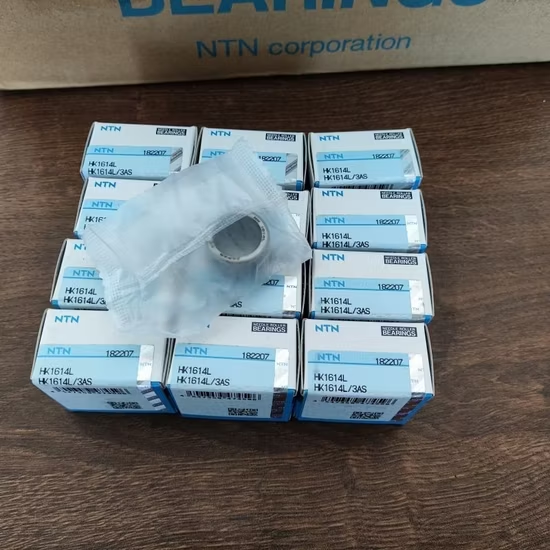
Nk14/16 Needle Roller Bearing — open-type radial needle roller design without inner ring, built from bearing steel for high radial load capacity in compact envelope spaces.
Every cross-reference is validated for clearance, cage material, and precision alignment before shipment confirmation.
Cross-Reference Alignment — We verify clearance, cage material, and precision suffixes to prevent thermal binding during Nk14/16 needle roller bearing replacement.
| Parameter | Value |
|---|---|
| Designation | Nk14/16 |
| Product Type | Needle Roller Bearing |
| Load Direction | Radial |
| Roller Diameter (Fw) | 14 mm |
| Outside Diameter (D) | 20 mm |
| Width (B) | 16 mm |
| Style Options | Without Inner Ring, With Inner Ring |
| Type | Open |
| Material | Bearing Steel |
| Customization | Available in stainless steel variants upon request |
| Industry | Typical Applications |
|---|---|
| Industrial Gearboxes | Planetary gear shafts and high-speed intermediate shafts |
| Machine Tool Spindles | Secondary support shafts and compact feed mechanisms |
| Automotive Components | Rocker arm pivots and transmission support journals |
| Agricultural Machinery | PTO shaft joints and compact harvester drive linkages |
Matching the base designation without verifying the internal geometry is a primary cause of sudden cage fragmentation. When an open-type compact radial bearing is installed in a high-vibration gearbox without confirming the exact cage material and clearance class, the rolling elements experience localized stress concentrations. This leads to premature fatigue and unplanned downtime, a failure mode frequently documented under . Sourcing the exact Nk14/16 needle roller bearing requires looking beyond the stamped outer ring to ensure the internal design matches the operational envelope.
Selecting the correct configuration for this compact radial component depends heavily on the hardness of the mating shaft. Our technical review ensures that whether your application requires the inner ring variant to protect softer shaft materials or the inner-ring-less design for maximum rigidity, the selected Nk14/16 needle roller bearing aligns perfectly with your specific radial load and spatial constraints.
In compact gearboxes, high rotational speeds generate significant friction heat, demanding precise clearance selection to accommodate thermal expansion. Open-type designs require a continuous flow of clean lubricant to prevent roller skidding and cage wear. If the operating environment introduces particulate contamination, the lack of integrated seals means external housing seals must be meticulously maintained to prevent abrasive ingress, as outlined in .
The NK prefix indicates a design without an inner ring, relying on the shaft itself as the inner raceway, which demands a hardened and ground journal surface. The numerical sequence defines the 14 mm roller diameter and the 16 mm width, dictating the radial load capacity within the compact 20 mm outer envelope. Because this is an open type, it permits superior heat dissipation and external lubrication flow compared to sealed variants. When cross-referencing, confirming the exact cage material—whether pressed steel for standard speeds or machined brass for high-vibration environments—is critical to preventing structural fatigue.
Installing a standard clearance variant in an application that inherently requires a C3 expansion clearance leads to thermal binding once the gearbox reaches operating temperature. This internal preload eliminates the lubricant film, causing rapid roller skidding and catastrophic damage to the shaft journal. Such premature failures not only void equipment warranties but also result in extensive secondary damage to surrounding gears, emphasizing the need for strict adherence to .
We eliminate the risk of counterfeit components with soft inner rings by providing batch traceability directly from the manufacturer's production facilities. Our cross-brand interchange expertise ensures that equivalent alternatives match the exact cage material and clearance, not just the base dimensions. Every shipment includes dimensional verification to guarantee the 14 mm bore and 20 mm outer diameter meet strict tolerances. We support your MRO team with technical selection reviews to prevent mismatches in high-vibration agricultural or automotive applications.
To ensure optimal performance and longevity, please provide your specific radial load values, operating speeds, and continuous temperature ranges. Supplying the OEM equipment number or the exact spatial constraints of the housing allows our engineering team to verify the cross-reference and confirm the necessary clearance class. This technical alignment guarantees the selected component withstands your unique operational demands without premature degradation.
Q: Why must the cage material be verified when cross-referencing this designation?
A: Base number matches often overlook the internal cage design. A pressed steel cage might fail under the high-vibration conditions of a planetary gearbox, whereas a machined brass cage would endure. Verifying the cage material ensures the replacement Nk14/16 needle roller bearing survives the specific dynamic loads and prevents sudden fragmentation and unplanned equipment downtime.
Q: How do I determine if I need the variant with or without an inner ring?
A: The inner-ring-less design requires the shaft journal to be hardened and precision-ground to act as the raceway. If your shaft material is softer or lacks the required surface finish, you must select the variant with an inner ring. This prevents premature wear on the shaft and ensures the rolling elements maintain a proper lubricant film.
Q: What is the recommended lubrication approach for this open-type design?
A: Open designs rely entirely on the housing's external lubrication system. You must ensure a continuous supply of clean oil or grease to dissipate friction heat and prevent roller skidding. Since there are no integrated seals, maintaining the effectiveness of external housing seals is critical to keep abrasive contaminants away from the rolling elements.
Q: How does your team verify the authenticity of the supplied components?
A: We provide comprehensive batch traceability and a Certificate of Conformity for every order. You can verify the authenticity directly by scanning the QR code on the packaging using the manufacturer's official mobile application. This process confirms the origin and ensures the bearing steel meets the required metallurgical standards, eliminating the risk of counterfeit parts.
Our 5-step process ensures every order is engineered, validated, and supported for optimal performance.
Technical needs assessment
Custom specifications
Free samples for $50k+
Pre-shipment inspection
On-site & predictive
Our certified engineers respond within 24 hours with detailed technical specifications, pricing, and lead time information.
![Zarn 55115 Ltn Combined Needle Roller Bearing 55x115x82mm [WARN] draft identifier mismatch](https://skfiso.com/wp-content/uploads/2026/09/zarn-55115-ltn-combined-needle-roller-bearing-55x115x82mm-warn-draft-identifier-mismatch-e60599.avif)

