01
Consultation
Technical needs assessment

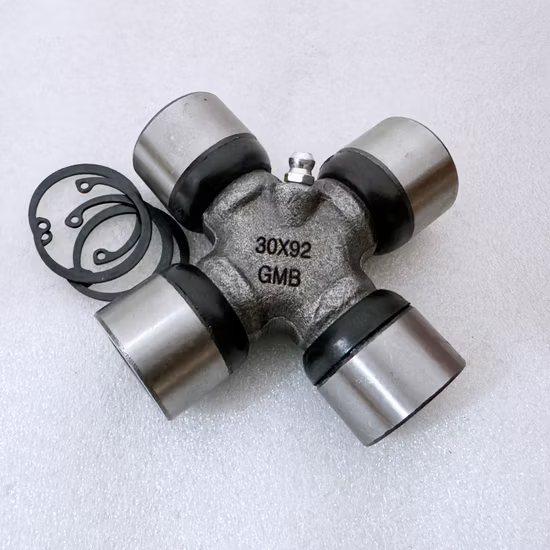
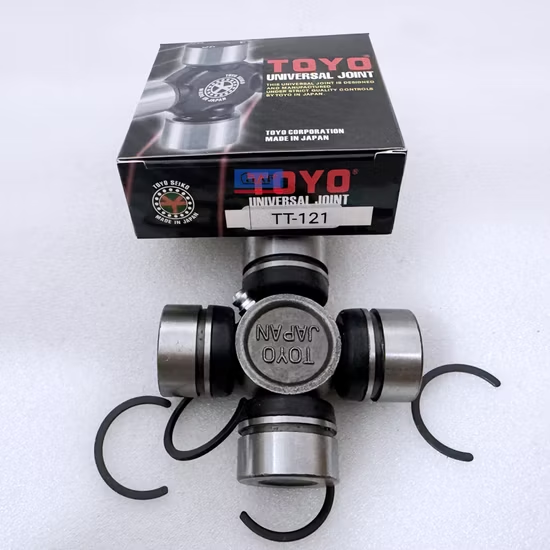


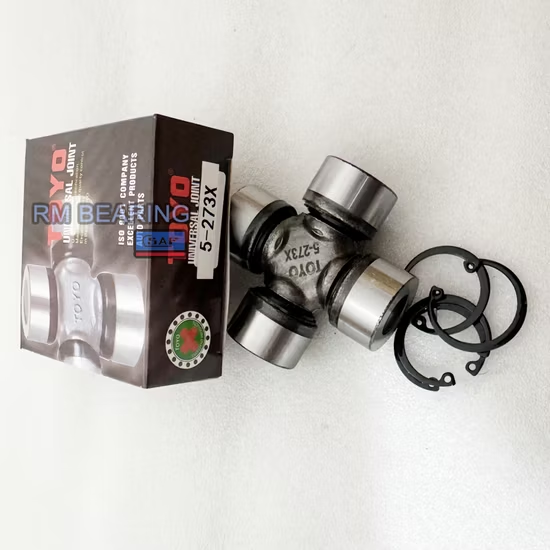
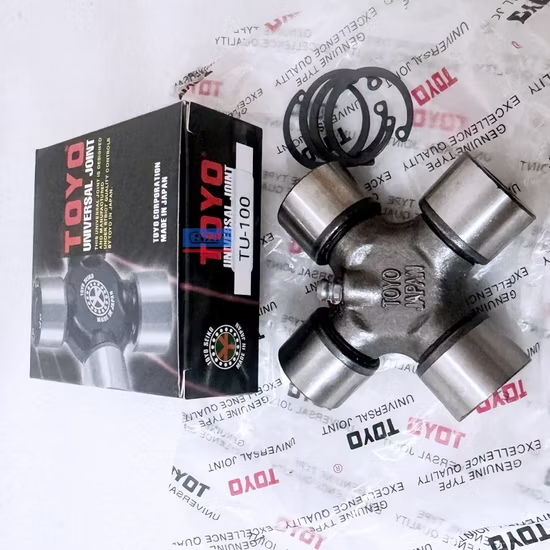
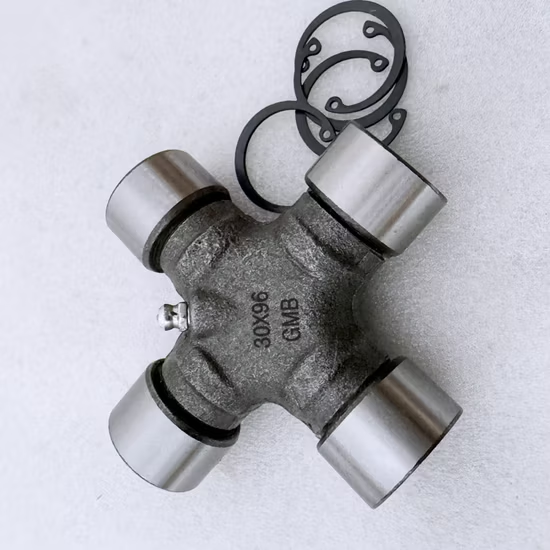
Guis-57 Universal Joint Cross Bearing cross-referenced to Uj321 for automotive wheel hubs and construction machinery.
Full Brand Authorization — consolidating mixed-brand drivetrain requirements into a single verified shipment without coordinating multiple suppliers.
| Parameter | Value |
|---|---|
| Designation | Guis-57 |
| Product Type | Universal Joint Cross Bearing |
| Cross-Reference | Uj321 |
| Material Options | Available in stainless steel or standard bearing steel variants |
| Structure | Single cross assembly |
| Certification | ISO |
| Industry | Typical Applications |
|---|---|
| Automotive & Heavy Vehicle Repair | Car wheel hub steering knuckles, heavy-duty drive shafts, steering column joints |
| Agricultural Machinery | Tractor PTO shafts, combine harvester driveline universals, implement hitch joints |
| Construction Machinery | Excavator swing gear drives, loader articulation joints, concrete mixer drum drives |
Internal material softening and microscopic dimensional deviations cause catastrophic joint seizure under peak torque.
In the Middle Eastern automotive aftermarket, I have inspected countless universal joint failures where the base designation matched perfectly, yet the cross journal seized inside the cap. The root cause is rarely the design itself. Counterfeit Guis-57 universal joint cross bearing assemblies often feature soft inner races and cloned QR codes that easily pass casual visual checks at the receiving dock. When these compromised components are subjected to the high-torque, high-temperature environment of a car wheel hub or a heavy-duty drivetrain, the needle rollers skew and bind. This leads to unplanned downtime and catastrophic damage to the surrounding yoke.
Selecting the correct Guis-57 universal joint cross bearing requires looking beyond the basic part number stamped on the yoke. Our technical team reviews the specific radial and axial loads, operating temperatures, and oscillation speeds of your automotive or agricultural equipment. By verifying the cross-reference to the Uj321 equivalent and checking the internal needle roller profile, we ensure the joint can handle the shock loads typical in heavy vehicle repair and construction machinery applications.
Universal joints in automotive wheel hubs and tractor PTO shafts endure severe combined loading, transitioning rapidly between driving and coasting torque. These shock loads demand high core toughness in the cross journal to prevent micro-fractures. Furthermore, friction within the needle roller caps generates significant heat. If the internal clearance is not properly matched to the thermal expansion of the yoke, the joint will thermally bind. Proper lubrication intervals and high-quality grease retention seals are critical to prevent abrasive dust from entering the cap, which rapidly accelerates wear and leads to premature failure.
The operational reliability of a universal joint cross depends heavily on the material and internal geometry. While standard bearing steel provides excellent core toughness and fatigue resistance for general automotive drivelines, stainless steel variants are available for agricultural and construction machinery exposed to moisture and corrosive fertilizers. The precision of the cross journal grinding directly dictates the load distribution across the needle rollers. Even microscopic deviations in the journal diameter or surface finish will cause edge loading, drastically reducing the service life of the joint under high-torque conditions.
Installing a non-verified cross bearing might save time initially, but the hidden costs are severe. A seized universal joint in a steering column or drive shaft can cause the yoke to fracture, leading to catastrophic damage to the vehicle's undercarriage and voiding equipment warranties. According to ISO 281 principles, the dynamic load rating is entirely dependent on correct alignment and lubrication; a counterfeit part with soft raceways will fail to meet these baseline requirements, resulting in frequent, unplanned maintenance stops that far exceed the cost of a genuine component.
We address the critical pain points of the automotive and heavy vehicle repair sectors by providing authorized coverage across all major international brands. When you order a Guis-57, we do not just match the base number; we verify the internal needle roller specifications and cap dimensions against OEM requirements. Our cross-reference expertise ensures that substituting with a Uj321 equivalent maintains the exact structural integrity needed for your specific yoke. Every batch is fully traceable to the manufacturer, eliminating the risk of refurbished or cloned parts entering your maintenance inventory.
To ensure the selected universal joint cross perfectly matches your drivetrain requirements, please provide the specific equipment model, yoke dimensions, and operating environment. Sharing details about the expected torque loads, oscillation speeds, and exposure to moisture or dust allows our engineering team to confirm the optimal material variant and internal clearance. Supplying the OEM equipment number enables us to perform a precise cross-reference verification, guaranteeing dimensional compatibility and long-term reliability.
Q: How can I verify the authenticity of a Guis-57 universal joint cross bearing before installation?
A: Authenticity is verified by scanning the manufacturer's QR code using the official brand application, which confirms the batch and lot traceability. Additionally, reviewing the provided material test report and dimensional inspection data ensures the cross journal hardness and needle roller fitment meet OEM specifications, effectively filtering out counterfeits with soft inner races.
Q: What dimensional details are critical when cross-referencing the Uj321 equivalent?
A: When cross-referencing to the Uj321, it is crucial to verify the exact cap diameter, overall cross width, and the presence of any snap ring grooves or zerk fitting locations. A mismatch in these structural dimensions, even if the base designation appears similar, will cause improper seating in the yoke, leading to cap walk-out or thermal binding under operational loads.
Q: How do stainless steel and standard bearing steel differ in universal joint applications?
A: Standard bearing steel offers superior core toughness and fatigue resistance for high-torque automotive drivelines. Stainless steel variants provide substantially higher resistance to moisture, corrosive fertilizers, and washdown environments, making them ideal for agricultural and construction machinery, though they may have different load capacity thresholds under extreme shock loading.
Q: What are the common failure modes of universal joint crosses under high torque?
A: Under high torque, common failure modes include needle roller skewing, edge loading due to yoke misalignment, and thermal seizure caused by inadequate lubrication or incorrect internal clearance. These issues often stem from compromised material hardness or dimensional inaccuracies in non-genuine parts, leading to catastrophic joint lock-up and yoke fracture.
Our 5-step process ensures every order is engineered, validated, and supported for optimal performance.
Technical needs assessment
Custom specifications
Free samples for $50k+
Pre-shipment inspection
On-site & predictive
Our certified engineers respond within 24 hours with detailed technical specifications, pricing, and lead time information.