01
Consultation
Technical needs assessment

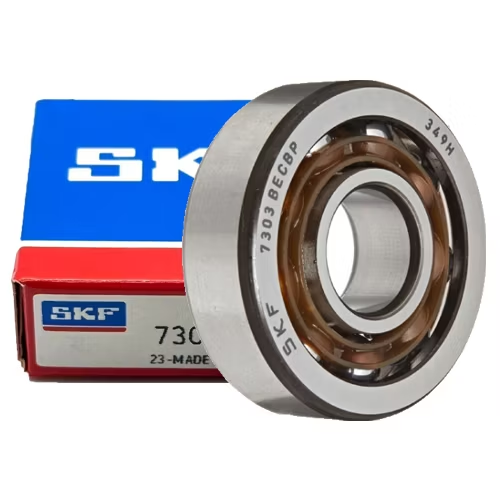


7016 CD/P4a Angular Contact Ball Bearing features a 15° contact angle to minimize friction heat during high-speed rotation, while P4A precision ensures strict running accuracy for demanding machine tool spindles.
Multi-Brand Authorized Sourcing — Consolidate mixed SKF, NSK, and FAG high-precision spindle orders into a single traceable shipment without coordinating separate regional suppliers.
| Parameter | Value |
|---|---|
| Designation | 7016 CD/P4a |
| Product Type | Angular Contact Ball Bearing |
| Contact Angle | 15° (CD suffix) |
| Precision Class | P4A (ISO Class 4 with enhanced running accuracy) |
| Material | Bearing Steel (stainless or hybrid ceramic variants available upon request) |
| Vibration Level Options | Z1V1 / Z2V2 / Z3V3 |
| Arrangement | Single row (universal matching variants like GA available for paired mounting) |
| Standards Compliance | ISO 492 |
| Origin Options | Germany / Japan / Sweden / Malaysia / China |
| Industry | Typical Applications |
|---|---|
| Machine Tool Manufacturing | High-speed CNC milling spindle front and rear support nodes |
| Precision Engineering | High-frequency grinding wheel headstock assemblies |
| Industrial Automation | High-speed robotic joint actuators requiring minimal runout |
| Fluid Machinery | High-speed centrifugal pump shaft support systems |
Matching the base 7016 designation while ignoring the CD and P4a suffixes is a primary driver of catastrophic thermal binding in high-speed spindles.
Early in my technical sales career in the Yangtze River Delta manufacturing hub, I investigated a severe downtime event where a high-speed motorized spindle vibrated excessively and seized. The teardown revealed the inner ring had thermally deformed. The maintenance team had replaced the original bearing with a standard P0 grade unit that matched the base 7016 number but lacked the required P4a precision and specific internal geometry. This mismatch generated excessive friction heat at high RPMs. When sourcing a 7016 CD/P4a angular contact ball bearing, overlooking the contact angle or precision class leads to rapid cage failure and scrapped workpieces .
High-speed cutting spindles demand extreme rotational accuracy and minimal heat generation. The 7016 CD/P4a angular contact ball bearing addresses these exact requirements through its optimized internal geometry. By strictly verifying the 15° contact angle and P4A running accuracy during the cross-reference process, we ensure the replacement unit handles the combined radial and axial cutting forces without introducing micro-vibrations that ruin surface finishes.
Spindle environments subject bearings to intense centrifugal forces and rapid temperature fluctuations. At elevated speeds, inadequate lubrication or incorrect internal clearance causes the rolling elements to skid, generating localized heat that degrades the lubricant. The 15° contact angle minimizes sliding friction compared to steeper angles, reducing the thermal load on the oil-air or grease lubrication system. Controlling this thermal boundary is critical to prevent the inner ring from expanding and eliminating the operational clearance .
The CD suffix designates a 15° contact angle with an optimized internal design, specifically engineered to reduce friction and heat generation during high-speed rotation. This geometry shifts the load distribution to favor radial capacity while maintaining sufficient axial rigidity for cutting operations. The P4a precision class goes beyond standard ISO Class 4 dimensional tolerances by enforcing much stricter limits on running accuracy, including radial and axial runout. This enhanced running accuracy is what prevents the microscopic velocity variations that cause chatter marks on precision-machined components.
Installing a bearing with an incorrect contact angle or inferior precision grade in a high-speed spindle rarely results in a simple, gradual wear-out. Instead, it triggers unplanned downtime and catastrophic damage to the spindle housing and tooling interfaces. According to failure analysis frameworks like ISO 15243, thermal instability from friction heat often leads to smearing and eventual cage disintegration. The cost of replacing a destroyed spindle shaft and recalibrating the machine tool vastly outweighs the initial investment in a correctly specified, fully traceable precision component .
The market is flooded with counterfeit high-precision bearings featuring soft inner rings and cloned QR codes that easily pass casual visual inspections. We protect your operation by providing authorized coverage across all major brands, ensuring every 7016 CD/P4a angular contact ball bearing is sourced through legitimate channels. Our cross-reference protocol strictly aligns the base number, the 15° contact angle, and the P4A precision class, eliminating the dangerous assumption that a base number match guarantees internal design compatibility.
To ensure optimal spindle performance and longevity, please provide your specific operating parameters, including radial and axial cutting loads, maximum operational RPM, and the chosen lubrication method. Sharing the OEM equipment designation allows our engineering team to perform a rigorous cross-reference check, verifying that the contact angle, precision class, and internal geometry perfectly align with your machine's original design requirements.
Q: Why is matching the base 7016 number insufficient for spindle replacements?
A: The base number only defines the physical envelope dimensions. Ignoring the CD and P4a suffixes means you might install a bearing with a steeper contact angle or standard precision. This mismatch generates excessive friction heat and runout at high speeds, leading to thermal binding, severe vibration, and catastrophic spindle failure rather than smooth operation.
Q: How does the P4a precision class differ from standard P4?
A: While both fall under ISO Class 4 for dimensional accuracy, the P4a designation enforces significantly tighter restrictions on running accuracy. This includes stricter limits on radial and axial runout, which is absolutely critical for high-speed machine tool spindles to prevent micro-vibrations, ensure superior surface finishes, and maintain strict machining tolerances.
Q: What is the practical difference between the CD and ACD contact angle suffixes?
A: The CD suffix indicates a 15° contact angle optimized for high-speed applications, minimizing sliding friction and heat generation. In contrast, an ACD suffix denotes a 25° contact angle, which provides higher axial rigidity for heavy thrust loads but generates more friction heat, making it less suitable for the extreme RPMs typical of modern high-speed milling spindles.
Q: How can I verify the authenticity of the received precision bearings?
A: Beyond visual checks, you must utilize the official mobile applications provided by the bearing manufacturers to scan the batch QR codes on the packaging. We supply complete batch traceability documentation and material test reports, ensuring the physical product matches the factory records and exposing any cloned codes used on counterfeit units.
Our 5-step process ensures every order is engineered, validated, and supported for optimal performance.
Technical needs assessment
Custom specifications
Free samples for $50k+
Pre-shipment inspection
On-site & predictive
Our certified engineers respond within 24 hours with detailed technical specifications, pricing, and lead time information.


