01
Consultation
Technical needs assessment

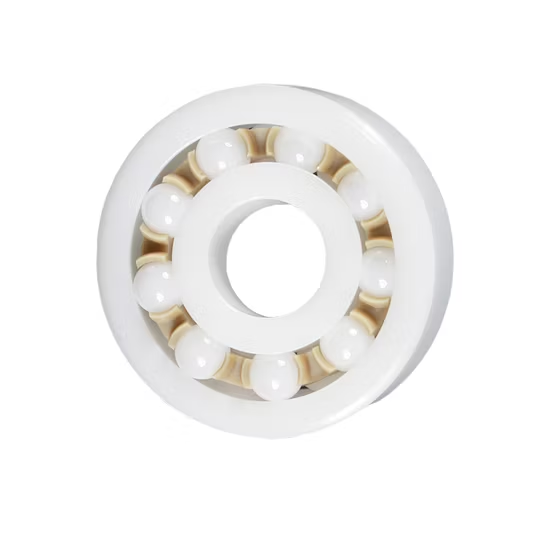
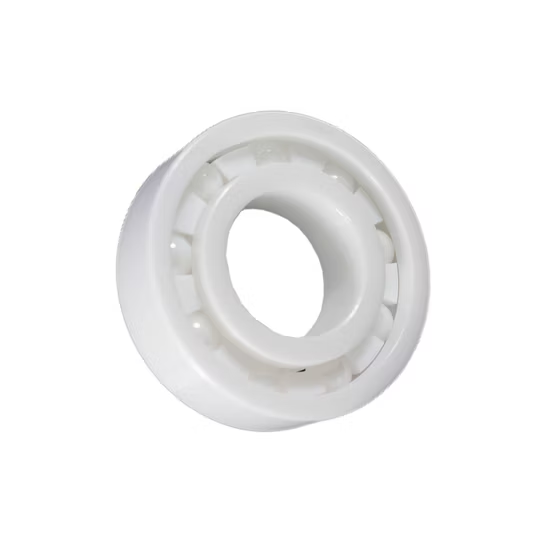


6309CE Zirconia Ceramic Deep Groove Ball Bearing P5 — engineered for extreme temperature and corrosive environments where standard steel fails.
Scan-to-verify authenticity — Every 6309CE batch carries a scannable QR code linking directly to the manufacturer's official verification app, eliminating the risk of cloned markings on counterfeit ceramic components.
| Parameter | Value |
|---|---|
| Designation | 6309CE |
| Bearing Type | Deep Groove Ball Bearing |
| Material | Available in zirconia ceramic or standard bearing steel variants |
| Precision Class | P5 |
| Seal or Shield Type | Open, rubber seals, or iron shields |
| Quality Level | Z1V1, Z2V2, Z3V3, Z4V4 |
| Feature | Low noise, high speed, long service life |
Note: The CE suffix in this specific designation remains an unverified manufacturer code requiring official catalog confirmation for exact internal structural definitions.
| Industry | Typical Applications |
|---|---|
| Chemical Processing | Agitator shafts and pump impellers exposed to corrosive fluids |
| High-Temperature Manufacturing | Conveyor rollers and fan bearings inside industrial drying ovens |
| Food and Beverage | Washdown-intensive packaging lines requiring non-magnetic components |
| Medical Equipment | High-speed centrifuge spindles demanding electrical insulation |
Material mismatch causes catastrophic seizure long before the rated fatigue life is reached.
In my years on the workshop floor in Ningbo, I have dismantled countless supposedly "premium" bearings that failed prematurely simply because standard bearing steel was forced into highly corrosive or extreme thermal environments. When procurement engineers overlook the chemical exposure or thermal expansion limits of standard alloys, the inner ring softens or corrodes, leading to sudden停机. Sourcing a genuine 6309CE zirconia ceramic deep groove ball bearing resolves this, provided the supplier can prove the material traceability and match the exact sealing configuration to the现场 contamination level .
Selecting the right variant goes far beyond just matching the base bore and outside diameter. We review your specific operational parameters to ensure the chosen seal type and clearance class align perfectly with the thermal and chemical realities of your equipment, preventing the all-too-common field failures caused by generic catalog substitutions.
When equipment operates at elevated temperatures, the differential thermal expansion between the shaft and the housing drastically alters the internal clearance of the bearing. If a standard CN clearance is installed where a C3 was required to accommodate this thermal growth, the bearing will thermally bind and seize under load. Furthermore, in washdown or dusty environments, selecting between non-contact iron shields and contact rubber seals dictates whether the bearing keeps contaminants out or simply generates excessive friction heat .
The P5 precision class ensures significantly tighter dimensional and running accuracy tolerances compared to standard P0 grades, which is critical for minimizing vibration in high-speed electric motors. When specifying the material, buyers can choose between zirconia ceramic variants for exceptional corrosion resistance and electrical insulation, or standard bearing steel for conventional heavy-load applications. The availability of Z1V1 through Z4V4 quality levels allows maintenance teams to select the exact noise and vibration threshold required for sensitive medical or precision machining equipment.
Overlooking a single suffix or assuming all ceramic grades perform identically inevitably leads to unplanned downtime and catastrophic damage to adjacent machinery. A mismatched cage material or incorrect internal clearance will cause the rolling elements to skew, generating localized heat that destroys the shaft journal. According to ISO 281 standards, operating a bearing outside its verified thermal and load boundaries voids any calculated L10 life expectancy, turning a minor maintenance task into a massive capital repair .
We do not just ship boxes; we engineer solutions by verifying every cross-reference against three critical alignment points: base designation, internal clearance, and cage material. While other traders might swap a required P5 ceramic unit for a cheaper P0 steel alternative that shares the same basic dimensions, our technical team intercepts these errors before shipment. We provide full batch traceability and application-based selection reviews, ensuring that the exact 6309CE configuration you need is the exact configuration you receive, eliminating the guesswork from critical spare parts procurement.
To ensure precise application matching and accurate L10 life calculations, please provide your specific radial and axial loads, operating speeds, and ambient temperature ranges. If you are replacing an existing unit, sharing the exact OEM equipment number allows our engineering team to perform a comprehensive cross-reference check, verifying that the clearance, seal type, and material options perfectly align with your original design intent.
Q: How does zirconia ceramic compare to standard steel in high-temperature applications?
A: Zirconia ceramic variants maintain their structural integrity and hardness at elevated temperatures where standard bearing steel would soften and lose load-carrying capacity. However, the exact thermal limit depends on the cage material and lubrication used. We always review the complete assembly specifications to ensure the chosen material option safely exceeds your maximum operating temperature.
Q: What does the P5 precision class mean for motor applications?
A: P5 indicates a significantly tighter tolerance on dimensional and running accuracy compared to standard P0 grades. In electric motors, this reduced runout minimizes vibration and acoustic noise at high speeds, directly extending the service life of the windings and adjacent components by preventing harmonic resonance and uneven load distribution.
Q: How do I choose between rubber seals and iron shields for this bearing?
A: Rubber seals provide superior protection against liquid and fine dust ingress but generate slightly more friction heat due to contact. Iron shields offer non-contact protection ideal for high-speed, low-contamination environments where minimizing friction and heat buildup is the primary operational requirement.
Q: Why is internal clearance selection critical when mounting ceramic bearings?
A: Ceramic materials exhibit different thermal expansion characteristics than standard steel shafts and housings. Selecting the correct internal clearance, such as C3 instead of CN, ensures the bearing maintains optimal internal geometry once the equipment reaches its operating temperature, preventing thermal binding and premature cage failure.
Q: What does the CE suffix indicate on this specific designation?
A: In this particular context, the CE suffix is an unverified manufacturer code that requires official catalog confirmation to define its exact internal structural or material meaning. We always cross-reference this suffix directly with the manufacturer's current technical documentation to guarantee it matches your precise engineering requirements.
Our 5-step process ensures every order is engineered, validated, and supported for optimal performance.
Technical needs assessment
Custom specifications
Free samples for $50k+
Pre-shipment inspection
On-site & predictive
Our certified engineers respond within 24 hours with detailed technical specifications, pricing, and lead time information.