01
Consultation
Technical needs assessment




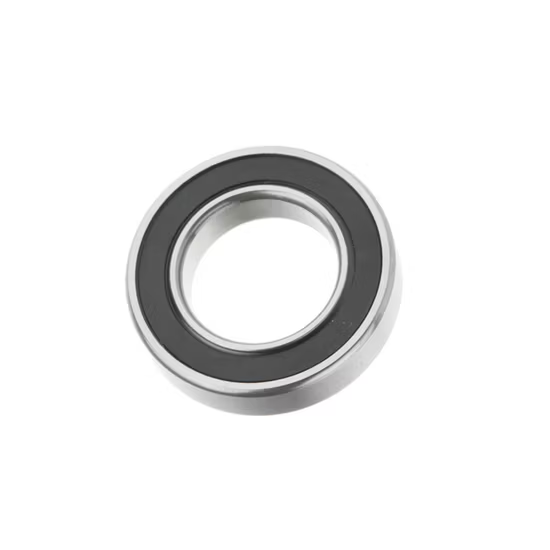
6200 Stainless Steel Deep Groove Ball Bearing — stainless steel construction ensures reliable corrosion resistance and high-temperature operational stability.
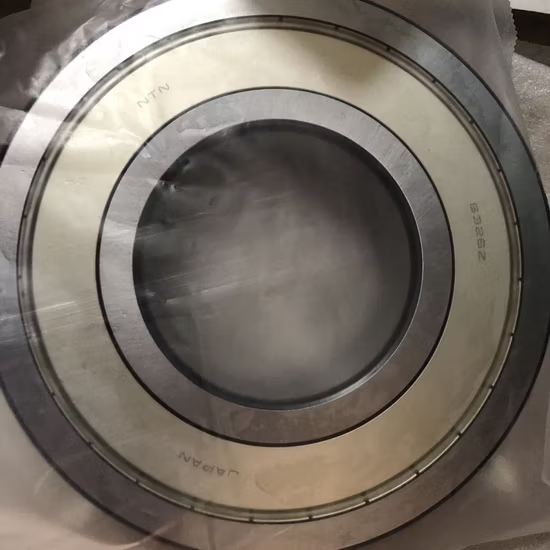
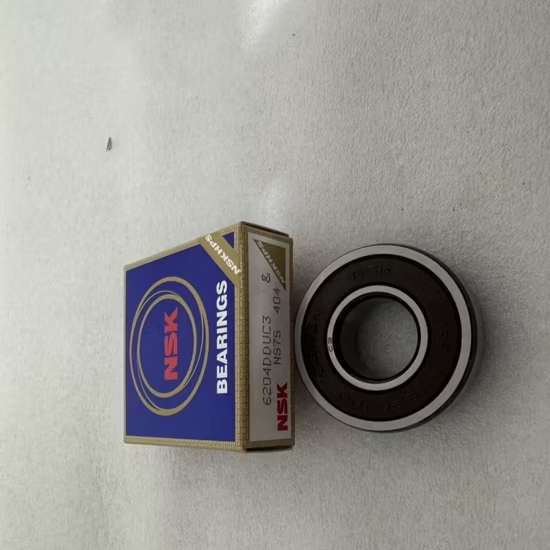
Unified Multi-Brand Sourcing — Consolidate your SKF, FAG, and NSK requirements into a single shipment with matched batch documentation for every 6200 variant.
| Parameter | Value |
|---|---|
| Designation | 6200 |
| Bearing Type | Deep Groove Ball Bearing |
| Material | Stainless Steel |
| Bearing Style | Open, Rubber Seals, Iron Seals |
| Seal or Shield Type | ZZ (Double steel shields), 2RS (Double contact rubber seals) |
| Quality Level | Z1V1, Z2V2, Z3V3, Z4V4 |
| Operating Temperature Range | High Temperature |
| HS Code | 848210 |
| Origin | Germany, Japan, Sweden, Malaysia, China |
| Industry | Typical Applications |
|---|---|
| Electric Motors | High-temperature motor shaft supports and cooling fan drives |
| Food and Beverage | Corrosive washdown conveyor rollers and packaging machinery |
| Industrial Gearboxes | High-heat gearbox input shafts and auxiliary drive mechanisms |
| Household Appliances | Moisture-exposed appliance drive mechanisms and pump assemblies |
Material substitution and ignored thermal expansion limits are the primary culprits behind sudden shaft lockups in high-heat environments.
In my years trading bearings out of Dongguan, I have seen countless production lines halt because procurement teams installed standard chrome steel units in high-temperature zones. The inner rings soften, the cages deform under thermal stress, and the bearing seizes entirely. Even when the base number matches, ignoring the required high-temperature clearance limits leads to rapid thermal binding. A significant share of premature failures in these environments stems directly from these cross-reference errors .
Selecting the right configuration requires looking beyond the base designation. We review your specific load, speed, and temperature parameters to ensure the chosen 6200 stainless steel deep groove ball bearing aligns perfectly with your equipment. Whether you need the low-friction profile of steel shields or the moisture exclusion of rubber seals, our application-based selection review prevents mismatched internal designs from reaching your assembly line.
High-temperature operations drastically alter lubrication viscosity and internal clearance dynamics. When thermal expansion exceeds the designed clearance class, the rolling elements bind against the raceways, generating excessive friction heat. Simultaneously, harsh environments introduce abrasive particulates or corrosive washdown fluids that degrade standard lubricants. Choosing between non-contact shields and contact seals involves balancing contamination exclusion against friction-induced temperature rise .
The suffix dictates the operational survival of the unit. The ZZ configuration utilizes double steel shields, providing a non-contact barrier that keeps out large debris without adding friction heat, making it ideal for high-speed, high-temperature applications. Conversely, the 2RS suffix indicates double contact rubber seals, offering superior protection against moisture and fine dust in corrosive washdown environments, though at the cost of slightly higher rotational friction. Furthermore, selecting the appropriate quality level—from Z1V1 up to Z4V4—ensures the vibration and noise profiles match the strict requirements of precision electric motors and household appliances.
Installing a standard clearance unit where a C3 or high-temperature variant is required inevitably leads to catastrophic thermal binding. When the internal clearance closes completely under heat, the resulting metal-on-metal contact destroys the raceways and shatters the cage. This unplanned downtime not only halts production but often causes catastrophic damage to the surrounding shaft and housing, voiding equipment warranties and triggering expensive secondary repairs .
We maintain authorized distribution coverage across all major international brands, allowing you to fulfill mixed-brand requirements in a single order. Our cross-brand interchange process verifies clearance, cage material, and precision suffixes—not just the base number—preventing the thermal binding issues common with lazy substitutions. Every batch is fully traceable to the manufacturer, and we provide application-based selection reviews to ensure your high-temperature and corrosive environment parameters are accurately addressed before shipment.
To ensure optimal performance, share your specific operating parameters, including radial and axial loads, rotational speeds, and exact temperature ranges. Providing your OEM equipment numbers allows our engineering team to perform a rigorous cross-reference check, verifying that the internal clearance and seal types perfectly match your original design requirements.
Q: How can I verify the material grade of the stainless steel bearings?
A: Every shipment includes a material test report confirming the specific stainless steel grade used. Additionally, you can scan the QR code on the packaging using the brand's official mobile application to verify the batch authenticity and trace the manufacturing origin directly.
Q: What are the cross-reference pitfalls when matching clearance for high temperatures?
A: The most common error is substituting a standard CN clearance unit when the equipment requires a C3 or specialized high-temperature clearance. This oversight ignores thermal expansion, causing the internal clearance to close completely under heat, leading to rapid thermal binding and premature cage failure.
Q: How do I choose between ZZ steel shields and 2RS rubber seals?
A: Select ZZ double steel shields for high-speed, high-temperature applications where low friction is critical and only large debris needs exclusion. Choose 2RS double contact rubber seals for environments with heavy moisture, corrosive washdowns, or fine dust, accepting a slight increase in rotational friction for superior sealing.
Q: What is the difference between Z1V1 and Z4V4 quality levels?
A: These designations indicate the vibration and noise limits of the bearing. Z1V1 represents standard commercial levels suitable for general industrial gearboxes, while Z4V4 denotes ultra-low vibration and noise, strictly required for high-precision electric motors and sensitive household appliance drive mechanisms.
Q: How do I properly select internal clearance for thermal expansion?
A: Internal clearance must account for the temperature differential between the inner and outer rings during operation. In high-temperature environments, providing your exact operating thermal profile allows us to calculate the necessary clearance class to prevent the rolling elements from binding as the shaft expands.
Our 5-step process ensures every order is engineered, validated, and supported for optimal performance.
Technical needs assessment
Custom specifications
Free samples for $50k+
Pre-shipment inspection
On-site & predictive
Our certified engineers respond within 24 hours with detailed technical specifications, pricing, and lead time information.