01
Consultation
Technical needs assessment


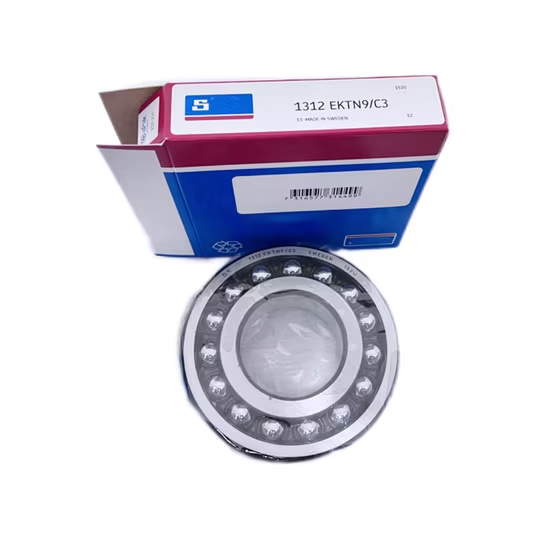


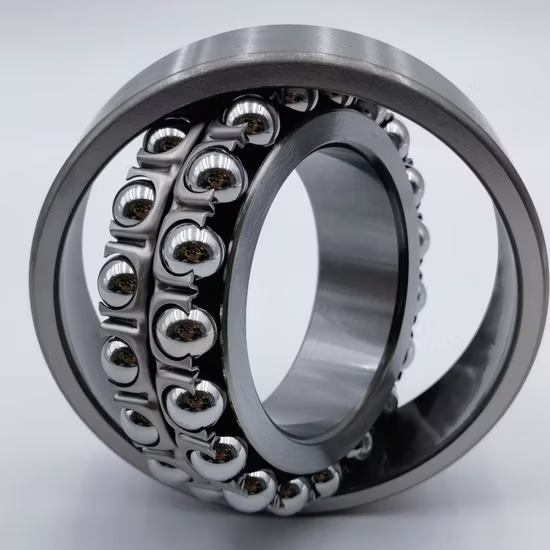
1207 Self-Aligning Ball Bearing — accommodates shaft deflection via a double-row spherical raceway, operating reliably in standard environments without requiring specialized seal or clearance suffixes.
Unified Multi-Brand Sourcing — procure SKF, FAG, and NSK 1207 equivalents in a single consolidated shipment without juggling multiple vendors.
| Parameter | Value |
|---|---|
| Designation | 1207 |
| Bearing Type | Self-Aligning Ball Bearing |
| Seal or Shield Type | Open, Rubber Seals, Iron Seals (available options) |
| Origin | Germany, Japan, Sweden, Malaysia, China (varies by brand) |
| HS Code | 848210 |
| Industry | Typical Applications |
|---|---|
| Electric Motors | Rotor shaft support accommodating minor housing misalignment |
| Industrial Gearboxes | Intermediate shafts subject to structural deflection under load |
| Agricultural Machinery | Conveyor drive rollers in harvesting and planting equipment |
| Textile Machines | Spindle supports requiring quiet operation and vibration dampening |
| Material Handling | Idler pulleys on belt conveyor systems exposed to dust |
Internal clearance and seal selection dictate survival, not just the outer dimensions.
Procurement teams often approve a 1207 self-aligning ball bearing based solely on the bore and outside diameter, ignoring the thermal expansion realities of the application. I have inspected numerous seized units in agricultural gearboxes where the base designation matched perfectly, yet the installed bearing lacked the necessary internal clearance to handle operational heat. When the shaft expands and the clearance collapses, the rolling elements skid rather than roll, leading to rapid cage failure and thermal binding . Sourcing the correct variant requires looking past the basic number to verify the exact seal type and clearance class demanded by the equipment's operating environment.
The primary advantage of this component lies in its outer ring, which features a continuous spherical raceway. This geometry allows the inner ring and ball assembly to align freely with the outer ring, compensating for initial misalignment, shaft deflection, or housing machining errors. For industrial gearboxes where long shafts bend under heavy radial loads, the 1207 self-aligning ball bearing prevents edge loading on the rolling elements. Our technical review process ensures that the selected variant provides adequate misalignment capacity for your specific housing tolerances, preventing premature fatigue that standard deep groove alternatives would suffer under the same deflection.
In agricultural and material handling environments, the operating conditions fluctuate wildly between heavy dust ingress and sudden temperature spikes. Selecting the right sealing configuration is critical. Open variants require robust external sealing and frequent relubrication, while rubber seals offer superior exclusion of fine particulate matter at the cost of slightly higher friction and temperature limits. Iron shields provide a non-contact barrier suitable for higher-speed electric motor applications where dust is less abrasive. Furthermore, ambient temperature shifts combined with frictional heat dictate the internal clearance requirement; a standard clearance will bind under thermal expansion, necessitating a C3 or C4 variant to maintain the operational film thickness .
The internal architecture utilizes two rows of balls guided by a single outer spherical raceway. This design optimizes the component for radial loads while accommodating moderate axial loads in both directions. The cage material—whether pressed steel, machined brass, or polyamide—must be matched to the vibration and speed profile of the machine. Pressed steel cages are standard for general purposes, while brass cages offer superior durability in high-vibration agricultural gearboxes. Understanding these internal design nuances ensures that the replacement part performs identically to the original equipment manufacturer's specification, rather than just fitting the physical envelope.
Substituting a bearing based purely on dimensional cross-referencing without verifying internal geometry often leads to catastrophic secondary damage. When a bearing seizes due to incorrect clearance or inadequate sealing, the resulting shaft scoring and housing destruction multiply the replacement costs exponentially. Unplanned downtime in a continuous production line far exceeds the price differential of sourcing the exact specified variant. Adhering to strict dimensional and running accuracy standards ensures the assembly operates within the designed fatigue life parameters, avoiding the cascade of mechanical failures triggered by a single compromised component .
Securing genuine components across multiple international brands eliminates the friction of managing fragmented orders. We consolidate SKF, FAG, and NSK equivalents into unified shipments, ensuring every 1207 self-aligning ball bearing arrives with verified batch traceability. Our cross-reference protocol strictly aligns internal clearance, cage material, and seal types, preventing the subtle mismatches that cause field failures. By demanding manufacturer-level documentation and QR verification for every unit, we shield your maintenance budget from the devastating impact of counterfeit rings that fail under operational stress.
To ensure the selected component survives your specific operating envelope, provide detailed load profiles including radial forces, axial thrust, and rotational speeds. Specify the ambient and operational temperature ranges to allow our engineering team to calculate the required internal clearance class. Detailing the contamination level and housing sealing capabilities will dictate whether an open, rubber-sealed, or iron-shielded variant is appropriate. Supplying the exact OEM equipment designation allows us to perform a comprehensive cross-reference check, guaranteeing dimensional and functional interchangeability.
Q: How do we verify the origin of multi-brand 1207 equivalents?
A: Every unit ships with batch traceability documentation and a unique QR code. Procurement and maintenance teams can scan this code using the respective manufacturer's official mobile application to instantly verify the production facility, date, and authenticity, ensuring the component is not a cloned counterfeit with substandard metallurgy.
Q: Why is clearance class critical during cross-brand interchange?
A: A base designation match does not guarantee internal geometry alignment. Installing a standard clearance variant in an application requiring C3 for thermal expansion will cause the double row balls to skid and bind as the shaft heats up, leading to rapid cage destruction and complete seizure under load.
Q: How do we choose between rubber seals and iron shields?
A: Rubber seals provide contact sealing that excels at excluding fine agricultural dust and moisture but generate higher friction, limiting maximum speed. Iron shields offer non-contact protection suitable for high-speed electric motor spindles where heat generation must be minimized and contamination is primarily dry particulate.
Q: How does the spherical raceway mitigate housing deflection?
A: The continuous outer spherical track allows the inner ring and ball assembly to pivot freely. This self-aligning capability prevents edge-loading on the rolling elements when long shafts bend under heavy radial loads or when housing bores are slightly misaligned during machining, significantly extending fatigue life.
Q: What mounting practices prevent damage to the inner ring?
A: Installation force must be applied exclusively to the inner ring bore, typically using an induction heater for interference fits. Driving the bearing by striking the outer ring transfers the shock load through the double row balls, causing permanent brinelling on the raceways and initiating premature spalling.
Our 5-step process ensures every order is engineered, validated, and supported for optimal performance.
Technical needs assessment
Custom specifications
Free samples for $50k+
Pre-shipment inspection
On-site & predictive
Our certified engineers respond within 24 hours with detailed technical specifications, pricing, and lead time information.

