01
Consultation
Technical needs assessment

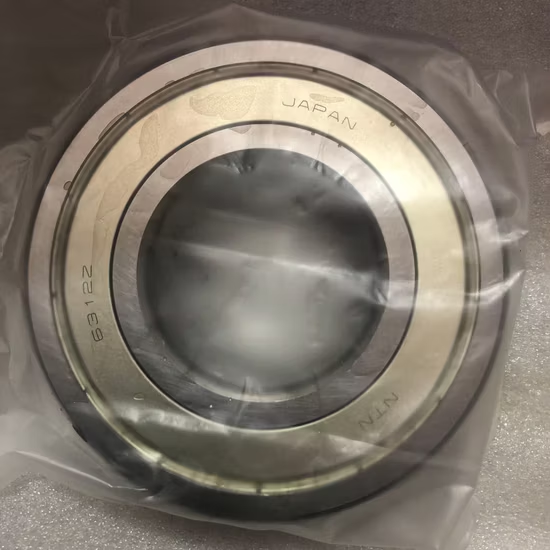


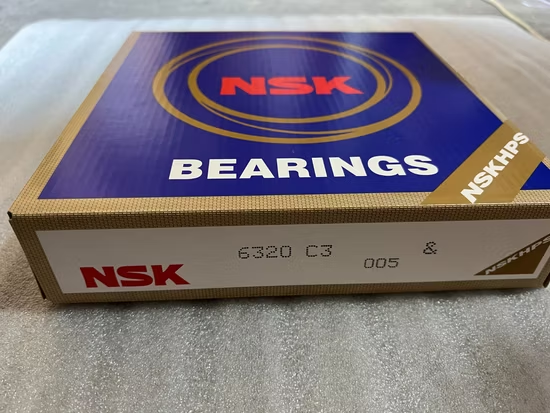

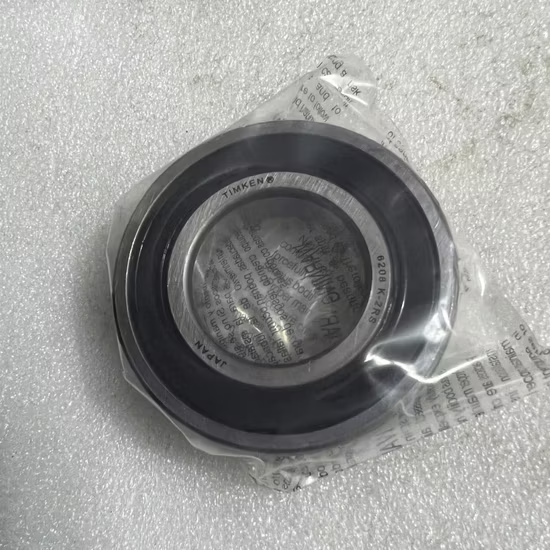
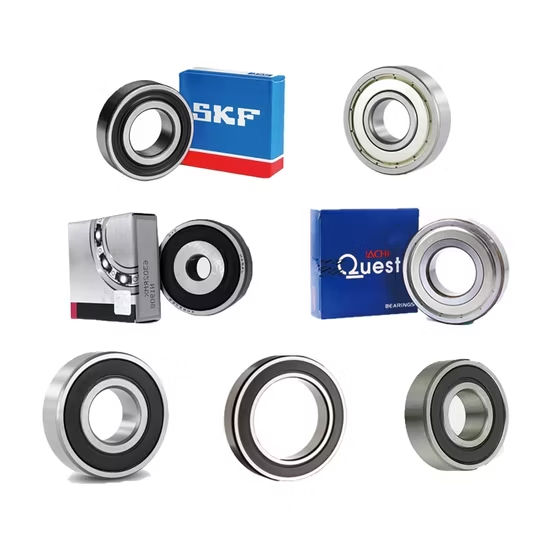
6211 6212 6213 6214 6215 Deep Groove Ball Bearings — configurable sealing styles and graded quality levels for reliable industrial operation.
Factory Batch Traceability — Every 6211 6212 6213 6214 6215 deep groove ball bearing ships with verifiable lot documentation linking directly to the manufacturer's production records.
| Parameter | Value |
|---|---|
| Designation | 6211 6212 6213 6214 6215 |
| Bearing Type | Deep Groove Ball Bearing |
| Seal or Shield Type | Open, Rubber Seals, Iron Seals |
| Quality Level | Z1V1, Z2V2, Z3V3, Z4V4 |
| Customization | Available |
| Origin | Germany, Japan, Sweden, Malaysia, China |
| Industry | Typical Applications |
|---|---|
| Electric Motors | Rotor shaft support requiring low vibration and high-speed stability |
| Industrial Gearboxes | Intermediate shaft positioning subjected to combined radial and axial loads |
| Material Handling | Conveyor drive pulleys and idler rollers operating in dusty environments |
Thermal binding from incorrect internal clearance destroys bearings long before fatigue limits are reached.
Procurement teams often approve orders based solely on the base designation, assuming any 6211 6212 6213 6214 6215 deep groove ball bearing will fit the housing. When a standard CN clearance unit is pressed into a gearbox operating at elevated temperatures without accounting for thermal expansion, the internal clearance vanishes. The rolling elements skid, generating massive friction heat that degrades the lubricant and ultimately seizes the cage . Matching the base number is merely the first step; verifying the exact clearance class and cage material is what keeps the machinery running.
Selecting the right configuration requires looking past the basic dimension series. Our technical review process evaluates the specific radial loads, axial thrust components, and rotational speeds of your application to recommend the optimal seal type and quality level. This ensures the supplied units handle the actual operational stresses rather than just fitting the physical envelope.
Industrial gearboxes and conveyor drives expose components to severe thermal cycling and particulate ingress. High ambient temperatures thin out standard greases, demanding specific clearance classes to prevent internal binding, while abrasive dust rapidly destroys open-type bearings. Selecting between rubber seals for maximum contamination exclusion or iron shields for lower friction heat generation dictates the maintenance interval and overall reliability of the assembly .
The Z1V1 through Z4V4 quality levels define the strictness of vibration and acoustic emission limits, with Z4V4 reserved for precision electric motors where noise is critical. Iron shields provide non-contact protection against large debris without adding rotational drag, making them ideal for high-speed applications. Conversely, rubber seals offer contact-based exclusion of fine dust and moisture but introduce friction that limits maximum RPM. Choosing the correct combination prevents premature lubricant degradation and ensures smooth operation across the intended speed range.
Substituting a unit based only on outer dimensions while ignoring internal geometry leads to catastrophic operational failures. An incorrect cage material might shatter under unexpected vibration, while a mismatched precision class introduces unacceptable runout in sensitive spindle applications. These errors trigger unplanned downtime, void equipment warranties, and cause secondary damage to adjacent shafts and housings, turning a simple component replacement into a major rebuild project .
We enforce strict alignment across the base designation, clearance class, and seal type during every cross-reference check. Our inventory provides full batch traceability, ensuring the units you receive match the exact specifications approved during the technical review. By supplying authentic components with verifiable origins, we eliminate the risk of soft inner rings and cloned markings that plague the secondary market. This rigorous validation guarantees that the internal geometry perfectly matches your equipment's thermal and mechanical requirements.
To ensure precise selection and L10 life calculation, provide the exact radial and axial loads, operating speeds, and thermal conditions of your application. Supplying the OEM equipment number allows our engineering team to perform a comprehensive cross-reference check, verifying that the clearance and sealing match the original design intent. This data enables us to deliver a configuration that withstands your specific operational environment.
Q: How do I verify the authenticity of the supplied bearings?
A: Every shipment includes verifiable batch documentation and QR codes linked to official brand applications. Scanning these codes confirms the manufacturing origin and authenticates the specific clearance and seal suffixes, protecting your facility from counterfeit parts that often feature soft inner rings and cloned visual markers.
Q: Why must clearance and seal types align during cross-referencing?
A: Matching only the base designation ignores critical internal geometry. Installing a standard clearance unit in a high-temperature gearbox causes thermal binding, while using an open bearing in a dusty conveyor leads to rapid abrasive wear. Exact suffix alignment ensures the internal expansion tolerances and contamination defenses match the actual operating environment.
Q: What distinguishes the Z1V1 from the Z4V4 quality levels?
A: These grades define the strictness of vibration and acoustic emission limits during manufacturing. While Z1V1 is suitable for general industrial gearboxes, Z4V4 undergoes rigorous sorting to minimize noise and vibration, making it essential for high-speed electric motors and precision appliances where acoustic performance is critical.
Q: How do I choose between rubber seals and iron shields?
A: Rubber seals provide contact-based exclusion of fine dust and moisture, ideal for harsh environments, but they generate friction that limits maximum speed. Iron shields offer non-contact protection against larger debris with minimal rotational drag, making them the preferred choice for high-speed applications where heat generation must be minimized.
Q: What documentation accompanies the shipment for traceability?
A: We provide a Certificate of Conformity, material test reports, and dimensional inspection data confirming the precision class. Additionally, batch traceability records and country-of-origin documents are included to ensure full supply chain transparency and support your facility's quality management and customs requirements.
Our 5-step process ensures every order is engineered, validated, and supported for optimal performance.
Technical needs assessment
Custom specifications
Free samples for $50k+
Pre-shipment inspection
On-site & predictive
Our certified engineers respond within 24 hours with detailed technical specifications, pricing, and lead time information.