01
Consultation
Technical needs assessment
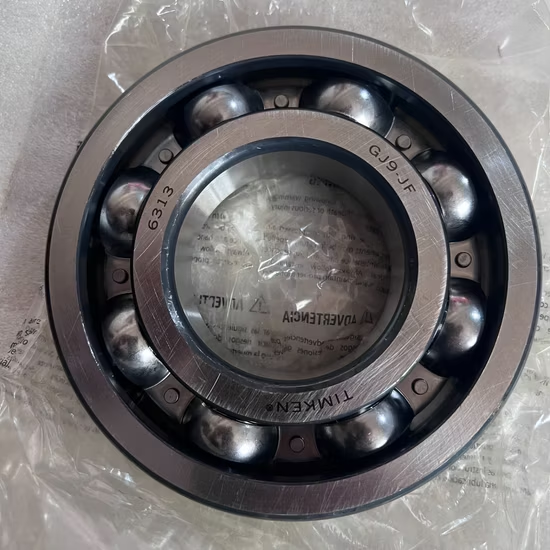
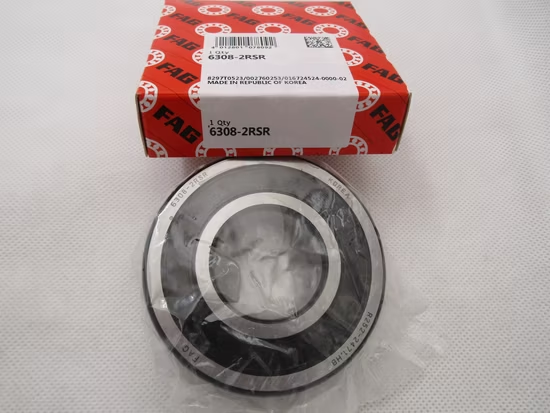
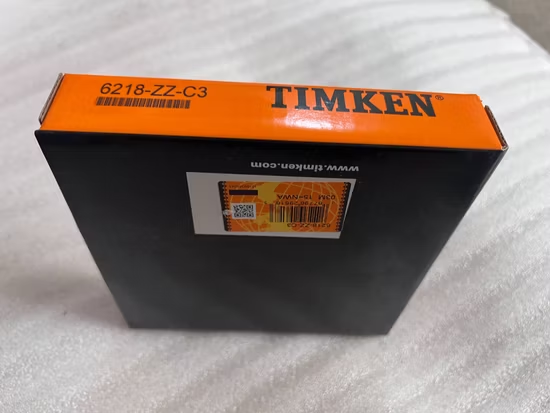
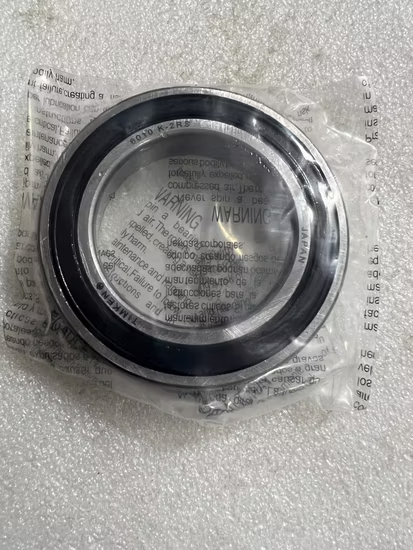
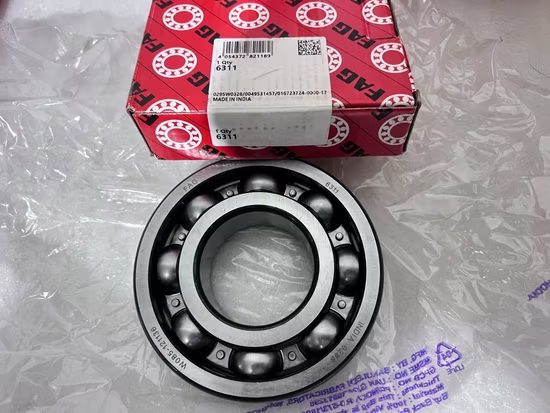
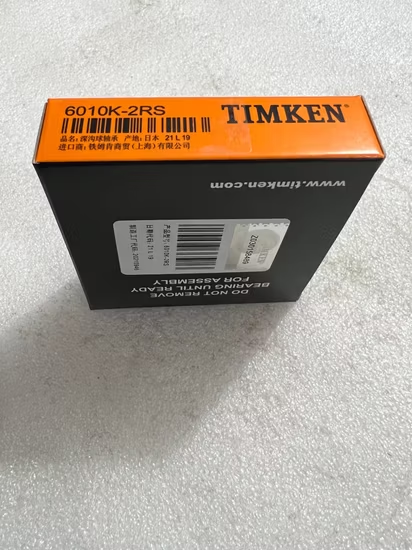
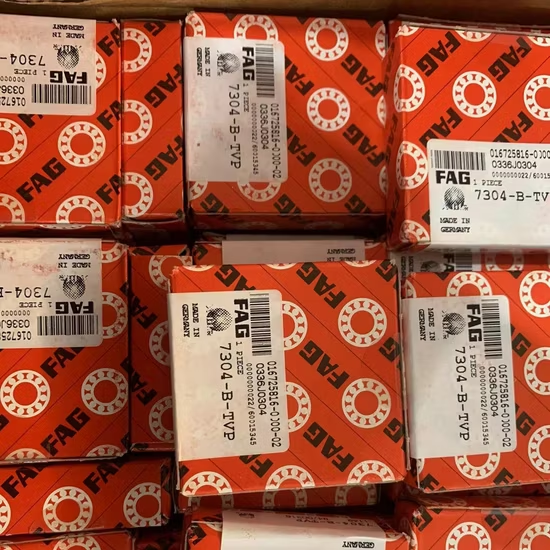
6316 6317 6318 6319 6320 Deep Groove Ball Bearings — stainless steel construction provides reliable corrosion resistance for washdown and high-moisture environments.
Multi-brand authorized coverage — source SKF, FAG, and NSK equivalents for the 6316 to 6320 series in a single consolidated shipment without juggling multiple vendors.
| Parameter | Value |
|---|---|
| Designation | 6316 6317 6318 6319 6320 |
| Bearing Type | Deep Groove Ball Bearing |
| Material | Stainless Steel |
| Bearing Style | Open, Rubber Seals, Iron Seals |
| Quality Level | Z1V1, Z2V2, Z3V3, Z4V4 |
| Origin | Germany, Japan, Sweden, Malaysia, China |
| HS Code | 848210 |
| MOQ | 2PCS |
| Industry | Typical Applications |
|---|---|
| Food & Beverage | Washdown conveyors, pasteurizer drive shafts, bottling line fillers |
| Agriculture | Fertilizer spreader discs, irrigation pump impellers, harvester augers |
| Material Handling | Corrosive environment roller beds, marine winch sheaves, dockside cranes |
Seeing a stainless steel deep groove ball bearing 6316 6317 6318 6319 6320 fail prematurely is rarely about the load; it is almost always about compromised metallurgy. I have dismantled seized units from food processing lines where the inner ring was magnetic and heavily pitted, proving it was standard carbon steel merely plated to look like stainless. When procurement focuses solely on the base designation and ignores material certification, the resulting corrosion causes catastrophic raceway spalling and unplanned line stoppages .
Matching a stainless steel deep groove ball bearing 6316 6317 6318 6319 6320 to a high-moisture application requires verifying the alloy composition before installation. Sourcing through authorized channels ensures the martensitic or austenitic grades used in the rings and rolling elements possess the necessary chromium content to resist aggressive cleaning chemicals. This metallurgical verification prevents the subtle galvanic corrosion that eventually locks the cage and halts production.
Washdown environments subject bearings to rapid temperature fluctuations and caustic detergents that easily penetrate inadequate seals. Selecting between open, rubber-sealed, or iron-shielded configurations dictates how well the internal grease survives high-pressure water jets and steam cleaning. Furthermore, thermal expansion during hot washdowns alters internal clearances, meaning a standard CN clearance might bind, necessitating a C3 clearance to maintain smooth rotation and prevent premature fatigue .
The absence of explicit suffixes in the base 6316 6317 6318 6319 6320 identifiers means the sealing and clearance states must be explicitly defined during procurement. Iron shields offer low-friction protection against dry particulates, while rubber seals provide superior exclusion of liquid contaminants at the cost of slightly higher operating torque. Pairing the correct seal type with an appropriate internal clearance ensures the bearing accommodates thermal growth without inducing excessive preload on the rolling elements.
Procuring a bearing that matches the base number but utilizes inferior steel leads to rapid oxidation and raceway degradation. According to ISO 281 frameworks, surface corrosion acts as a stress concentrator, drastically reducing the calculated L10 life and leading to unpredictable, catastrophic equipment failure. This premature breakdown voids machinery warranties and incurs severe downtime penalties that far exceed the initial savings of buying unverified stock .
Our distribution network guarantees that every stainless steel deep groove ball bearing 6316 6317 6318 6319 6320 is sourced directly from authorized manufacturer production facilities. We prevent cross-reference errors by verifying not just the base dimensions, but the exact seal friction characteristics and internal clearance class required for your specific thermal profile. Every shipment includes verifiable batch documentation, eliminating the risk of receiving counterfeit units with soft inner rings that fail under minimal operational stress.
To ensure the selected units perfectly match your operational demands, provide our engineering team with your specific radial and axial loads, operating speeds, and washdown temperature ranges. Sharing the OEM equipment number or the exact spatial constraints allows us to execute a precise cross-reference review and confirm the optimal seal and clearance combination for your machinery.
Q: How do I verify the stainless steel material authenticity for these bearings?
A: Authenticity is verified by scanning the QR code on the packaging using the manufacturer's official application, which links directly to the production batch. Additionally, we provide a material test report confirming the specific stainless steel grade, ensuring the rings and rolling elements are not merely plated carbon steel prone to rapid corrosion.
Q: What cross-reference checks are critical beyond the base designation?
A: Beyond matching the base numbers like 6316 or 6320, you must verify the internal clearance class, seal friction type, and cage material. A base number match with an incorrect clearance can cause thermal binding during hot washdowns, while the wrong seal type will allow caustic detergents to penetrate and degrade the internal lubricant prematurely.
Q: How do I choose between rubber seals and iron shields for washdowns?
A: Rubber seals provide a contact barrier that effectively excludes high-pressure water and liquid chemicals, making them ideal for direct washdown zones. Iron shields offer a non-contact gap seal that minimizes friction and heat generation, which is better suited for areas exposed only to dry particulates or occasional splashing where low torque is critical.
Q: What distinguishes the Z1V1 from Z4V4 quality levels in operation?
A: The Z-levels classify the bearing's noise and vibration thresholds during rotation. Z1V1 represents standard commercial grades suitable for general conveyors, while Z4V4 indicates ultra-precision balancing and machining, delivering exceptionally smooth, quiet operation required for high-speed food processing mixers or sensitive packaging machinery.
Q: How do I ensure the correct clearance class for thermal expansion?
A: In washdown environments, rapid temperature shifts cause the stainless steel rings to expand and contract. If a standard CN clearance is used, thermal growth can eliminate the internal play, leading to excessive friction and seizure. Specifying a C3 clearance provides the necessary internal room to accommodate these thermal fluctuations safely.
Our 5-step process ensures every order is engineered, validated, and supported for optimal performance.
Technical needs assessment
Custom specifications
Free samples for $50k+
Pre-shipment inspection
On-site & predictive
Our certified engineers respond within 24 hours with detailed technical specifications, pricing, and lead time information.