01
Consultation
Technical needs assessment
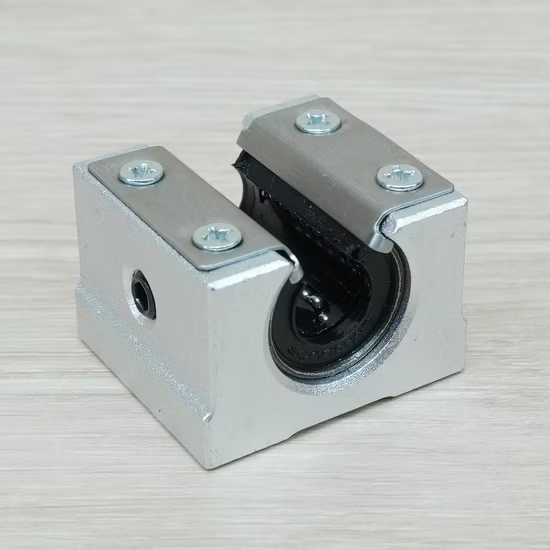
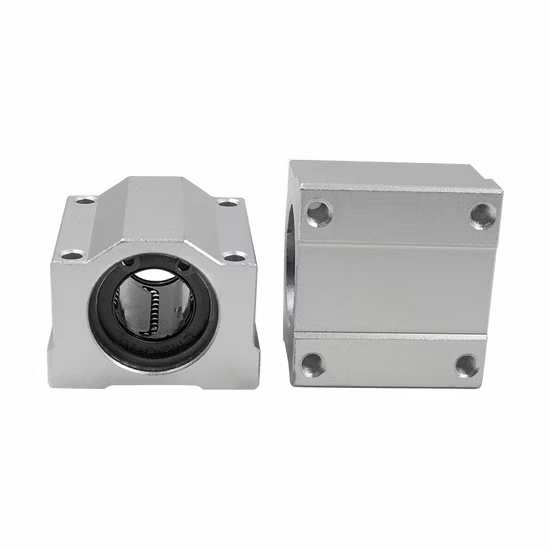

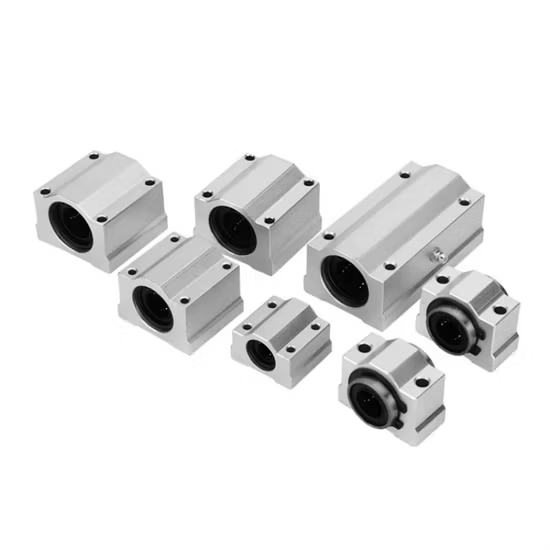


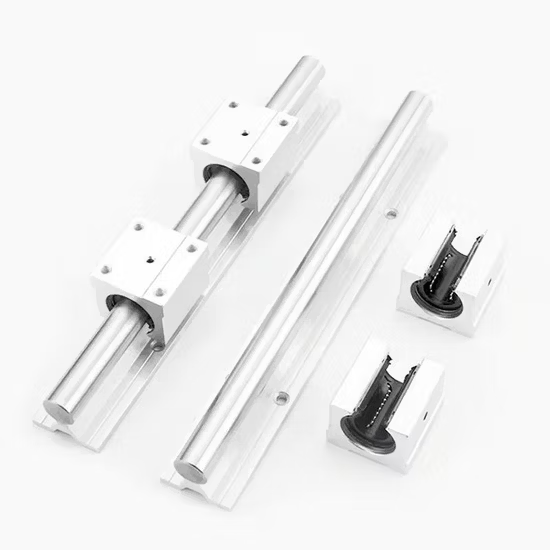
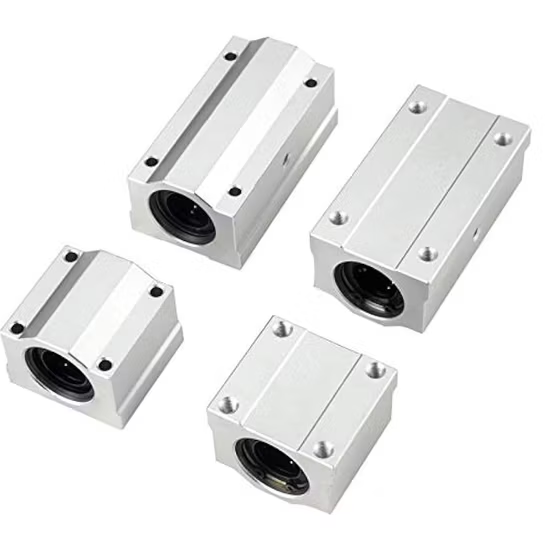
SC25UU SC30LUU SC30UU SC35LUU Linear Guide Ball Slide Bearings — engineered with stainless steel for high corrosion resistance in demanding environments.
Unified Multi-Brand Sourcing — consolidating your SC25UU SC30LUU SC30UU SC35LUU linear bearing requirements into a single verified shipment eliminates cross-vendor coordination delays.
| Parameter | Value |
|---|---|
| Designation | SC25UU SC30LUU SC30UU SC35LUU |
| Bearing Type | Linear Bearing |
| Material Options | Stainless Steel, Carbon Steel variants available |
| Profile Type | Hollow Profile |
| Surface Treatment | Polished |
| Precision Rating Options | P0, P6, P5, P4, P2 |
| Feature | High Speed, Low Voice |
| Corrosion Resistance | High Corrosion Resistance |
| Length | Custom Length |
| Certification | CE, CS, EPA, ISO 9001:2000, ISO 9001:2008, RoHS |
| Origin | Germany, Japan, Sweden, Malaysia, China |
Note: The SC, UU, and LUU designations listed above are unverified suffixes requiring manufacturer catalog confirmation for exact dimensional interchange.
| Industry | Typical Applications |
|---|---|
| Industrial Automation | Multi-axis CNC router gantries, automated pick-and-place robotic arms |
| Medical Equipment | Motorized surgical imaging tables, precision laboratory liquid handling sliders |
| Food Processing | Stainless steel washdown conveyor guides, automated packaging sealing mechanisms |
| Electronics Manufacturing | Cleanroom semiconductor wafer transfer carriages, SMT placement machine heads |
Standard carbon steel guides suffer rapid raceway pitting when exposed to aggressive cleaning agents, whereas a properly specified SC25UU SC30LUU SC30UU SC35LUU linear bearing maintains structural integrity through high corrosion resistance.
Procurement teams frequently overlook the internal carriage design when replacing failed units, leading to repeated breakdowns. In my early years sourcing components in Shenzhen, I watched a packaging line grind to a halt because a supplier provided a standard open-carriage guide for a high-dust environment, completely ignoring the necessary sealed retainer requirements. That single oversight caused premature ball retainer fracture and catastrophic rail scoring. True reliability demands matching the internal seal architecture to the actual contamination level, rather than just swapping base numbers .
Selecting the correct SC25UU SC30LUU SC30UU SC35LUU linear bearing requires evaluating the specific travel dynamics of your automation equipment. Our engineering review process verifies that the carriage length and block configuration align with your moment load requirements, preventing edge-loading that prematurely destroys the recirculating ball paths.
Linear motion systems in food processing and medical environments face severe operational threats from moisture and particulate ingress. High-pressure washdowns easily penetrate standard end-wipers, washing out factory grease and introducing corrosive agents directly into the ball circuit. Specifying units with enhanced sealing and polished hollow profiles prevents fluid pooling and ensures smooth, low-voice operation even after repeated chemical exposure. Proper lubrication intervals must also be adjusted based on the specific seal friction and environmental washout rates .
The hollow profile design significantly reduces moving mass, allowing for higher acceleration rates without sacrificing the rigidity needed for precision machining. When evaluating precision ratings from P0 up to P2, the selection directly dictates the running accuracy and positional repeatability of the carriage along the rail. Furthermore, understanding the specific suffix variations is critical; while standard configurations suit general transport, extended or sealed variants are mandatory for maintaining cleanroom integrity or surviving harsh particulate exposure. We verify these internal design differences during cross-referencing to ensure the replacement unit matches the OEM equipment's exact tolerance stack-up.
Substituting a basic linear block without verifying the exact internal ball diameter or seal geometry leads to rapid positional drift and unplanned downtime. According to failure analysis frameworks similar to ISO 15243, geometric mismatch in linear guides causes localized stress concentrations that spall the raceway far earlier than calculated L10 life expectations . This premature failure not only halts production but frequently damages the mating rail, exponentially increasing the total replacement cost.
Our technical team prevents cross-reference errors by validating the exact seal type and carriage length, not just the outer dimensions. We provide batch traceability to the manufacturer, ensuring the stainless steel metallurgy meets the required corrosion standards for your specific washdown environment. Every shipment includes dimensional inspection reports confirming the running accuracy matches the requested precision class. By focusing on application-specific selection rather than generic catalog swaps, we eliminate the risk of receiving visually identical but internally incompatible components.
To ensure optimal performance, provide your equipment's travel speed, moment loads, and environmental exposure details for a comprehensive L10 life calculation. If replacing existing hardware, share the OEM equipment number or detailed carriage measurements so our team can execute a precise cross-reference review. This technical validation guarantees the supplied units perfectly integrate with your current rail infrastructure.
Q: How do I verify the authenticity of linear bearings to avoid counterfeits?
A: We supply genuine components with full batch traceability. You can verify authenticity using QR codes through official brand applications. Additionally, we provide material test reports and dimensional inspection documents that confirm the internal architecture and metallurgy meet exact manufacturer specifications, protecting your equipment from premature failure caused by soft inner rings.
Q: What cross-reference parameters matter beyond the base designation?
A: Base numbers often ignore critical internal differences. We verify the exact carriage length, seal geometry, and ball recirculation design. Matching these internal features ensures the replacement unit handles your specific moment loads and contamination levels without causing raceway scoring or premature retainer fracture in the field.
Q: How do I select the right precision rating and material for my application?
A: Material selection depends on environmental exposure; stainless steel variants are essential for washdown or corrosive settings. Precision ratings from P0 to P2 should be chosen based on your positional repeatability requirements. Share your operating speeds and load profiles so our engineers can recommend the optimal configuration for your automation setup.
Q: What documentation is provided for customs and quality compliance?
A: Every shipment includes a Certificate of Conformity, material test reports, and dimensional inspection certificates. We also provide country-of-origin documentation and batch traceability records. These documents ensure smooth customs clearance and provide your quality assurance team with verified proof of the high corrosion resistance and precision class.
Q: How do I determine the correct custom length and mounting arrangement?
A: The required length and block configuration depend on your specific travel stroke and moment load distribution. Provide your equipment's mounting space constraints and dynamic load data. Our engineering team will calculate the optimal carriage geometry to prevent edge-loading and ensure smooth, low-voice operation across the entire travel distance.
Our 5-step process ensures every order is engineered, validated, and supported for optimal performance.
Technical needs assessment
Custom specifications
Free samples for $50k+
Pre-shipment inspection
On-site & predictive
Our certified engineers respond within 24 hours with detailed technical specifications, pricing, and lead time information.