01
Consultation
Technical needs assessment
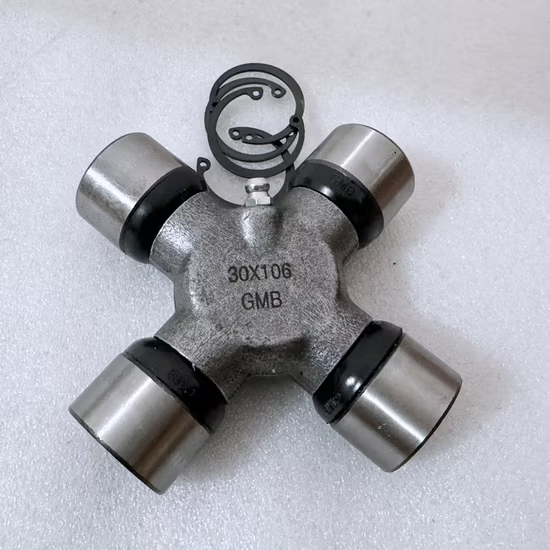
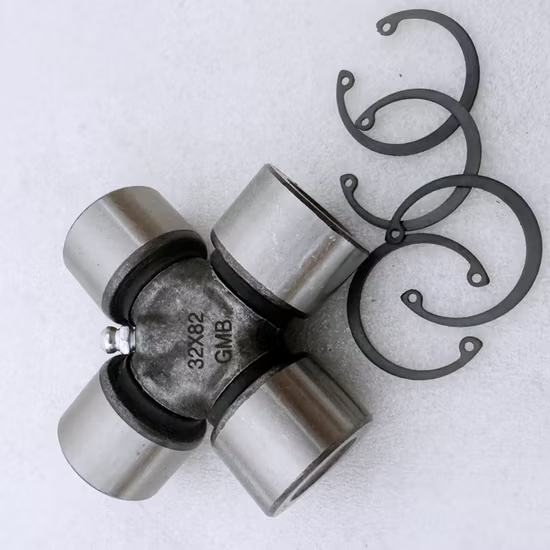


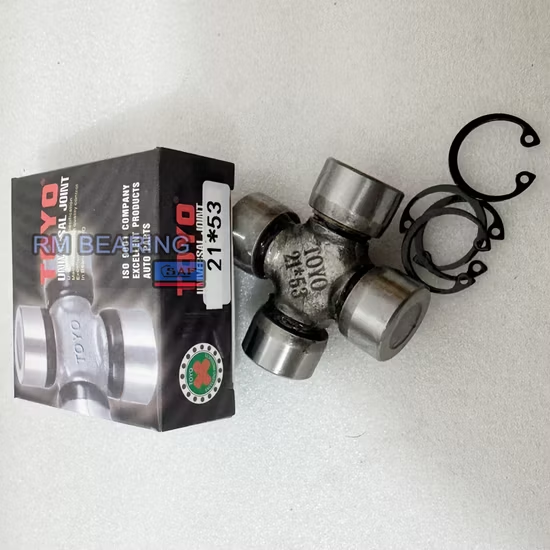
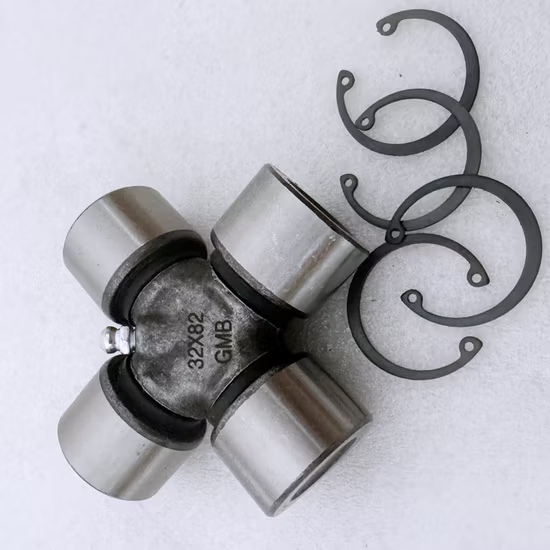
Universal Joint Cross Bearing for Automotive and Construction Machinery — ISO-certified single structure featuring stainless steel construction to resist corrosion in demanding rolling environments.
Verified via official apps — Every universal joint cross bearing we dispatch carries batch-level QR codes, allowing buyers to scan and confirm authenticity directly through the manufacturer's official mobile application.
| Parameter | Value |
|---|---|
| Product Type | Universal Joint Cross Bearing |
| Material | Available in stainless steel or standard bearing steel variants |
| Structure | Single |
| Certification | ISO |
| Quality | High Precision |
| Application | Automotive, Tractors, Construction Machinery, Rolling Equipment, Wheel Hubs |
| Origin | Germany, Japan, Sweden, Malaysia, China |
| Industry | Typical Applications |
|---|---|
| Automotive and Heavy Vehicles | Steering column U-joints, drive shaft cross assemblies, wheel hub articulation points |
| Construction and Agricultural Machinery | Tractor PTO shafts, excavator boom linkage joints, loader drivetrain cross bearings |
| Industrial Rolling Equipment | Conveyor drive shafts, material handling articulation joints, rolling mill guide mechanisms |
Matching a base part number without verifying internal geometry and material specs is the primary cause of premature cross bearing failure.
In the automotive and heavy machinery aftermarket, procurement teams often assume that matching a reference like Gum81 or Uj625 guarantees a direct fit. However, ignoring the internal structural design or cage details during cross-referencing leads to catastrophic results. I once investigated a high-speed drivetrain failure in the Pearl River Delta region where a replaced cross bearing shattered early; the base number matched, but the internal clearance and material were entirely wrong for the operating RPM. Selecting the right universal joint cross bearing supplier means partnering with a team that audits the structural integrity and material grade, not just the stamped digits .
Drivetrain articulation points face wildly different environmental threats depending on the equipment. For agricultural tractors or construction loaders operating in wet, muddy, or chemically exposed conditions, stainless steel variants offer substantially higher corrosion resistance compared to standard bearing steel. Conversely, for high-load mining crushers where shock loads dominate and moisture is minimal, standard high-carbon bearing steel provides the necessary core hardness. As a specialized universal joint cross bearing supplier, we guide buyers through these material options to ensure the selected cross assembly survives its specific operational environment.
Universal joints endure complex combined loading, constantly shifting between radial and axial forces as the shaft angle changes during operation. This oscillating motion makes it difficult to maintain a stable hydrodynamic lubrication film, increasing the risk of boundary lubrication and wear. Furthermore, wheel hub and PTO shaft applications expose the bearing to severe particulate contamination. If the sealing arrangement or internal geometry is not optimized for these specific articulation angles and dirt ingress risks*d surface fatigue .
When sourcing replacement cross bearings, the internal structural design dictates the component's fatigue life. High precision manufacturing ensures that the needle rollers or internal trunnions distribute the load evenly across the contact surfaces, preventing localized stress concentrations. The availability of stainless steel options introduces different thermal expansion characteristics, which must be accounted for during the assembly phase to avoid binding when the drivetrain reaches operating temperatures. Adherence to ISO certification standards guarantees that the dimensional tolerances and running accuracy meet the rigorous demands of high-speed automotive and heavy machinery applications, preventing the micro-vibrations that destroy adjacent seals.
Relying solely on a superficial part number match often results in unplanned downtime that far exceeds the cost of the component itself. When a cross bearing fails due to an overlooked internal design discrepancy, it can cause catastrophic damage to the entire drive shaft, yoke, or wheel hub assembly. This secondary damage voids equipment warranties and forces extended operational halts. Proper technical verification prevents these cascading failures, ensuring that the replacement part handles the exact torque and articulation angles required by the OEM design .
Our cross-referencing process for parts like Gum-81 or Uj625 strictly aligns the base number, internal structural design, and material specifications. We maintain authorized distribution channels across major international brands, allowing procurement teams to consolidate mixed-brand drivetrain orders into a single shipment. Every batch is tracked with traceable documentation, eliminating the risk of receiving counterfeit components with soft inner rings that fail under torque. Our technical team reviews the specific load and articulation parameters of your application to recommend the correct material variant, ensuring reliable field performance.
To ensure the correct universal joint cross bearing is selected for your equipment, please provide the specific OEM equipment model, the exact installation space dimensions, and the operational torque and RPM parameters. If the application involves extreme environments, detailing the exposure to moisture, chemicals, or abrasive dust allows our engineering team to recommend the optimal material variant. Supplying these technical parameters enables us to perform a precise cross-reference check and confirm the structural suitability for your drivetrain.
Q: How do we determine the exact universal joint bearing model for our specific equipment?
A: Provide the OEM equipment model number, drive shaft torque ratings, and maximum articulation angles. Our engineering team uses these parameters to cross-reference the exact internal geometry and material requirements, ensuring the selected model matches the original design specifications without relying on guesswork or incomplete part numbers.
Q: Why must we verify material and internal design during cross-referencing?
A: Base part numbers often cover multiple internal variations. Matching only the base number might result in installing a standard steel bearing in a highly corrosive environment, or ignoring a required internal clearance. Verifying these details prevents premature binding, surface fatigue, and catastrophic drivetrain failure under load.
Q: What are the selection boundaries between stainless steel and standard bearing steel?
A: Standard bearing steel offers superior core hardness and load capacity for heavy shock loads in dry environments. Stainless steel variants provide substantially higher corrosion resistance for agricultural, marine, or washdown applications where moisture would rapidly degrade standard steel. The choice depends entirely on the dominant environmental threat versus the peak mechanical load.
Q: How do we source reliable replacements when the original OEM cross bearing is discontinued?
A: Share the original equipment drawings or the obsolete part number. We utilize our multi-brand authorized network to identify equivalent alternatives, verifying that the replacement matches the exact trunnion diameter, cap size, and material grade required to maintain the drivetrain's structural integrity and operational safety.
Our 5-step process ensures every order is engineered, validated, and supported for optimal performance.
Technical needs assessment
Custom specifications
Free samples for $50k+
Pre-shipment inspection
On-site & predictive
Our certified engineers respond within 24 hours with detailed technical specifications, pricing, and lead time information.