01
Consultation
Technical needs assessment


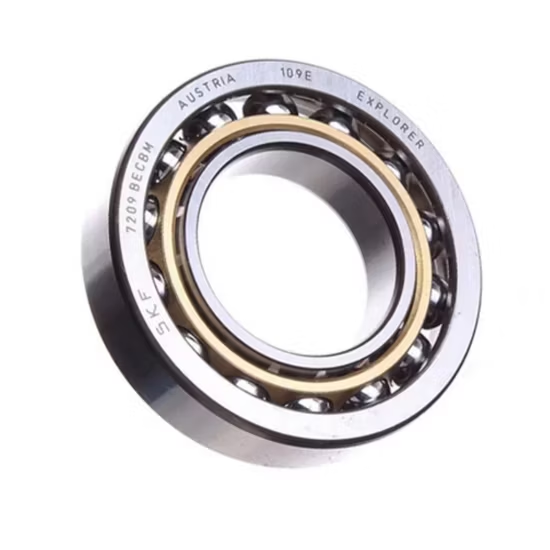
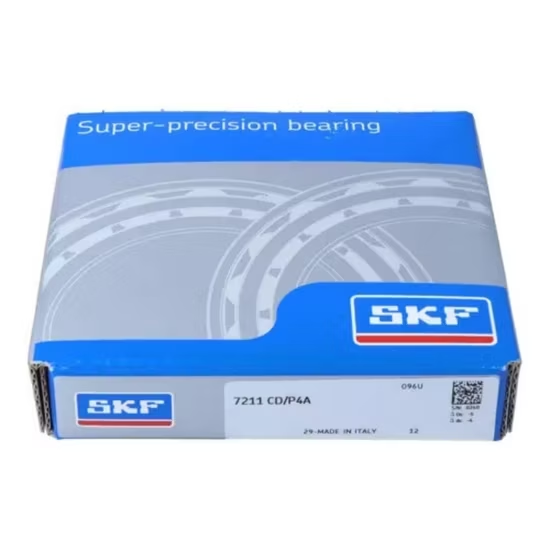
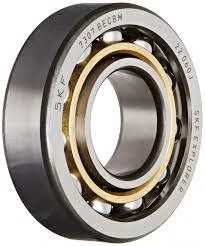


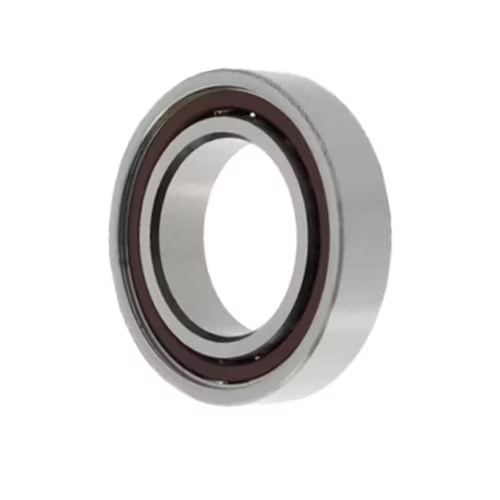
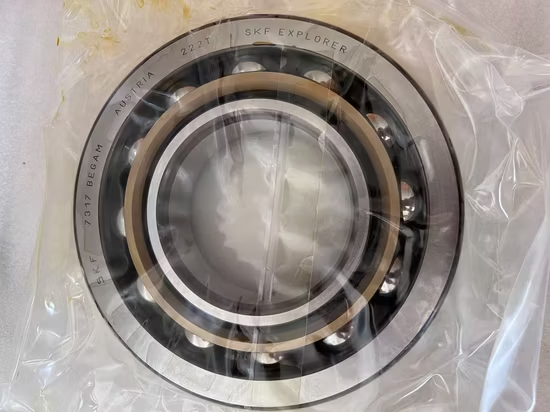
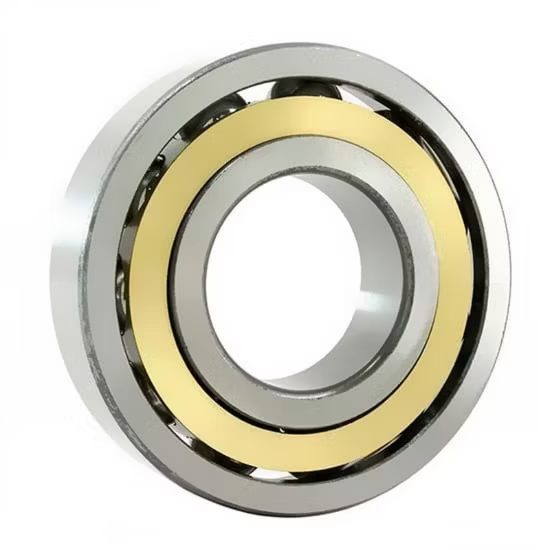
7012 CD/P4a 7012 Cdga/P4a Angular Contact Ball Bearing 60×95×18 mm — 15° optimized contact angle from the CD suffix reduces friction heat during sustained high-speed operation, while P4a precision class delivers strict dimensional and running accuracy for demanding machine tool spindles.
Traceable Factory Batches — Every 7012 CD/P4a 7012 Cdga/P4a angular contact ball bearing ships with manufacturer lot documentation for complete origin verification.
| Parameter | Value |
|---|---|
| Designation | 7012 CD/P4a 7012 Cdga/P4a |
| Bearing Type | Angular Contact Ball Bearing |
| Bore Diameter (d) | 60 mm |
| Outside Diameter (D) | 95 mm |
| Width (B) | 18 mm |
| Contact Angle | 15° |
| Precision Class | P4a |
| Material | Bearing Steel |
| Vibration Level | Z1V1 / Z2V2 / Z3V3 |
| Origin | Germany / Japan / Sweden / Malaysia / China |
| HS Code | 8482102000 |
Note: The 'dga' suffix combination appears non-standard in primary catalogs; universal matching and preload specifics require manufacturer confirmation before finalizing the 7012 Cdga/P4a order.
| Industry | Typical Applications |
|---|---|
| Machine Tool Manufacturing | High-speed spindle assemblies requiring P4a running accuracy |
| Precision Equipment | Robotics joint actuators and precision measuring devices |
| Fluid Machinery | High-speed pump shaft support systems |
Mismatched contact angles and ignored precision suffixes silently destroy high-speed spindles.
Sourcing teams often fixate on the base 7012 dimension set while overlooking the critical CD and P4a designations, leading to catastrophic thermal binding during continuous operation. When a standard P0 grade or incorrect contact angle variant is forced into a precision spindle, vibration levels spike immediately, ruining surface finishes and triggering unplanned downtime. Procurement engineers who treat the 7012 CD/P4a 7012 Cdga/P4a angular contact ball bearing as a generic commodity inevitably face severe financial penalties from scrapped production batches .
Selecting the correct variant ensures the spindle maintains tight radial and axial tolerances under dynamic cutting loads. We supply the 7012 CD/P4a 7012 Cdga/P4a angular contact ball bearing with verified cross-brand interchangeability, ensuring the replacement perfectly mirrors the original equipment manufacturer's preload and stiffness requirements.
At elevated rotational speeds, friction heat generation becomes the primary enemy of bearing longevity. The 15° contact angle minimizes sliding friction compared to steeper angles, but this advantage vanishes if the lubrication regime fails. Oil-air or minimal quantity lubrication systems must be precisely calibrated to flush heat without causing churning losses. Furthermore, the P4a running accuracy ensures that localized stress concentrations do not develop within the raceways, which would otherwise accelerate lubricant degradation and initiate premature fatigue .
The CD suffix specifies a 15° optimized contact angle, deliberately chosen to balance axial stiffness with the high-speed capability required in modern machining centers. This geometry reduces the gyroscopic sliding of the rolling elements against the raceways. Concurrently, the P4a designation dictates exceptionally tight dimensional and running accuracy tolerances, far exceeding standard industrial grades. This strict geometric control prevents the micro-vibrations that degrade machined surface finishes. When combined with Z2V2 or Z3V3 vibration classifications, the internal geometry guarantees smooth, quiet operation essential for precision grinding and milling applications.
Substituting a verified precision component with an unverified alternative introduces severe operational risks. According to failure analysis frameworks like ISO 15243, incorrect internal geometry or substandard material hardness leads directly to smearing, raceway spalling, and eventual cage disintegration. These failures rarely occur during initial setup; they manifest weeks later as catastrophic spindle seizures, voiding machine warranties and necessitating complete assembly rebuilds .
Our procurement process prevents the common error of matching only the base 7012 number while ignoring the vital CD contact angle and P4a running accuracy suffixes. We verify that the universal matching and preload arrangements align exactly with your spindle design, preventing thermal binding caused by incorrect internal clearance. Every shipment includes batch traceability to the manufacturer, eliminating the risk of counterfeit rings with soft inner cores. Furthermore, our application engineers review your specific speed and load parameters to confirm the selected vibration class is appropriate for your spindle's operational envelope.
To ensure the 7012 CD/P4a 7012 Cdga/P4a angular contact ball bearing perfectly matches your application, please provide the spindle's maximum operating speed, expected radial and axial cutting loads, and the required rigidity level. If replacing an existing unit, sharing the original equipment manufacturer's part number allows our engineering team to perform a comprehensive cross-reference check, verifying that the contact angle, precision class, and preload arrangement are fully compatible with your machinery.
Q: Why must the CD contact angle and P4a precision suffix be matched exactly during cross-referencing?
A: Matching only the base 7012 dimension set ignores critical internal geometry. A different contact angle alters axial stiffness and heat generation, while a lower precision class introduces vibration. Exact suffix alignment ensures the replacement maintains the spindle's original thermal balance and machining accuracy.
Q: How does P4a precision differ from standard P5 or P4 grades under ISO standards?
A: P4a indicates standard P4 dimensional accuracy but with significantly tighter running accuracy tolerances. This strict control over inner and outer ring runout minimizes spindle vibration at high speeds, which is essential for achieving superior surface finishes in precision grinding and milling operations.
Q: What is the functional difference between the CD (15°) design and standard C (15°) contact angles?
A: While both denote a 15° contact angle, the CD suffix typically indicates an optimized internal design for high-speed applications. This optimization often involves specific raceway curvatures and ball size adjustments to reduce friction heat and improve the bearing's speed limit compared to standard C variants.
Q: How do we verify the authenticity of the P4a bearings upon delivery?
A: We provide comprehensive manufacturer batch traceability and Certificates of Conformity. Buyers can verify authenticity by scanning the packaging QR codes using the brand's official mobile application, which instantly detects cloned codes commonly found on counterfeit products with soft inner rings.
Our 5-step process ensures every order is engineered, validated, and supported for optimal performance.
Technical needs assessment
Custom specifications
Free samples for $50k+
Pre-shipment inspection
On-site & predictive
Our certified engineers respond within 24 hours with detailed technical specifications, pricing, and lead time information.
![71918 CD/P4a 71918cdga/P4a Angular Contact Bearing High Speed Super Precision [WARN] draft identifier mismatch](https://skfiso.com/wp-content/uploads/2026/09/71918-cd-p4a-71918cdga-p4a-angular-contact-bearing-high-speed-super-precision-warn-draft-identifier-mismatch-f98c45.avif)