01
Consultation
Technical needs assessment



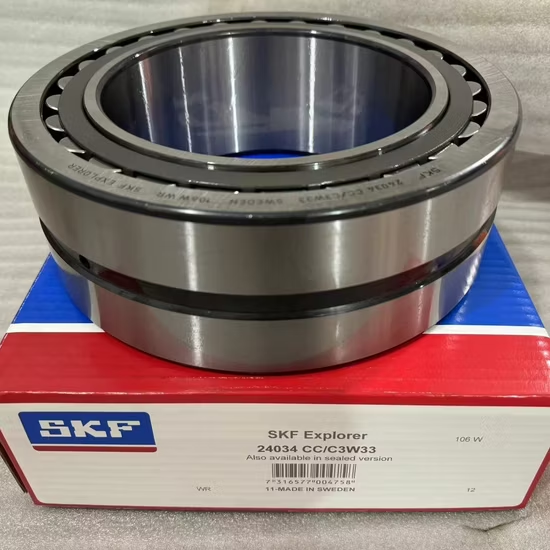
22134 Spherical Roller Bearing — engineered for heavy-duty applications including vibrating screens, crushers, and mining equipment, providing excellent self-aligning capacity to accommodate shaft deflection under severe shock loads and misalignment.
Full Batch Traceability — Every 22134 spherical roller bearing ships with verifiable manufacturer lot records to ensure complete supply chain visibility.
| Parameter | Value |
|---|---|
| Designation | 22134 |
| Bearing Type | Spherical Roller Bearing |
| Origin | Germany / Japan / Sweden / Malaysia / China |
| Customization | OEM service available |
| HS Code | 8482500090 |
| Industry | Typical Applications |
|---|---|
| Mining and Crushing | Vibrating screen exciter mechanisms and jaw crusher eccentric shafts |
| Steel and Metallurgy | Continuous casting machine roll guides and ladle turret slewing supports |
| Cement Production | Rotary kiln support roller stations and clinker cooler drive shafts |
| Paper Manufacturing | Paper machine dryer section felt rolls and press section suction rolls |
Matching the base designation without verifying internal design parameters guarantees premature failure under heavy shock loads.
Procurement teams often source replacements by searching the basic number, assuming any matching part will fit the housing and shaft. In heavy industries like mining and cement, this oversight leads to severe operational disruptions. I have seen facilities install standard clearance variants where thermal expansion demanded a C3 or C4 class, resulting in catastrophic thermal binding within hours of startup. When cross-referencing across different manufacturers, ignoring cage material and internal geometry differences turns a simple replacement into a critical liability .
Selecting the correct 22134 spherical roller bearing requires looking past the outer dimensions to evaluate the internal load-carrying architecture. Our engineering review process cross-references the specific OEM equipment requirements against available internal designs, ensuring the roller profile and cage guidance system align with the actual radial and axial forces present. This prevents the common trap of installing a generic replacement that lacks the necessary fatigue resistance for continuous heavy-duty cycling.
Equipment like vibrating screens and crushers subjects components to relentless shock loads and significant shaft deflection. The self-aligning capability compensates for housing misalignment, but the cage must withstand intense inertia forces without fracturing. Furthermore, abrasive dust in cement and mining environments demands robust sealing solutions or specialized lubrication strategies to prevent particulate ingress . Selecting the appropriate clearance class is equally vital to accommodate the heat generated by heavy friction and external process temperatures.
When no specific suffix is appended to the base number, the component typically defaults to standard radial clearance and a pressed steel or machined brass cage, depending on the manufacturer's baseline protocol. However, standard configurations rarely survive the extreme demands of modern heavy machinery. Through our OEM service, we facilitate custom internal modifications, allowing buyers to specify enhanced clearance classes, specialized cage materials, or optimized roller profiles. This ensures the component is engineered specifically for the thermal and mechanical realities of the target application, rather than relying on a generic catalog default.
Installing a component with incorrect internal geometry or insufficient clearance leads to rapid degradation and unplanned downtime. Skewed rollers and fractured cages are frequent outcomes when the selected variant cannot handle the specific load spectrum. These failures often cause secondary damage to shafts and housings, escalating repair costs and voiding equipment warranties. Adhering to failure analysis frameworks helps identify these root causes, proving that precise specification alignment is far more cost-effective than emergency replacements .
Sourcing this specific designation requires more than just checking a catalog number; it demands rigorous technical validation. We provide authorized coverage across major global brands, allowing mixed-brand orders to be consolidated without sacrificing traceability. Our cross-reference protocol strictly aligns clearance, cage design, and internal geometry, preventing the dangerous assumption that identical base numbers are universally interchangeable. Every shipment includes batch traceability verified through official brand applications, ensuring you receive genuine components capable of handling your specific operational demands.
To ensure the selected variant perfectly matches your machinery, provide detailed operational parameters including radial and axial loads, rotational speeds, and ambient temperatures. Sharing the original OEM equipment number allows our engineering team to perform a comprehensive cross-reference check, verifying that all internal design nuances align with your specific application. This technical review guarantees the proposed solution addresses your exact mechanical and environmental challenges.
Q: How do I verify the authenticity and batch origin of the received units?
A: Each unit is accompanied by manufacturer lot traceability documentation. You can verify authenticity by scanning the packaging QR code using the respective brand's official mobile application. This process confirms the production facility, manufacturing date, and original specifications, effectively filtering out counterfeit products with cloned labels or substandard metallurgy.
Q: What happens if the clearance class is ignored during cross-referencing?
A: Overlooking the clearance class often results in thermal binding or excessive internal play. If a standard clearance variant replaces a required C3 or C4 class in high-temperature applications, thermal expansion eliminates the internal gap, causing severe friction, rapid heat generation, and eventual catastrophic seizure of the machinery under heavy operational loads.
Q: How should internal design be selected for high-shock vibrating screens?
A: Vibrating screens demand specialized internal geometry and robust cage designs to withstand intense inertia forces and shock loads. Standard cages may fracture under these conditions. We review the specific vibration frequency and load spectrum to recommend heavy-duty cage materials and optimized roller profiles that resist fatigue and maintain structural integrity during continuous operation.
Q: Do different manufacturing origins affect performance and delivery times?
A: Components sourced from Germany, Japan, Sweden, Malaysia, or China all meet strict global quality standards, but lead times and pricing structures vary. We help you balance your project timeline and budget by selecting the optimal origin. Our OEM service ensures that regardless of the manufacturing facility, the internal specifications strictly match your application requirements.
Q: What is the proper mounting procedure to avoid damaging the components?
A: Proper mounting requires controlled induction heating to expand the inner ring evenly without overheating the steel. Forcing the component onto the shaft or applying impact blows directly to the rings can cause microscopic brinelling and cage deformation. Always follow precise thermal expansion guidelines and use dedicated mounting tools to preserve the factory-set internal geometry.
Our 5-step process ensures every order is engineered, validated, and supported for optimal performance.
Technical needs assessment
Custom specifications
Free samples for $50k+
Pre-shipment inspection
On-site & predictive
Our certified engineers respond within 24 hours with detailed technical specifications, pricing, and lead time information.